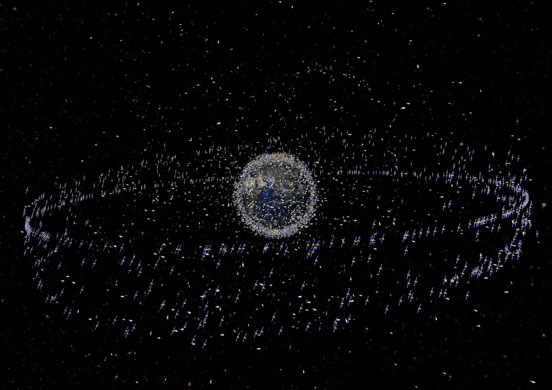
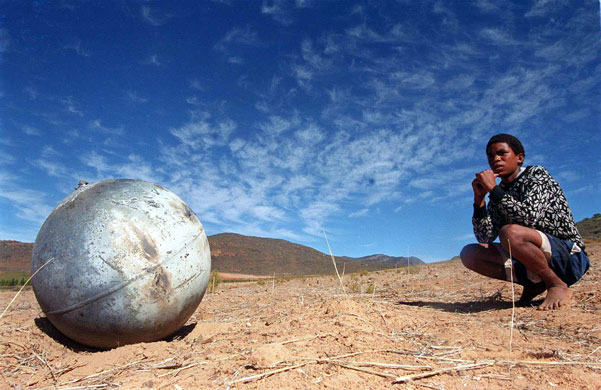
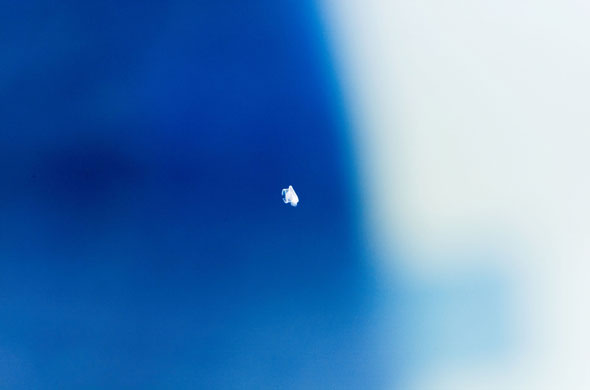
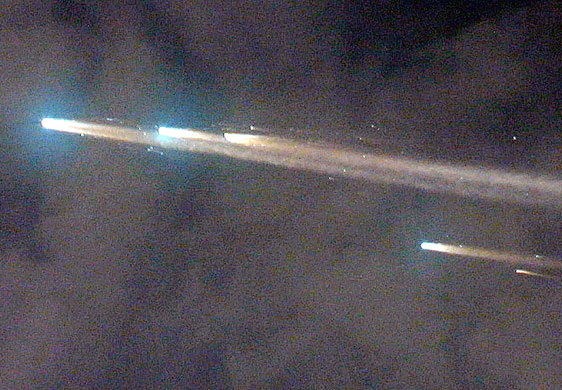
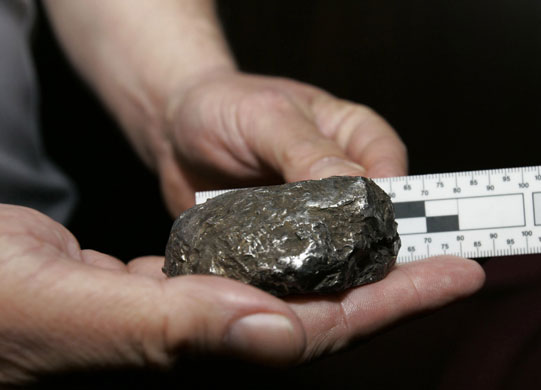
A computer-generated, artist's impression released by the European Space Agency showing approximately 12,000 objects in orbit around the EarthPhotograph: ESA/AFPTheodore Solomons sits next to the metal ball that he saw fall from the sky on a farm close to Worcester, about 150 kilometres outside of Cape Town, south Africa in April 2000. A second metal ball dropped out of the sky the following day on a farm approximately 50 kilometres outside of Cape Town. Astronomers said the balls, which were white-hot when they landed, could be parts of a decaying satellitePhotograph: Enver Essop/EPAThis photo provided by Nasa shows unidentified possible small debris recorded with a digital still camera by astronaut Daniel Burbank onboard the space shuttle Atlantis in September 2006.Photograph: NASA/AP
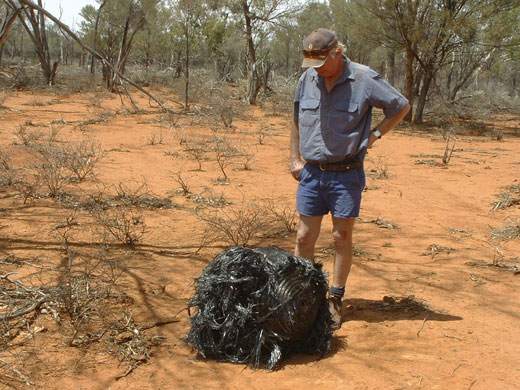
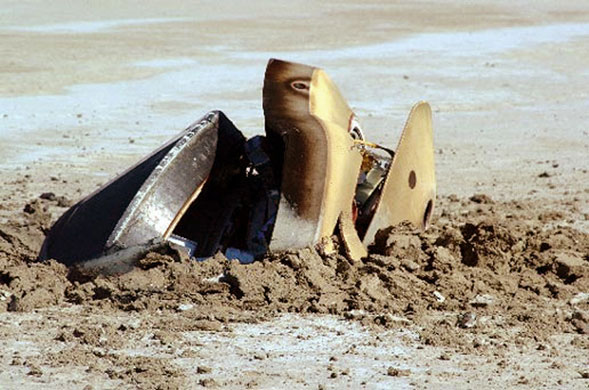
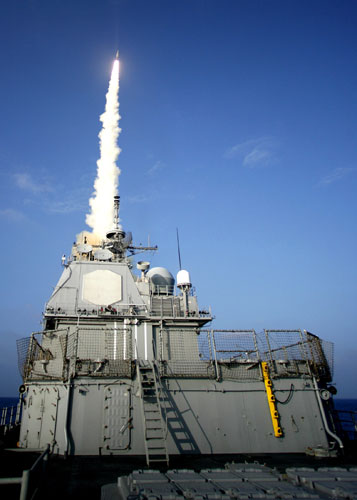
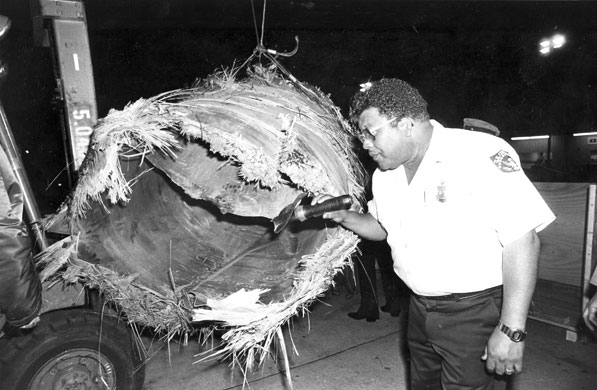
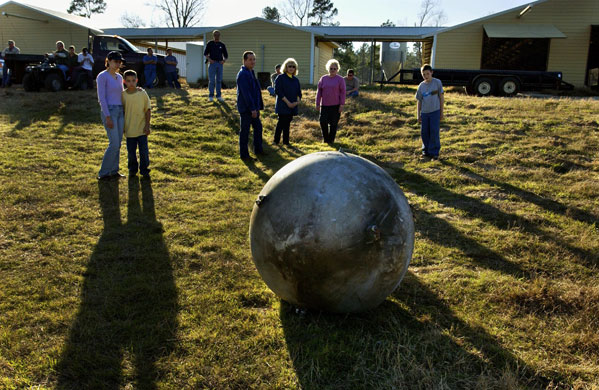
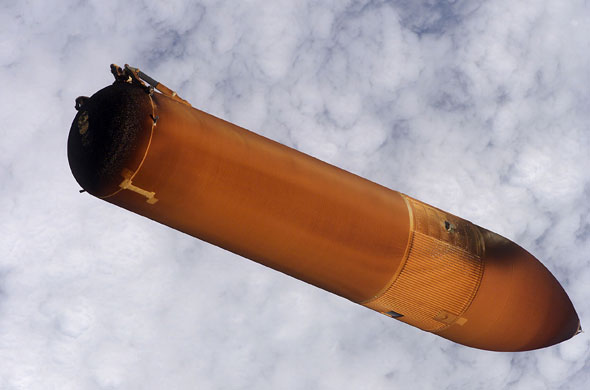
Australian farmer James Stirton stands next to a ball of twisted metal, purported to be fallen space junk, on his farm in southwestern Queensland in March 2008. Stirton found the giant ball, which he believes is space junk from a rocket used to launch communications satellites. Photograph: Reuters/CorbisThe Russian Space Station Mir burns up as it enters the Earth's atmosphere over Nadi, Fiji, in March 2001. After 15 years of service in outer space, Mir made its re-entry to EarthPhotograph: Rob Griffith/APA mysterious metallic object that crashed through the roof of a New Jersey family's home in January 2007 was not a meteorite after all. Scientists say it is a stainless steel alloy that does not occur in nature and is most likely orbital debris, perhaps remnants of a satellite, a rocket or some other spacecraft componentPhotograph: Mike Derer/APThe Genesis spacecraft capsule after it crashed in the Utah desert in September 2004. The $64m mission was designed to collect charged solar particles on delicate wafer-like plates and return them to Earth for examination. The wafers were believed to be so fragile that a helicopter-assisted parachute landing was planned but the parachute failed to deploy sending Genesis hurtling to Earth at 200 mphPhotograph: ReutersThe USS Lake Erie launches a Standard Missile-3 at a non-functioning National Reconnaissance Office satellite as it travels in space at more than 17,000 mph over the Pacific Ocean in February 2008. A missile from a US Navy warship hit a defunct US spy satellite above the Earth in an attempt to blow apart its tank of toxic fuel, the Pentagon saidPhotograph: US Defense Department/ReutersA US Customs official inspects the largest piece of wreckage from the downed Skylab at the San Francisco International Airport, California, in July 1979. The one-ton piece wreckage was found in AustraliaPhotograph: APPeople gather around a spherical object, which may be a hydrogen containment tank, on a chicken farm in Nacogdoches, Texas, USA in 2003. The object fell from the disintegrating Space Shuttle ColumbiaPhotograph: Steve Liss/CorbisThe external fuel tank of the orbiter falls back to earth after detaching from the space shuttle Discovery in July 2005. Engineers are analysing these photos as part of the extensive imagery data being gathered to understand falling debris during the shuttle's launch Photograph: NASA/AFP
Sign up to read this article
Read news from 100’s of titles, curated specifically for you.