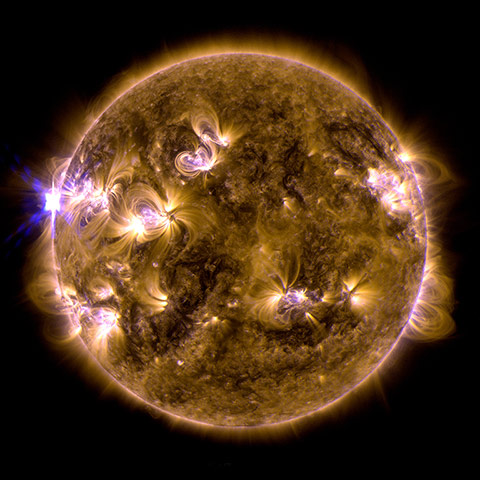
On 12 May, a vast eruption took place on the surface of the Sun – an X-class flare, the most powerful of all types of solar flare. Emerging from the upper left part of the solar disc, the eruption was captured by Nasa’s Solar Dynamics Observatory and reveals the intense forces that shape the surface of our Sun. Apart from the major X-class eruption, two smaller flares emerged nearby, along with a coronal mass ejection (CME). Harmful radiation from a flare or from a CME cannot pass through Earth’s atmosphere. But if one is intense enough it can disturb the upper atmosphere and affect the performance of GPS and communications satellites. This eruption missed Earth, however Photograph: NASA
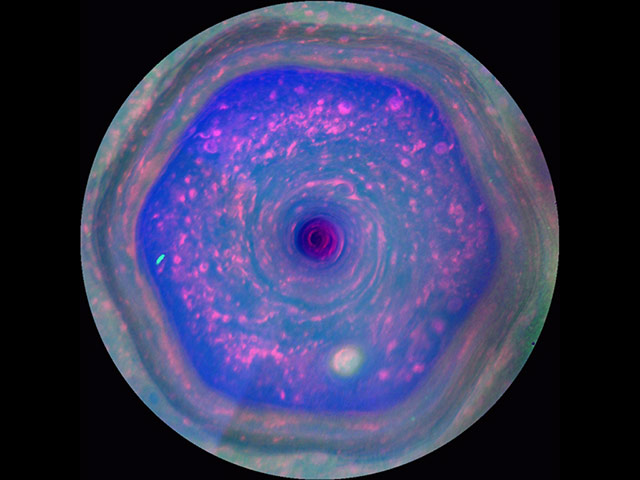
This strange, six-sided purple and pink object was photographed using colour filters last month by Nasa’s Cassini robot spacecraft as it swept over the planet north pole. The image shows a complete view of the top of Saturn down to about 70 degrees latitude and reveals a hexagonal storm that spans about 20,000 miles. A wavy jet-stream of 200mph winds surrounds a massive, rotating vortex at the centre of the image. There is no weather feature like this anywhere else in the solar system, astronomers say
Photograph: NASA
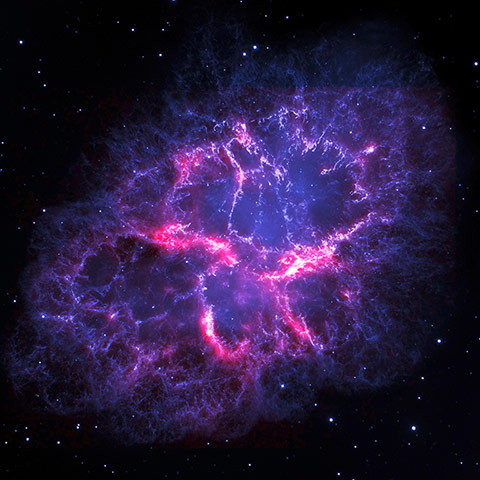
Made up of filaments of gas and dust, the Crab Nebula is the remnant of a supernova explosion. This image is a composite photograph taken last year by two large orbiting observatories: Europe’s Herschel telescope and the joint Esa-Nasa Hubble telescope. Their measurements also revealed the presence of argon hydride atoms inside the nebula. “It was a surprise,” said astronomer Mike Barlow, of University College, London. “You don’t expect an atom like argon, a noble gas, to form molecules, and you wouldn’t expect to find them in the harsh environment of a supernova remnant” Photograph: NASA/Reuters

Taken in April to celebrate the 23rd anniversary of the Hubble telescope, this ethereal image reveals the Horsehead Nebula in infra-red light. The nebula is part of a star-forming complex in Orion and is being eroded by radiation from nearby stars. It is thought the nebula will disintegrate within five million years Photograph: AFP/Getty Images
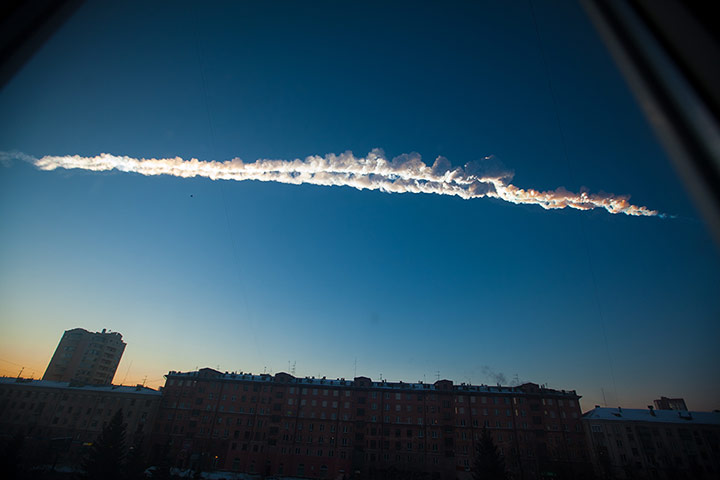
On 15 February, a giant meteor exploded 14 miles above Chelyabinsk in Russia, leaving a trail across the morning sky. The energy released was far greater than the atomic bomb that destroyed Hiroshima, though most was absorbed by the atmosphere. But 1,500 people were injured, mainly by shattered glass Photograph: Yekaterina Pustynnikova/AP