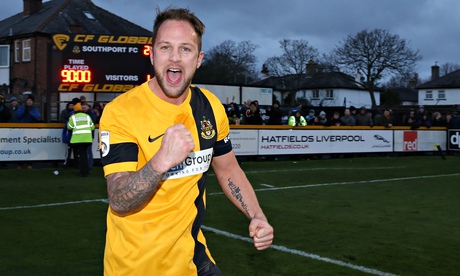
Southport sold out their initial allocation of 2,700 tickets for the third-round tie at Derby County quite quickly, leading club officials to hope that a little of the added interest the FA Cup brings spills over into the Conference season.
“Our average attendance this season is 956,” explains club statistician and historian Rob Urwin. “We know there is a little bit more support for us in the town than that though, so if we can just keep a few dozen of the extra spectators to nudge us towards four figures that would be great.”
Regular watchers of the Sandgrounders will know this has been an uneven season with a change of manager at the start and a mini-exodus of players helping explain why the club is currently flirting with relegation but just managing to keep itself out of trouble. The club is just above the bottom four, though two wins in the past three games have at least provided a seven-point buffer. A certain level of stoicism has usually been part of the deal for Southport supporters, however – even when the club held league status crowds were small and times generally hard.
Southport were the last club to be voted out of the Football League, making way for Wigan Athletic by the re-election process in 1978. Wigan were by no means certain to gain acceptance, because their previous incarnation of Wigan Borough had resigned from the league in 1931 with their applications for re-entry were resisted for years, but Southport presented such a feeble case – three-figure crowds, dilapidated ground, almost permanent residence at or near the bottom of the table – that they lost a narrow vote.
“I actually went along to the Cafe Royal on the day, and it was the only occasion when football reduced me to tears,” Urwin says. “The W-word was a dirty one in our house for a long time after that, although I must admit Wigan took their chance and made something out of it. I was as pleased as everyone else to see them win the FA Cup. In all honesty, even in my wildest dreams I don’t think I could ever envisage Southport doing that, but it is all about having money behind you. Wigan ended up with a chairman who pumped money into the club, and that is what you need to go up through the divisions. Fleetwood have just done the same. I can remember not too long ago when they were two or three divisions below us, now they are in League One and going well. That is wholly down to Andy Pilley and the money he has put into the club, and you do wonder what might happen were he to change his mind and walk away, but that is a risk clubs have to take if they want to get ahead.”
What comes around goes around and if they are not careful Wigan could find themselves in the same division as Fleetwood next season. Before Dave Whelan decided to help out his hometown club in the mid-80s Wigan were finding out what Southport already knew, that most of the football allegiances in the north-west are long-established and tough to break. “We obviously live in the shadow of Liverpool and Everton, but at one point a few seasons ago there were seven Premier League clubs on our doorstep,” Urwin points out.
“Some of them were offering cheap deals on tickets as well, so there is all that football on offer before you consider Preston, Morecambe or Blackpool, also handy and also above us. Basically we have to hope people will consider supporting two clubs, we don’t mind sharing spectators with some of the bigger teams. I just don’t think we will ever get back into the league on that basis, unless a backer comes along. It would be nice to get back into the league; when it’s what you have been brought up on you don’t feel happy about letting it go, though at least we have found a level at the moment where we can look forward with a bit of optimism. Towards the end of our time in the league, and for a few years afterwards when the club seemed to be dying every day, it was hard to see us making any progress at all.”