photo: Tristram Kenton
Trevor Nunn's trawl through the Broadway blockbusters now brings us up to Rodgers and Hammerstein's South -Pacific. But the 51-year-old musical is beginning to show its age, and Nunn's decently dull production has little of the raffish èlan you find in Privates on Parade, which also deals with inter-racial marriage and the camp entertainments of wartime.
Nunn's chief problem is that he has invested the story with more realism than it can contain. He gives us documentary war footage, hurtling jeeps, bullets biting the sand, anda lot of sweat-stained shirts.
But essentially this is a romantic musical about a racially blinkered nurse from Little Rock who falls in love with a French planter and learns to love him, and, eventually, his two children.
Like the heroine, Nellie Forbush, the show is "as corny as Kansas in August" and any attempt to dress it up as a serious study of race relations or of American wartime policy is preposterous.
To be fair it has a liberal intent which, especially when you know it dates from 1949, is not to be lightly dismissed. But Nellie's quick conversion to racial tolerance, because of the planter's wartime bravery, lacks logic and dramatic development.
What also convinces me that not all of Nellie's and Emile's evenings will be totally enchanted is that he is steeped in Proust while she claims scarcely ever to have read a book. In addition, Rodgers and Hammerstein's enlightened plea for racial harmony is vitiated by their condescending vision of Pacific islanders as essentially smiling, happy, sun-kissed folk only too ready to oblige all of the visiting Americans.
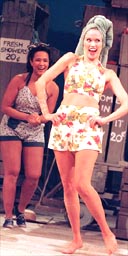
That still leaves the songs - which are first-rate. But I couldn't believe the awfulness of the sound at the National, where the band, placed upstage, gave the impression they were phoning the score through from a glass booth. All the actors were heavily miked, which meant the volume remained identical wherever they were on stage; you had, therefore, a show that often sounded as if it were taped although, demonstrably, it was live. It had, of course, its plus points. It burst into life in the second half with Matthew Bourne's staging of the revue number, Honey Bun, which had a Dionysiac showbiz energy. Philip Quast as the French planter, with a white streak in his hair that made him the big romantic number, was a resonant passion.
Nick Holder had also endowed the profiteering Luther Billis with a predatory gleam. John Shrapnel was all tactical urgency playing the iron-bellied captain. But Lauren Kennedy, though she sang agreeably, was too blandly ordinary as Nellie: a woman prepared to overcome her Arkansas origins to marry a French planter needs a bit of sass and spunk.
And that for me typifies an evening which dutifully delivers a musical classic but only briefly acquires a touch of ecstasy. Michael Billington In rep. Box office: 020-7452 3000.