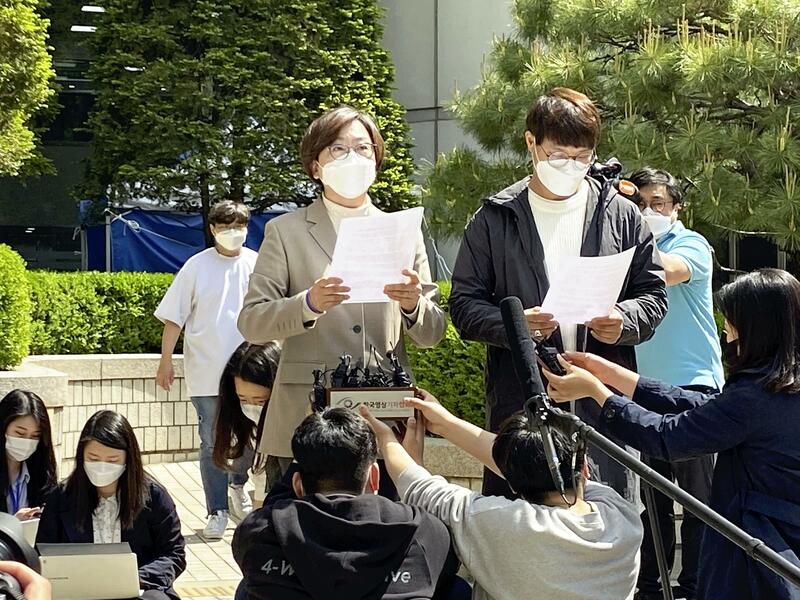
SEOUL -- The Seoul Central District Court acknowledged the principle of sovereign immunity on Wednesday, rejecting the claims of former so-called comfort women in South Korea seeking compensation of 3 billion won (about 291 million yen) from the Japanese government.
Under international law, sovereign immunity is a concept in which a sovereign state cannot be sued in a court of another sovereign state.
The ruling revealed the same court's judgments are divided on the issue. In January in a separate lawsuit, the court acknowledged former comfort women's claims and ordered the Japanese government to pay compensation.
In the Wednesday ruling, the court said, "Only customary international law can set the criteria for determining whether sovereign immunity can be applied." Citing previous decisions made by the International Court of Justice and recent South Korean Supreme Court precedents, the ruling said that not applying the principle only to cases involving former comfort women "could lead to future uncertainty over sovereign immunity."
Regarding postwar compensation between Japan and South Korea including on the former comfort women issue, the Japanese government takes the position that the issue has been settled under the 1965 Agreement on the Settlement of Problem Concerning Property and Claims and on Economic Cooperation between the two countries. In 2015, Tokyo and Seoul confirmed that the issue of comfort women had been "resolved finally and irreversibly."
This latest lawsuit was filed by 20 plaintiffs, including 16 former comfort women. Of the 16, nine have received cash from the support foundation established by the South Korean government. Based on the 2015 agreement, the Japanese government contributed 1 billion yen to the foundation.
The ruling mentioned that most of the former comfort women have received cash from the foundation and stated it was "a Japanese government relief measure acknowledging the rights of former comfort women."
After the earlier ruling in January, South Korean President Moon Jae-in said during a press conference the same month that he was "confused" about the ruling ordering the Japanese government to pay compensation. He also said that the 2015 agreement was officially made between the two governments, although in effect he had glossed over it.
The first ruling was finalized when the Japanese government, adhering to the principle of sovereign immunity, did not appeal to a higher court. The plaintiffs have subsequently demanded the Japanese government pay for the costs of the lawsuit.
According to South Korean newspaper JoongAng Ilbo's Wednesday edition, however, the district court has denied the request, saying that compulsory execution of another country's assets could be a violation of international law. Based on this, it is unlikely that Japanese assets in South Korea will be seized even when the Japanese government does not comply with orders to pay compensation.
Read more from The Japan News at https://japannews.yomiuri.co.jp/