If South Africa beat Australia in the third Test, which starts in Sydney on Saturday, they will replace their opponents as the best team in the world according to the ICC rankings.
It would be a position few could argue with. Unless, of course, you come from Mumbai, Kolkata, Chennai, Nagpur, New Delhi or any of the other cricket-obsessed cities in the wonderfully diverse nation of India.
India, and India only, could argue with the pre-eminence of South Africa on current form. India beat Australia 2–0 earlier this year, and if you were picking a combined team from the two countries you would probably have more Indians than South Africans in it.
Virender Sehwag, Sachin Tendulkar and VVS Laxman would surely bat in such a team. South Africa would contribute Graeme Smith, Jacques Kallis and AB De Villiers, so there's little in it so far.
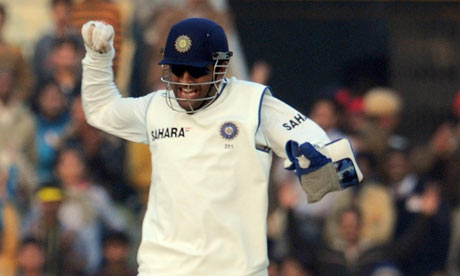
But Mahendra Singh Dhoni would wear the gloves and the bottom half of the side would be India-dominated for they have, it could be argued, the better-balanced attack.
They have the best spinner on either side in Harbhajan Singh (South Africa have a historical weakness in this department). Zaheer Khan's ability to reverse-swing the ball showed up the England fast bowlers' deficiencies in this month's series and he would saunter into the side.
South Africa would contribute Dale Steyn, the match-winner in Melbourne. The third fast-bowling spot would be a toss-up between India's Ishant Sharma and South Africa's Morne Morkel. Both are 24, have similar records, and are and bowlers with real potential.
So much for the pencil-sucking fun. But is this really the best way to decide the relative strengths of two teams?
South Africa's victory in Australia must rate above India's in India. It has been an extraordinary year for South Africa, who beat England in England in the summer following that Graeme Smith-inspired victory at Edgbaston. They have not been defeated since they went to Sri Lanka in 2006.
So how do South Africa and India shape up when they play each other? The most recent evidence we have is the drawn series in India in March and April this year. India still had Anil Kumble and Sourav Ganguly aboard then.
The first Test, in Chennai, was a high-scoring draw. In the second, at Ahmedabad, India were swept aside after being bowled out for just 76 in 20 overs. South Africa replied with 494–7 declared and then bowled out India again, this time for 328, to win by an innings and 90 runs – eight wickets for Steyn.
In the third Test, in Kanpur, India had a first-innings lead of 60, bowled South Africa out for 121 and went on to win by eight wickets to level the series.
Historically, South Africa beat India in South Africa. They have won six and lost just one of their 12 Tests there. In India, the score is 4–4 in 10 Tests.
If these two countries were to play each other today it would be big box-office. The result could be decided by one player's outstanding contribution and if that were the case the player could well be Steyn, on current form the world's outstanding fast bowler.
His lack of height, some said, would be a disadvantage. But the ability to move the ball away from the right-hander, at pace, has always been a winner. In five Tests against New Zealand and the West Indies he picked up 40 wickets and when he took 14 in two more against Bangladesh he won three successive Man of the Series awards. Now he could be in line for another.
If South Africa do topple Australia next week they will deserve their new status after a magnificent 12 months.