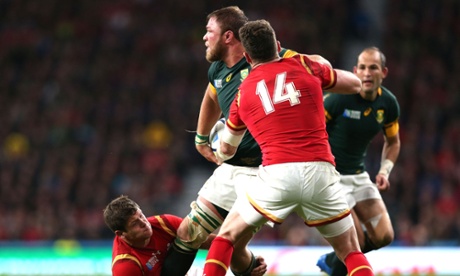
For those who like their back-row forwards Twickenham was the place to be on Saturday – and it will be again next Saturday. South Africa’s breakaway trio went toe-to-toe with Wales’s in a titanic clash that acted as a microcosm for a brutal quarter-final, decided in the midst of the carnage by a moment of subtlety from Duane Vermeulen for a 23-19 win. The Springboks, beaten in their first game by Japan in the greatest upset of them all, now move on to a semi-final with the All Blacks as if nothing untoward had ever happened.
Next up for Francois Louw, Schalk Burger and Vermeulen are Jerome Kaino, Richie McCaw and Kieran Read. The two best back rows in the world – and who is to say the All Blacks and the Springboks do not remain the two best teams?
Both have had their trials this World Cup. South Africa’s need no further delineation but New Zealand, too, had seemed listless and flabby until they burst into life a couple of hours after the Springboks claimed their semi-final berth. The All Blacks suddenly look unstoppable again while South Africa remain beneath the radar – but still very much there, where they had always planned to be. If there were one team in the world New Zealand would choose not to be playing on the threshold of a World Cup final, it would probably still be them.
Two Springbok forwards, Bismarck du Plessis and Lood de Jager, are injury doubts. Du Plessis sustained a wound to his right hand after being trodden on by Louw, and De Jager has a foot tendon injury. Both will be assessed through the week, as will Victor Matfield, who is making positive progress in his rehabilitation.
The Springboks, as we knew they would, spent the final half-hour of a game here that they were losing in all-out belligerence, monopolising possession, sending wave after wave of adamantine ball-carriers at an equally unyielding Welsh defence. Burger’s work rate was extraordinary but so too was that of Wales’s back row. Dan Lydiate made 24 tackles – indeed, Wales’s back row made more than 60 between them.
It was an impasse. And so came the denouement. Where belligerence had not worked Vermeulen’s sleight of hand did, coupled with the captain Fourie du Preez’s speed of thought and foot. South Africa, at 18-19, won an attacking scrum with a 20-metre blindside on the left. “We wanted to go for a penalty in the scrum,” said Vermeulen. And they might well have had one, had he kept the ball at his feet, for South Africa’s set piece was driving forward and wheeling left. “Fourie said the blind is on. I picked up and heard a noise but I just don’t know how I did that. But it ended up in his hands and he scored the try, so well done to him for being in the right spot at the right time.”
Vermeulen had sucked in two defenders, while Sam Warburton, who was magnificent, back to his best all of a sudden, was turned away from the action by the scrum’s wheel. The Springbok No8’s offload sent Du Preez on the loop to an unattended corner for the game’s decisive try. After 75 minutes in which they had more than matched South Africa, Wales had been undone by the sort of clarity of thought and precision in execution that still marks out the southern hemisphere nations, however close the battles with them may be.
A seething Dan Biggar acknowledged as much. “They’re consistently in the top three in world rankings,” he said. “So you’d have to say they’ve just got the edge at the minute. I think South Africa certainly know they’ve been in a game but we’re not interested in bravery and sympathy or being proud losers. At the end of the day we’ve lost a quarter-final. We don’t want any kind words written about us. That’s just the way it is.”
For long stretches of the match it had seemed South Africa would struggle to land the decisive blow amid a barrage of hopeful ones. Many were the times they spilled ball in the face of the Welsh defence or just lacked concentration at the crucial moment. Had Wales finished with more precision in the first half, South Africa might have found themselves too far adrift. But the relentless psychology of these slugfests, particularly when the underdog is holding a lead, put an end to any thoughts Wales might have had of playing attacking rugby of their own in the final half-hour. They knew, just as the Springboks and the watching world did, that this game would have to be won by defence.
“It was a massive bash-up for the forwards,” said Vermeulen, “but it could have gone either way. We’re just lucky we came out on top. We were confident coming into it, we had a game plan, but we got put on the back foot. I think we can definitely take a lot from this game. We needed this before heading into the semi-final.”
South Africa Le Roux; Pietersen, Kriel (Serfontein, 67), De Allende, Habana; Pollard (Lambie, 76), Du Preez (capt); Mtawarira (Nyakane, 56), B du Plessis (Strauss, 55), Malherbe (J du Plessis, 60), Etzebeth (Du Toit, 67), De Jager, Burger, Louw (Alberts, 67), Vermeulen.
Try Du Preez. Pens Pollard 5. Drop goal Pollard.
Wales Anscombe; Cuthbert, T Morgan (Hook, 67), Roberts, North; Biggar, (Priestland, 73) G Davies (Lloyd Williams, 71); Jenkins (James, 55), Baldwin (Owens, 56), Lee (Francis, 55), Charteris (B Davies, 63), AW Jones, Lydiate (Tipuric, 67), Warburton (capt) Faletau.
Try G Davies. Con Biggar. Pens Biggar 3. Drop goal Biggar.
Referee Wayne Barnes (Eng). Attendance 79,572.