Anyone who, like me, is juggling a career, a social life, and a relationship – while also trying to get their foot on the housing ladder – will know that just the mere thought of adding anything else to their plate (even a potentially delicious new hobby) is quite frankly exhausting.

Maybe in our pre-industrial past it was possible to sort out life admin and start a new hobby in your spare time – cave painting perhaps, or mastering a primitive form of chess. Nowadays it feels like the uninitiated can’t get a look in: who among us would dare tackle the complexities and pitfalls of personal finance and enter the specialised world of an artisan cookery class in the same day?
Well me, as it turns out. Though I can’t pretend I wasn’t more than a little daunted.
Having recently had an offer accepted on my first flat, I wanted to check out my options for getting a second credit card to help me kit the new place out. Once I started to think about the damage a failed application could do to my credit rating however, my imaginary spending spree lost a bit of momentum. Was I sure I’d be eligible? Could I weather the credit check? I suddenly felt like I was jumping out of a plane without knowing whether I was strapped to a parachute or a sack of potatoes.

So I took a step back from the edge and headed over to Compare the Market’s new Credit Card EligibilityCheck, which assesses your eligibility for a whole range of credit cards all at once, saving the slog of asking individual providers for quotes, all the while leaving your credit rating unscathed. Like most people, my spare time’s really precious to me, so I was genuinely surprised – and massively relieved – that the whole process took mere minutes, not hours. The well-built tool crunches basic personal data – salary, rent or mortgage payments, previous addresses and such – and produces a bespoke report detailing which products you could be eligible for, should you apply.
If credit cards could be demystified so quickly and painlessly, I was left thinking, maybe I could get over my hobbyist’s reluctance, too. With a newly freed-up day in hand – a day I’d need every minute of as it turned out – I signed up for a sourdough masterclass with Martha de Lacey, an east London-based foodie I’ve been hungrily Instagram-stalking for some time.
I’ve always loved food, both cooking and eating it, but I’ve never been a very proficient baker. There’s something mysterious about breadmaking – a kind of alchemy that turns a few powders and a splash of water into the stuff of life – that seems designed to keep dilettantes at bay. And it doesn’t come much more mysterious than sourdough.


Pictured from top: Shorten and de Lacey work the dough; it is then scraped into proving baskets; the process is completed with baking in a Dutch oven
There’s a serious scholarly argument, for instance, that the reason the Israelites took unleavened bread with them on their way out of Egypt was because they hadn’t had time to add sourdough starters, or leavens, to their loaves before the exodus began. There’s a sourdough “library” in Belgium containing more than 80 different starters, some of them more than 100 years old and still in use. A basic starter, made up of flour and water and left to ferment, takes about a week before it’s ready to be added to a bread mixture, and baking a simple loaf is the work of a full day.
So, when I arrived at de Lacey’s kitchen, the dough – which was made with her own five-year-old starter – had already spent half the morning busily absorbing warm water to give the fermentation process a boost. My first job was to mix it (or “smoosh it”, to use de Lacey’s words) with sea salt. When that was fully absorbed, I was ready to get physical.
De Lacey likes to slap at first and start stretching later, but, as with everything sourdough-related, there are different schools of thought on the matter. Either way, the goal is the same: to strengthen the gluten in the dough while also folding it repeatedly to incorporate enough air for those signature sourdough bubbles.
For the next few hours, while de Lacey worked smoothly and neatly, bits of my dough flew all over the room, splattering surfaces and joining remnants left stuck to the ceiling by classes past. A stray splodge that landed on my phone is still there as I write, dried to a tiny, rock-hard peak.
Thankfully, the dough needed long periods of rest during this process, which gave me a chance to get my breath back and enjoy some of de Lacey’s otherworldly smoked butter and signature “TrashCrumpets” – which are made using discarded sourdough starter – sharing tasty morsels with her extremely well-socialised schnauzer Olive.
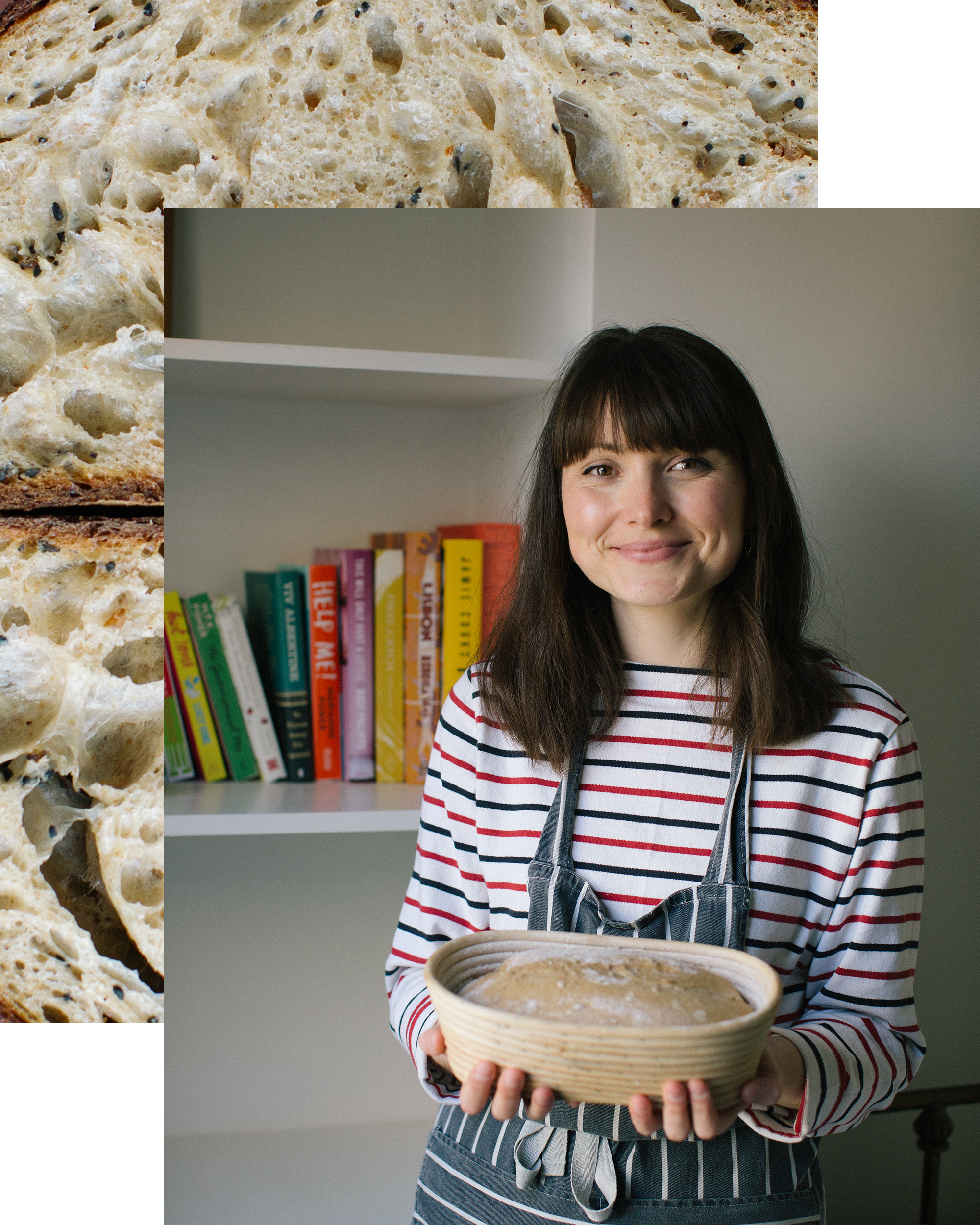
Eventually, having reduced the intensity of my slapping and stretching to more of a gentle massage (lucky dough), I was ready to scrape the dough, now beautifully pillowy, bouncy and smooth, into a proving basket where it could sit comfortably for a few days before baking. When the time comes, it is placed into a special cast-iron pot, known (genuinely) as a Dutch oven for the final firing.
I got to take the scrapers and baskets home with me, but I needed a Dutch oven equivalent (the genuine article can cost upwards of £150!) to complete the process. After a bit of a wild goose chase, I managed to track down a cheap alternative the following day and baked my loaf that night. And while it wasn’t a work of art, it rose, had bubbles inside it, and was a hit with my boyfriend.
De Lacey also gave me a little jar of her starter to take home for future experiments; I can already picture the dough spatters on my new kitchen’s ceiling.
Download the Meerkat app and use our Credit Card EligibilityCheck to find the right credit card to meet your needs. Customers of Compare the Market can also use the app to get two-for-one at restaurants and cinemas for a whole year. T&Cs apply