
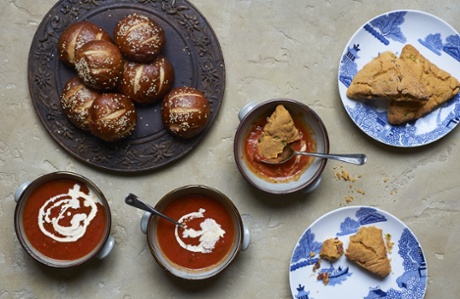
I’ve never had a single soup or stew that wasn’t 10 times better for being served with bread. What’s the point of a dark, meaty stew nicely rounded with a splash of ale, or a cure-all chicken broth, or a hearty root vegetable soup, without something to dunk into it? A bowlful of deep, savoury stock without a hunk of bread is only half a meal, to my mind. Those puddles of rich, tomatoey juice left behind at the end of your casserole are nothing half‑cold in the dip of your spoon, but everything soaked into a wedge of ciabatta or good, crusty baguette. Especially in the hungry wake of the virtuous wellness bloggers, who’d have you believe that soup is good only when it is carb–free, I take a great delight in working through half a loaf of sliced white in the course of a single bowl of stew. Here are a couple of breads that’ll spruce up even the most basic soups and stews.
Smoky chilli cornbread scones
Plenty of paprika and bacon make these easy scones perfectly smoky and sweet. Because they use polenta in place of a good part of the flour, they’re crumblier than normal scones. A little egg helps to keep them moist as they bake, but I think their short, slightly sandy texture makes them perfect for dunking into chilli, sauce, soup and stew anyway.
Makes 16
150g smoked back bacon
200g fine cornmeal/polenta
200g plain flour
2 tbsp soft light brown sugar
5 tsp baking powder
2 tsp smoked paprika
½ tsp bicarbonate of soda
½ tsp celery salt
¼ tsp cayenne pepper
100g butter
2 green chillies, deseeded and finely chopped
2 large eggs
100-125ml milk
1 Preheat the oven to 200C/400F/gas mark 6. Finely chop the bacon rashers and fry until crisp and browned. Leave to cool.
2 Stir together the cornmeal, flour, sugar, baking powder, smoked paprika, bicarbonate of soda, celery salt and cayenne pepper in a large mixing bowl. Cut the butter into small cubes, add to the dry ingredients then rub in between your fingertips, working the ingredients together until no visible chunks of butter are left.
3 Toss the chopped chillies and the fried bacon bits to the flour mixture and stir to combine. Lightly whisk the eggs with the milk then add to the mixing bowl, working everything together until a rough, slightly sticky dough forms. It’s important that the dough’s not too firm, or the scones will end up heavy and dry. Leave the dough to rest and absorb water for 10 minutes, then see how it feels and add an extra splash of milk or water if you need to.
4 Tip the dough out on to a work surface dusted with cornmeal and pat it out, just using your hands and with the help of a little extra cornmeal, if it sticks, until it’s roughly 15x30cm. Cut in half for two 15x15cm squares, then cut each square along its lines of symmetry into 8 small triangles. Arrange the triangles on a large oven tray lined with baking parchment.
5 Bake for 15 minutes, until golden, well risen and firm to the touch.
Pretzel rolls
Obviously if it’s not twisted, wrapped and knotted into that pretzel shape, it’s not a pretzel. But what I’m after with these simple dinner rolls, though, is a really basic, beginner-friendly bread that’s easy to make, shape and bake but still has that burnished, sweet pretzel crust that’s so distinctive.
The key to that crust is a brief dip in simmering water before baking: the rolls develop a toughened outside, which will bake to a nice chewy crust, while the bicarbonate of soda in the water helps along the Maillard reaction once the buns hit the oven – deepening the crust’s colour to that trademark amber hue.
Makes 16
550g strong white flour
50g soft light brown sugar
7g instant dried yeast
1 tsp salt
300ml lukewarm water
2 tbsp olive oil
3 tbsp bicarbonate of soda
1 Stir together the flour, sugar, yeast and salt, then add the water with the oil. Work the ingredients together using your hands until a smooth, slightly stiff dough forms, then knead for 10 minutes. The dough will feel a little tight to begin with, but you should notice it grow softer and more elastic as you knead. Once kneaded, place in a lightly oiled bowl, cover the bowl with clingfilm and leave the dough to rise at warm room temperature for 1-2 hours, or until doubled in size.
2 Tip the risen dough from its bowl and divide into 16 equal portions. Roll each piece around in a circle under your cupped palm on an unfloured work surface to get a rough spherical shape, then pinch any rough edges or bulges underneath to give a smooth, taut top. Leave to rise, uncovered, for 30-40 minutes, or until visibly puffier, but no more than 1½ times their original size – if you leave them too long, they’ll collapse when you boil them. Usually it’s best to cover your dough to avoid a skin forming, but it’s exactly that skin that will help these rolls to hold their shape as they boil and bake.
3 While the buns rise, preheat the oven to 200C/400F/gas mark 6. Heat a large pan of water until it’s gently simmering, then add the bicarbonate of soda. Gently lower the buns into the simmering water and cook for 30 seconds on each side. Carefully lift the buns from the water and arrange on a well-greased baking tray.
4 If you’re using seeds to finish, scatter them over the top of the rolls as soon as they’re out of the water. Score each bun down the centre with a very sharp knife or lame blade. Bake in the preheated oven for 20-25 minutes, until the buns are well risen with a deep amber crust.



.png?w=600)








