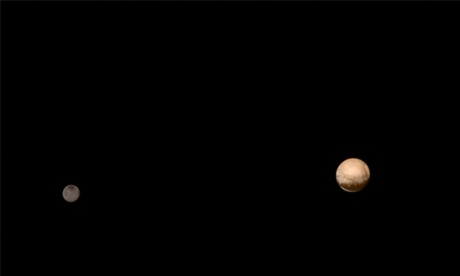
We are starting to discover what it looks like, as the data from the New Horizons mission is beamed back to Earth - but what might Pluto sound like? The question isn’t quite as idiotic as it seems. Nasa has previously released sonic predictions of the electromagnetic vibrations of the planets – like these astonishing “recordings” of Jupiter, Uranus and the rings of Saturn – but we will have to wait a little longer until scientists can do the same with the littlest quasi-planet in our solar system, or the biggest rock in the Kuiper belt, however you choose to define it. (These videos on YouTube are obvious hoaxes, since nothing before Nasa’s New Horizons has been close enough to Pluto to record any potential sonic information about our furthest possibly-planetary cousin.)
Musicians have already been inspired by Pluto and Nasa’s mission to discover more about it, with results ranging from the nerdily hilarious (astrophysicist Tim Blais’s brilliant Bruno Mars parody: Pluto Mars’s Outbound Probe) to the sci-fi soundtrack-like and cliché-ridden (Part 10 of Michael J Burkard’s Solar Symphony). Best by far, though, is Colin Matthews’s Pluto the Renewer, his orchestral work from 2000 that was commissioned by the Hallé Orchestra as a continuation of Holst’s Planets Suite, reaching into the darkest reaches of the solar system.
It’s music that takes the evanescence of Holst’s ending for Neptune (the final part of the Planets Suite) into still more weightless musical territory. Matthews’s music reflects his understanding at the turn of the millennium of Pluto’s elusive status: as he says, the “planet” was discovered four years before Holst’s death, but Holst himself never thought about adding a Plutonic movement to his suite, and at the time Matthews was writing, Pluto’s orbit meant that it was actually closer to Earth than Neptune (although it was, officially at least, still a planet, before it was reclassified in 2006). What’s eerily in tune with the New Horizons mission in Matthews’s music is the sense of cosmic speed that the piece generates, creating a sense of the probe and the planetoid tearing through the cosmic void at scarcely believable velocities. “It is very fast ... solar winds were my starting point”, Matthews wrote at the time.
Prefiguring the suddenness with which New Horizons eventually came into meaningful contact with Pluto and revealed itself to the world, there are a couple of moments when the spectral cosmic whispering of Matthews’s music explodes with shocking ferocity, as if the cold, impassive power of Pluto’s stark geology were violently revealed. As we wait for what might hopefully be Nasa’s sonic realisation of Pluto, Matthews’s seven-minute tone-poem is an ethereally imaginative place to start.