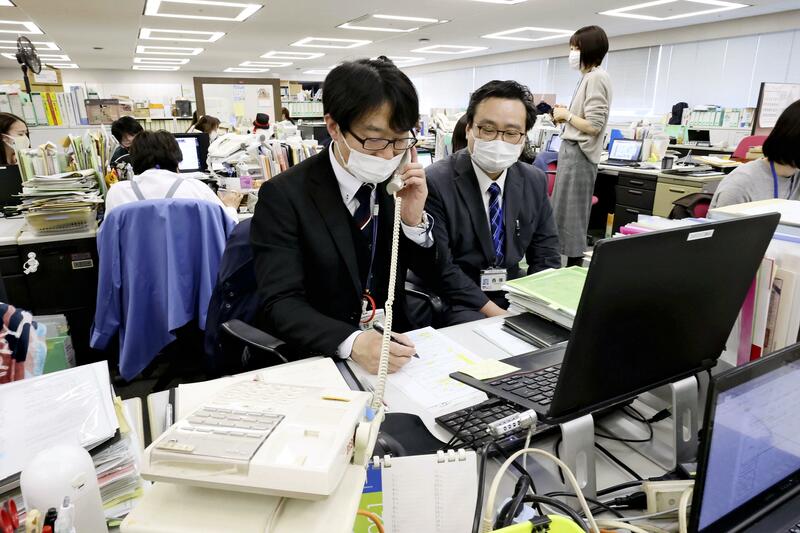
Public health centers should sort tasks that can be outsourced so that their staff in charge of infectious diseases will be able to concentrate on their highly specialized work.
The third wave of the COVID-19 pandemic has exposed weaknesses in the systems employed at such centers, which are at the forefront of infection control measures.
There is also an urgent need to establish a support system in case of the spread of infection and to develop specialized human resources with a long-term vision.
-- Not easy to increase staff
"The spread of the disease during the year-end and New Year holidays was far beyond our expectations," said Kayo Matsumoto, director of the Minato Public Health Center in Minato Ward, Tokyo, looking back on the third wave of the infection.
After experiencing the first wave of the epidemic last spring, the public health center has increased the number of staff dedicated to infection control to about 70 -- more than three times the usual number -- with support from other sections.
The center has changed the system so that data entry of infected patients is done by clerical staff instead of nurses and other specialists.
It also set up a system in which Minato Ward officials who have experience dealing with the novel coronavirus rush to support the center when the infection spreads. By the beginning of this year, nearly 10 people had joined the team to support the system.
In a single week in early January, however, the number of infections reported by medical institutions was 774, more than nine times the peak during the first wave, putting the health center's operations in a tight spot.
Since last summer, the center has been hiring temporary health care workers, nurses and clerical staff. But as it takes one to two weeks for interviews and training, the center is unable to respond adequately in case the number of infected people suddenly surges.
"There's a limit to the number of staff we can increase when the infection spreads," Matsumoto said. "We need to prioritize our work."
-- Epidemiological studies
Public health centers have been performing a wide range of tasks related to the novel coronavirus.
They accept reports of infection and interview infected people about their symptoms by phone. They decide the place of treatment, whether the patient should be hospitalized, receive overnight treatment or recuperate at home. They are also in charge of arranging for the transportation of patients and monitoring the health of those recovering at home.
It also is important to conduct active epidemiological studies in order to determine the routes of infection and people who have been in close contact with those infected with the virus. Knowledge and experience are essential to find the sources of infection by interviewing infected people about their activity history before and after the onset of illness.
Regarding tasks the public health center should prioritize when the infection spreads, Kanagawa Prefecture and Tokyo decided to temporarily reduce the scope of epidemiological studies.
One public health center in Tokyo, for its part, prioritized epidemiological studies at facilities and medical institutions for the elderly, who are more likely to become seriously ill.
"It is impossible to uniformly conduct epidemiological surveys of all infected people when many young people are asymptomatic," an official of the center said.
In Kanagawa Prefecture, the public health center in Sagamihara has strengthened health observations, including house calls to patients, preparing for sudden changes in patients recuperating at home.
The Sumida Ward public health center in Tokyo, which concluded epidemiological studies were essential to prevent the spread of infection in its area, maintained the survey of all cases by outsourcing part of the health observation of patients recovering at home to medical associations.
-- Support system
As part of the basic policy to combat the pandemic, the government is calling for health centers to outsource their work and use a system for dispatching public health nurses, so that they can concentrate on epidemiological studies among other tasks necessary to prevent a surge in infections.
The Health, Labor and Welfare Ministry in August last year established the IHEAT (Infectious disease Health Emergency Assistance Team) human resource bank. More than 3,000 people have registered with IHEAT and about 150 people so far have been dispatched to six prefectures, including Hokkaido and Kanagawa.
The ministry on Friday decided to dispatch about 10 people to Sendai, where the number of infection cases is rapidly rising.
"The most important role of health centers is to detect infection cases among communities at an early stage through epidemiological studies and to take measures to prevent further spread of infections," said Norio Omagari, director of the Disease Control and Prevention Center at the National Center for Global Health and Medicine. "It is necessary to organize the tasks that health centers should perform in the event of a surge in infections by outsourcing medical care, such as monitoring patients' health conditions, to local doctors."
Read more from The Japan News at https://japannews.yomiuri.co.jp/