Two of the strangest and most enigmatic works of art in Britain can be found in a tower beside the river Thames. The Salt Tower is part of the Tower of London. Like other places in this vast fortress, it has been used at various times in its history as a prison. And the images carved into its walls were created, like many other graffiti in the Tower, by a prisoner making his mark before he suffered who knew what awful death.
Hew Draper was a 16th-century Bristol innkeeper who got sent to the Tower for attempted sorcery. He claimed that although he had been interested in magic, he had burnt all his magical books – but his engravings, cut into the very stone of the Salt Tower, reveal he knew plenty about the occult. For a man trying to prove he was no witch, these arcana are the equivalent of someone accused of dissidence in 1950s Russia writing passages from Orwell's Nineteen Eighty-Four on the cell wall.
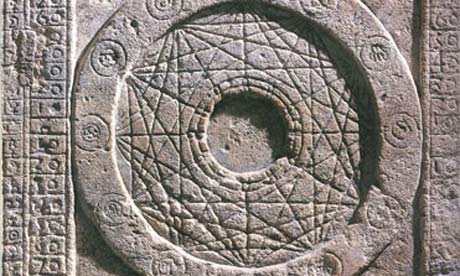
On one wall, he carved a spectacularly large and detailed astrological sphere with Zodiacal signs. It is intricately detailed, replete with numbers and crisscrossing lines that communicate Draper's deep belief in the power of the stars. Nearby is a still more accomplished image: a picture of a bronze astrological globe. This image has a sense of depth as well as the same geometrical accuracy as the big sphere. On the Zodiac design, he wrote: "Hew Draper of Brystow made this spheere the 30 day of Maye anno 1561."
Many prisoners bear witness to their dangerous beliefs in carvings in the Tower of London, but most record one variety or another of Christian faith, with crosses or Jesuit monograms. Draper's images give us a view of another, truly heterodox side of British culture in the past. They are also arguably the most artistically accomplished carvings in the Tower. They can be compared with woodcuts in the kinds of books Draper denied he owned.
Here is a rare survival of popular art. Draper was not a priest, a university scholar, or a gentleman. He was an innkeeper. In these mysterious marks, we gain access to the mind of a freethinking everyman from Tudor Britain – an outsider using his reading to achieve power over the world.
What happened to Draper? No one knows. His death is not recorded in the Tower annals; nor is his escape, or his later life. Perhaps the occult experiment he was performing in the Salt Tower was a success and he vanished from captivity in a puff of smoke.