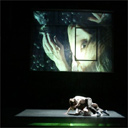
In terms of scale, let alone subject matter, stories don't get much more daunting than Sophie's Choice. With William Styron's 600-page novel already having been adapted as a Hollywood film and a four-hour opera, Cathy Marston's aim to reduce it to a 40-minute ballet sounds audacious, if not plain skimpy.
Marston has certainly been bold in compressing her narrative. She has only two dancers on stage, Sophie (Antonia Franceschi) and Nathan (Karl Sullivan), and she filters large sections of the plot through video sequences that run alongside the live choreography: Sophie enduring her father's bullying, Sophie servicing the commander of Auschwitz, and so on. The defining choice of the novel (Sophie's impossible denial of one of her children) is absent. So the surface logic of the ballet becomes almost archetypal: it is the story of a woman who seems to have survived the traumas of the war, but cannot ultimately escape the ghosts of her past.
It is an artful compression, and at its best the surviving material remains flayed and haunted by the intensities of the original. Marston and her video collaborator Terry Braun have been particularly adroit in their editing, so that the live Sophie frequently morphs into video images of herself, and we see a literal rendition of her being sucked back in time. There is an especially hair-raising sequence in which a video of Sophie licking the boot of the Nazi commander overlays her on-stage embrace of Nathan.
However, it is very hard for video and dance to remain equal partners. While Braun has invented some of the most startling images of his career to map the states of Sophie's mind, his eloquence frequently puts Marston in the shade. Too often, the choreography given to Sophie and Nathan looks generic, even bland. We rarely sense the poignancy and desperation of their attempts to survive as lovers. We rarely get to appreciate the full dramatic talents of Franceschi and Sullivan.
Marston's talent gets a much better showing in Stateless, a ballet set to Rachmaninov's Variations on a Theme of Chopin, which explores, in abstract form, the theme of dispossession running through Sophie's Choice. The score is a challenge (Marston has only six dancers to contain its epic romanticism), and the ballet does not quite hang together. But Marston displays a fine eye for the details of the limbo these dancers inhabit - as their limbs shiver with apprehension, as they blindly cling to each other, as they sicken and fall. Throughout the artful orchestration of their dancing, she maintains the illusion that these are people who have been thrown together, and wrenched apart, by the forces of history.