Sophie Pascoe wins the first bronze in her 17-medal glittering Paralympic Games career - but she had to "guts it out" as a new wave of young swimmers come through.
Two-and-a-half hours before winning her 17th Paralympic medal on Monday night, Sophie Pascoe would have switched into “Soph mode”.
Her coach of the past 20 years, Roly Crichton, knows it so well. Even lying in bed half a world away, recovering from surgery, Crichton knew every second of the structured process that his famed swimmer would have gone through.
Yet this wasn't the expected result in a far-from typical campaign for our greatest Paralympian, who's struggled to get into the groove over the past 18 months - all of her structure thrown out of kilter by the global pandemic.
As the defending Paralympic champion in the 100m backstroke S9, Pascoe was aiming to win her 10th Paralympic gold. She made a powerful start underwater and led the field at the 50m turn, but faded towards the finish and had to settle for third - the first bronze medal of her four Paralympic Games career.
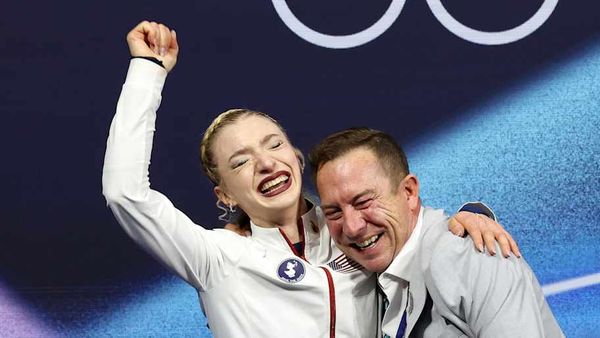
It was a glistening-eyed Pascoe who stood on the podium, on a step unfamiliar to her, next to an even more tearful Hannah Aspden, the young American who won her very first Paralympic gold.
Perhaps Crichton had an inkling this would not be 28-year-old Pascoe's night. Before she had even raced her heat on Monday morning, her coach said over the phone: "She’s awesome at backstroke, but the rest of the world is catching up in that event."
Pascoe suggested it, too, after a tough race: "What you see is a new era of girls who have had that extra year of training. It's exciting."
But it was hard to take, too. "I'm not going to lie. It was a really tough time to take in. I've never swum slower in a Paralympic final," she said afterwards. Her time of 1min 11.15s was slower than she'd swam in the morning's heat and nearly 4s off her world record set in 2019.
"But it was a gusty effort in the last 25m and that's all I could have asked of myself. I don't know if you saw me at the end of the race, but I was buggered."

This was still her second medal from two events in Tokyo. She won silver in the 100m breaststroke last Thursday, but that was a shakedown event for Pascoe. Her other four events – swum over four consecutive days – were where her main focus has been for the last few years.
It's not easy for Pascoe without Crichton at these Games. The coach who has guided her at every Paralympics underwent major surgery in Christchurch before Pascoe left for Tokyo. He’s still bedridden but in a “halfway house” – a rehabilitation centre – and making good progress.
On Monday night he was watching the race on a big screen TV in his rehab room, wearing the Team Pascoe black t-shirt which Pascoe’s mum, Jo, had delivered.
He remains in “very close contact” with Pascoe every day, either texting with her in the mornings of her heats, or sending pointers to her through Matt Ingram, a High Performance Sport NZ coach who’s filling part of Crichton’s role on the ground in Tokyo.
“I text and phone Matty; I don’t annoy Sophie too much,” Crichton says. “She texts me from the bus on her way to the pool. She’ll tell me how she’s feeling, and I might give her a wee pointer.
“You have to be careful not to say too much before the race. You will destroy the person with too much smothering.”
Straight after her heat, where she finished a comfortable second, she was on the bus straight back to the athletes’ village to eat and rest. And then she began her process.
“Two and a half hours before, she gets out of bed, has some food, gets on the bus and goes to the pool. She goes into the zone. I call it Soph Mode,” Crichton says.
“She has it all written down and she will follow it to a tee. And that will become even more important as this week goes on, because she will get more and more tired, of course.
“It’s built into Soph now, she can do that without me. I can coach her from the bloody hospital bed because it’s entrenched in her.”
Before the 100m backstroke heat, Crichton predicted she would need a time of around 1m 11s to make her way efficiently into the final. And he was spot on, Pascoe swimming 1m 11.02s, and looking to ease up when she knew she was guaranteed second place in her heat and a place in the final. She was the third fastest qualifier.
Crichton is always urging Pascoe not to swim too fast in the morning’s heat. “Sophie is a lactate beast,” he says.
Too much lactic acid can build up in her bloodstream in an intense burst of swimming, and her muscles seize up. It happened at the 2018 Commonwealth Games after she won the 200m individual medley SM10 gold. “It’s important not to go too hard in the morning, or it becomes too hard to flush her out at night. And then she has a real job on her hands,” he says.

But in the final she couldn't swim any faster. Aspden's winning time was 1m 9.22s.
“She’s not really there at the moment, but that’s around her mental health and wellbeing rather than the training she hasn’t been able to do,” Crichton said of Pascoe's times, before the final had been swum.
Pascoe has made no secret of the fact she struggled mentally with the lockdowns of 2020 that kept her out of the pool and the year-long postponement of the Games, followed by the uncertainty that they would go ahead.
“They’ve been very tough times,” Crichton says. “The year 2020 was a sheer disaster. Sophie likes to be very prepared, she’s a very structured person; that’s her strength. But she was in a big dark hole and to get out was bloody hard.”
On the side of the pool, she worked with Paralympics NZ’s performance psychologist Rod Corban and clinical psychologist Rowena Palmer. Two-time Olympian and Commonwealth Games swimming champion Anna Simcic would come in and talk with Pascoe, too.
“We’re lucky to have a team down here who are really close. They’ve been chosen for a reason,” Crichton says. “Anna Simcic can come in and talk to Sophie and I step away. You use people for their strengths, what they bring to the table."
And being in Tokyo – and having her structure and process in place again – has really helped her, Crichton says.
“Every day she’s been over there, she’s got better. She’s developed a better feel for the water,” he says.
“We have a bus that we hop on and we cruise along for four years, Paralympics to Paralympics. There are only a few people who are entrusted with a ticket, and that’s our team.
“I used to drive the bus when Sophie was young, and she sat in the back seat. By 2012, she was halfway up the bus. But by 2016 she took over the wheel and I was pushed to the back seat!”
Pascoe’s next event on Tuesday is the 100m freestyle S9, with the 200m individual medley SM9 on Wednesday, and ending with perhaps her strongest discipline, the 100m butterfly S9, on Thursday.
"This is going to be the hard bit now, getting into these three events, but they are also my favourite events, all in a row." But she wants to prove she can get back up on that podium, especially the top step.