The thing about faith schools is that they sound so scary. As if they instruct you, like the Queen in Alice in Wonderland, only to believe in six impossible things before breakfast. Creationism. Fundamentalism. Paradise. Faith instead of facts. You can see why it would be a good idea to abolish the lot of them and integrate the teaching of our children into a fairer system that doesn’t care what invisible idols your parents claim to worship. The former Labour education secretary Charles Clarke has called for an end to the legal requirement for a daily act of worship in schools, faith or otherwise, and said that religious instruction is often best left to “Sunday schools and madrasas”. Clarke wants schools to focus on morality as well as gods, and I want to agree. In fact, I want to think that God is nonsense and causes nothing but trouble.
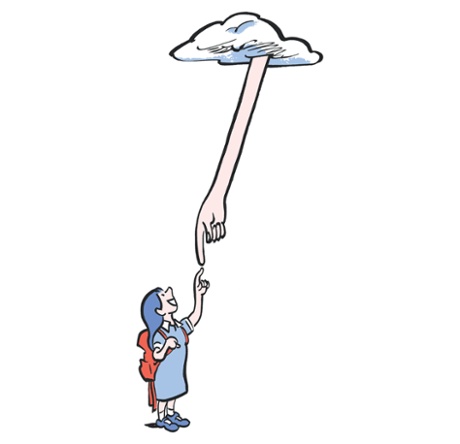
Except then I think about all the stuff I learned at my own Sunday school: that God was love, that there was always somebody there who longed for us, no matter what. How, when nobody wanted to be my friend, this made me feel like I was in a warm bath wherever I went. I feel sorry for kids who didn’t go to Sunday school, and who never got that from school. I went to a faith school – two, in fact, both Church of England, a religion perfectly suited to atheists, which is just as well: my parents were not religious people and the fascination was mine alone. The vicar told me, when I asked if he ever doubted his faith, that he doubted it every day of the week – a profoundly helpful answer for a curious child.
At my faith schools, we were taught to compare the four gospels, to see how the same story had been told by different authors, and then decide which seemed the most boastful. After reading the miracle of the loaves and the fishes, we were told to think about how all that food might really have appeared. Most likely, our teacher said, people had dug to the bottom of their bags and remembered that they had brought a bit of something to eat, too. And thus miracles were presented as shopping trips, a Yorkshire dourness imposed on to the story. Everything was up for questioning.
I read the whole of the Bible, new and old versions, in no particular order. The plot changed so much anyway. People kept begetting other people. Small wars. Plagues. Rows about housework. That age-old moral conundrum: if your brother dies, should you marry his wife? I had the Song of Solomon going round my head, caught up in its lovesong to a man who would lie “betwixt my breasts”, and the vines with a tender grape that “give a good smell”. I couldn’t be entirely sure that it was about sex, but I had my suspicions about the pomegranates.
Jeanette Winterson writes in her memoir, Why Be Happy When You Could Be Normal?, about the working-class Lancashire men who went to evening classes in the 1960s to get an education, and found they could follow Shakespeare just fine – because they had been raised with the King James Bible, published around the same time. But then the Bibles were rewritten. “It was a useful continuity,” Winterson writes, “destroyed by the well-meaning, well-educated types who didn’t think of the consequences for the wider culture.” And all this in a book about how religion also made her life hell.
Education is getting more boring now. A friend with two children close in age, one having learned to read on the pre-Michael Gove syllabus and the other after his reforms, says it is deeply depressing to see how much duller the younger child’s introduction to literacy has been. The rote learning, the lists. And then there’s the testing. The inspections. The endless grading. This boring need for absolutely everything to make ordered sense.
I’m no creationist, but it’s worth pointing out that life doesn’t actually make sense. So why not prepare yourself for it by reading some bizarre stuff from 2,000 years ago? Many Muslims, Hindus and Jews will feel the same about their religion, even if, like me, they no longer pursue the faith. That it can still give you pause for thought. It’s that mad little crack where the light gets in.
• This article was amended on 16 July 2015. An earlier version said that Charles Clarke had called for religious instruction to be taken out of schools and that he wanted schools to focus on morality without gods. In fact the report he produced with Linda Woodhead said they did not agree that religion should play little or no part in the state education system.