On the western perimeter of Cotehele’s sheltered demesne, in the quiet before the annual wassail, a roe deer bounds towards the shelterbelt and adjoining arable fields of winter cereals. The morning’s pearlescent sky is enhanced by a section of rainbow as a shaft of early sunlight momentarily illuminates the stack on the summit of distant Kit Hill.
Here, in this exposed orchard of local varieties, young trees have been regularly pruned to grow on tall trunks and form branches that will withstand the wind and eventually spread to meet across the broad avenues. Unwanted shoots below the grafts were cut out a year ago. Now, in the mildness of midwinter, orange leaves still cling to graceful branches and the recently mown grass is dotted with molehills of soft brown earth.
For today’s celebrations, the breadfruit has been chosen, singled out from the 300 apple trees planted in 2007‑08, bound with ribbons, hung with slices of toast and a flutter of red and green tatters.
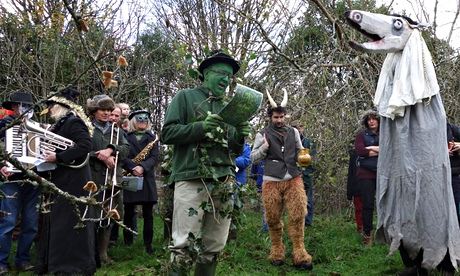
Soon, the sound of drums, whistles, melodeon and brass announces the approach of the procession as it wends through the chapel courtyard, past the flowers of “Cornish Snow” camellia and fragrant chimonanthus, and along paths between clipped yew hedges to the adjoining, older orchard of lichen-covered trees with swags of mistletoe.
The orchardist is out in front carrying a jug of cider. His role of satyr, with horns on head and furry trousers, is reminiscent of the faun depicted in the bacchanal tapestry decorating a wall of the punch room within the old house.
Dressed-up musicians of the Rubber Band orchestrate the ceremony before a crowd of enthusiastic followers and curious first-time participants, all eager to join in and be jolly. First they circle and serenade an old Beauty of Bath. Then, with morris dancers, “tramp the path, go merry, carrying good luck from the old to the new” orchard, which remains years away from maturity and the “sacks full” of apples that are wished for in the wassail chant.