TAKASAKI, Gunma -- A song about a woman who lost her husband in the August 1985 crash of a Japan Airlines plane on Osutaka Ridge in Gunma Prefecture was written recently.
The song, "Akane Zora" (Red sky), is about the feelings of Machiko Taniguchi of Minoo, Osaka Prefecture, and the life of her family.
The song is by singer-songwriter Tatsuya Kitagawa, 33, who was born in Minoo a month before the crash, and it is based on the words of Taniguchi, who is now 70. Hoping to keep the tragedy from being forgotten, Kitagawa gave his first public performance of the song at Minoo municipal Higashi Elementary School on July 18, and plans to release it on CD in August.
"We have a tree that is fed with the water of tears. Fruit of a red sky color makes me smile."
The lyrics start with a persimmon tree at Taniguchi's house. Her husband Masakatsu Taniguchi, who died in the accident at the age of 40, had planted the tree in their garden, saying, "I want my two sons to eat persimmons."
The persimmon seedling, only about 70 centimeters tall when it was planted, grew and bore fruit for the first time two months after the accident. Now, the tree is almost as high as the home's second-story roof.
The lyrics describe the life of the family, who overcame their grief and regained the power to live.
Kitagawa is active as a singer mainly in the Kansai region. In November 2017, he visited his alma mater, Higashi Elementary School, and met Taniguchi by chance. She was visiting the school to read to the students her self-published picture book "Papa no Kaki no Ki" (Father's persimmon tree), which was published in July 2016.
Kitagawa was born in July 1985. He said he had scant knowledge of the accident and the families of the victims until he met Taniguchi. Impressed by the stories of her family and the persimmon tree, he told her he wanted to write a song that could be sung by children.
Kitagawa graduated from the same elementary school as her sons and was born in the year of the accident. Feeling a special bond with him, Taniguchi willingly accepted his offer.
The song says: "I could not tell you 'Thank you' or 'Goodbye.' If you hear me, I just want to tell you one thing, 'We were happy.'"
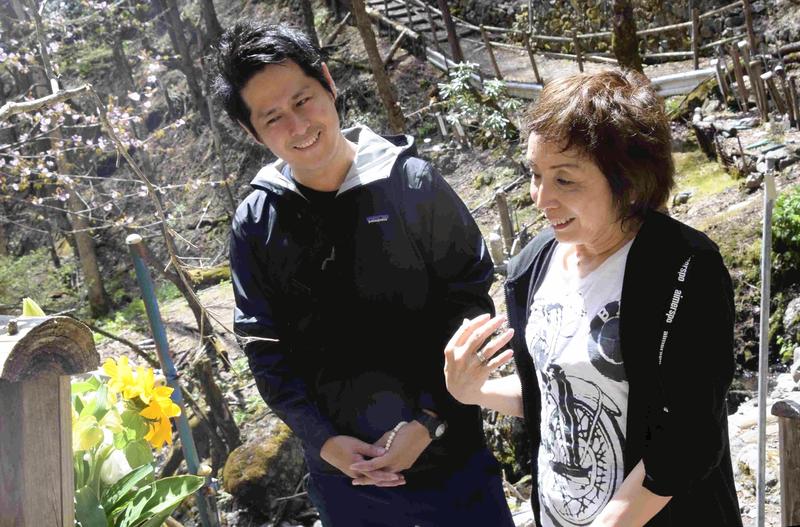
Kitagawa made many visits to Taniguchi's home and listened to her stories. In April, they went together to visit the crash site on Osutaka Ridge in Ueno, Gunma Prefecture, to offer prayers for the crash victims. Kitagawa also visited JAL's education facility for employees, the Safety Promotion Center in Ota Ward, Tokyo.
While on the plane, Masakatsu had written a farewell note: "Machiko, please take good care of our children." Taniguchi raised her children with his words in mind and now has a grandchild.
The lyrics of the song describe her feelings: "From the red sky, you would tell me, 'Look forward and walk,'" and "A new light brighter than the one we lost now shines on us. The spring is coming after a long winter."
The title of the song comes from the color of the sunset on Aug. 12, 1985, the day of the accident. Osaka-based illustrator Kazuhiro Teishima, 42, will take charge of designing the CD jacket. Teishima also drew the pictures for Taniguchi's book.
On July 18, Kitagawa invited Taniguchi to the elementary school, and he and the sixth grade students sang the song together.
"A powerful and good song was written. I hope it will convey the importance of everyday life to children who do not know about the accident," Taniguchi said.
Read more from The Japan News at https://japannews.yomiuri.co.jp/