A festival like Sónar does not care for lethargy. It takes one look at your weak body parts and then drills you with intense electronic beats that sound like parallel universes being ripped apart. I know this because, at 4pm on Friday, I’m being engulfed by industrial-spiked techno so menacing that any exhaustion has run away in abject fear. The person responsible for this is Vessel, a young Bristolian producer on a mission to turn any venue he plays into a boiler room with distorted warning sirens on loop. His music is vast and impressively brutal.
The irony is that, while Vessel is as cold as steel inside, outside the Barcelona sun is burning hot. Across the street from the festival, local schoolchildren are hosting a talent show in the playground and singing Shake It Off. But within the festival walls, there are experimental artists in every shadowy corner. It doesn’t matter what the temperature is: any time is a good time to showcase electronic music that is redefining the cutting edge. One minute you can be outside on the AstroTurf watching violinist Owen Pallett’s majestic kraut-pop as people soak each other with water balloons, the next you’re sat in an auditorium, locked in drone duo KTL’s vice-like grip, and thinking that this is definitely what sleep paralysis must feel like.
Punishing moments like these are everywhere over the weekend – Björk collaborator Arca occupied the same red curtain-draped hall the day before with his brilliantly grotesque live visuals by Jesse Kanda, while the Bug and grime MC Flowdan cracked open their apocalypse dub on Saturday. Memorably, a set by Kanye cohort Evian Christ appeared to try and fast track the end of the world. He amplifies the aspartame euphoria of 90s trance and disconnects hip-hop to its most minimal and militant, and then cuts through it with stabby choir samples and chest-crushing bass. But his visuals take this to a nightmarish level, as Christ trolls the audience with a disorientating combination of billowing smoke, relentless strobes and a flashing panoramic lighting strip that gives glimpses of him at the controls in a non-ironic Tiësto T-shirt. It’s somewhere between the opening scene of Blade and a bad 90s Eurodance video.
Sónar has been offering a platform for, as they put it, “advanced music” for the past 21 years, and will take place in a further seven countries this year. But the original Spanish version is a festival of two halves. Sónar By Day, which takes place in a Southbank-style complex, is a chance for up-and-coming UK producers like Numbers funkmaster Redinho and grime’n’bass DJ Swindle to play the main stage, and each year has a showcase that celebrates a particularly singular record label (this year, it’s long-running avant-garde imprint Editions Mego).
Sónar By Night, meanwhile, beams out of an aircraft hangar cum expo centre and rages until sunrise with bigger acts on a combination of indoor and outdoor stages – of these, Hudson Mohawke is the star, his red-hued backdrop and blaring horns signalling one of the festival’s most momentous performance, closely followed by the dodgems. If you’re not ramming into the back of a bumper at 6am then you’re not doing Sónar properly.
Alongside these two halves there’s also the unofficial after-party circuit, dubbed OFF Sónar, which is now as extensive as Sónar itself and pops up to help extend the festival from Monday till Sunday. It means that those without a festival ticket can get stuck into the musical tapas, too. On Thursday night, I go to Hessle Audio and Hinge Finger’s night, which turns a regular sticky-floored club, Be Cool, into a temple of gurny techno. Here, the label’s elusive house head Joy Orbison steps up to the plates, while elsewhere in the city DJ Erol Alkan plays a monastery for dance music website Resident Advisor, and Skrillex is spotted hanging out at the Numbers party, where the likes of Optimo and Jackmaster are DJing.
There’s another side to Sónar away from the nocturnal debauchery – one that represents future technologies and multimedia art. The festival’s networking space, Sónar D+, is an increasingly significant part of the daytime offering – and for European festivals full stop. Everyone from South By South West to Primavera now has an industry area with workshops, demos and keynote speeches.
Essentially, Sónar D+ is nerd heaven, a digital trade show that is actually cool and accessible, and it’s here that I’ve been invited to host a talk with electronic artist Holly Herndon about her creative process. She gives me some sound advice about where to have the quickest wee (“Use the fourth-floor loos – it’s the hackers’ floor, there are barely any women up there”) and we go on stage for a more formal chat about the various ideas behind her new album, Platform. Looking around the various levels, what strikes me is that Sónar D+’s multi-floored space filled with futuristic computer gear is a playground for a tech-savvy musician like Herndon. In one area, new sensor technology is being demonstrated via a giant dance mat that reacts to your shape-throwing with sound; in another, there’s a demo on motion design.
For all it’s highbrow highlights, however, Sónar also deals in massive pop moments. And, this year, curiously, Duran Duran. At Sónar By Night, PC Music affiliate SOPHIE draws an enormous crowd of people attempting to dance to his bubblewrap-popping beats. His set is like an alien rave fronted by Edward Scissorhands, as the producer bobs over the decks in a PVC jacket and a mess of curls. At times, his Marmite mix of cutesy samples, trap and happy hardcore sounds like something you’d hear in the background of the Cyberdog shop. Yet, there’s a glimpse at the hyper-cute future of pop when he’s joined by cyborg-ish singer Hey QT, all supermodel limbs and simplistic, Dance Central-aping movements, for their song of the same name. “I don’t know why I like it, it’s berserk,” yells one pogo-er to her friend, as the saccharine Eurodance fizzes like a WKD Blue.
But while SOPHIE confounds people of any language, some artists appearing do get a bit lost in translation. Colombian quartet Bomba Estéreo draws one of the biggest crowds of Sónar By Day, though their electro-tropical ruckus is so smiley and carnivalesque that it comes off as cheesy among the rest of the bill.
By contrast, having seen them turn the Brighton’s Dome into a mass moshpit at the Great Escape earlier this year, I wondered how London grime kingpins Skepta and JME would fare in Europe. They headline the festival’s final day, but their room is only a quarter full, most of the audience outside lapping up Henrik Schwarz’s Balearic house vibes instead. Even so, the brothers reel off high-energy hits like Too Many Man and German Whip and by the end of their set they’re shutting down the stage with hundreds of gun fingers poised in the air. Skrillex, meanwhile, tries a different tack: he must be the only living person to drop an EDM remix of Macarena during a DJ set. His skronky bass might not be to everyone’s tastes – I raise you the aurally offensive DJ Salva, whose aggressive EDM hip-hop remixes I have summarised in my notes as “trollstep flambéing my will to live” – but his fearlessness should be applauded.
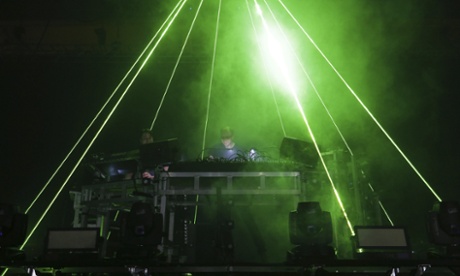
The fact that Sónar runs from 12pm to 7am and is laid out so that you can easily stumble across stages means that it’s possible to see a huge number of acts in a day. It is for this reason that, somewhere towards the lasering end of the Chemical Brothers on Saturday morning, I realise I can’t feel my feet. This being a city festival, taxis are truffle mushroom-rare, and you can’t just trudge to your tent and wriggle into your sleeping bag. At times like this, at least the sweetener with Sónar is that you’re keeping on keeping on with the best of the world’s electronic music talent instead of, say, a DJ called Max B and his crates of hard house. Sónar may not care much for low staminas, but its quality control is unfalteringly high.