FALLS CHURCH, Va. _ It was 1997, and Corey Stewart, fresh out of law school in St. Paul, had bigger plans than working for Republican senators at the Minnesota Capitol. Two decades later, he's running for governor of Virginia _ and drawing national rebukes for defending Confederate symbols and imagery.
Feeling surrounded by liberals in the Twin Cities, Stewart fled Minnesota and his St. Paul political job by 1998. Within five years he was on the Prince William County Board of Supervisors, and in June he's a candidate in Virginia's Republican primary for governor _ a race that in recent weeks has revolved around his comments about Southern pride.
"Everyone should feel free to honor their heritage and their history without fear of being shamed and ridiculed," Stewart told the Star Tribune in an interview last weekend, relating how a longshoreman's son from northern Minnesota came to fight so loudly to preserve what many view as relics of slavery and white supremacy.
In recent months, Stewart joined a rally in Charlottesville to protest the removal of a statue of Confederate Gen. Robert E. Lee. In April, he hailed the Confederate flag during an Old South Ball in Danville and told the crowd, "over my dead body when I'm governor ... are we ever going to take down a statue of Robert E. Lee, Stonewall Jackson or any other hero of the commonwealth of Virginia!"
Last week, when Stewart took to Twitter to say that nothing was worse than a Yankee telling a Southerner that his monuments don't matter, social media exploded back at him.
"You're no southerner, you are a Minnesotan," former NFL wide receiver Donte Stallworth tweeted back. "Respect your home state's sacrifice for helping the United States win the Civil War."
With President Donald Trump revisiting the Civil War this week in his own highly publicized interview, the controversy over Stewart's campaign persona is another representation of how old American wounds still fester in 2017.
Virginia and New Jersey are the only states with gubernatorial races this fall, making them political bellwethers in the new Trump era. Virginia Gov. Terry McAuliffe, a Democrat, is leaving due to term limits, leaving a wide open race in a swing state that supported Democrat Hillary Clinton over Trump.
As a county supervisor, Stewart, 48, has pushed to slow explosive growth in the Washington, D.C., bedroom communities that he represents. He also led an unprecedented crackdown on illegal immigration, which helped position him last year to leading Trump's Virginia campaign for a time.
Now Stewart is touting opposition to political correctness in an effort to win over Trump voters. He faces an uphill battle to win Virginia's June Republican primary against front-runner Ed Gillespie, the former chairman of the Republican National Committee.
Stewart was born in Duluth and grew up in a Democratic household; his father was a longshoreman on Lake Superior. Stewart said he saw the economic malaise of the 1970s up close in Duluth, and came to view Ronald Reagan's presidency as a burst of hope.
At Duluth's Central High School, a debate coach encouraged Stewart to capitalize on his newfound conservatism by attending GOP caucuses for Minnesota governor in 1986. It was his first foray into organized Republican politics. After high school he attended St. Olaf College in Northfield for a year before transferring to Georgetown University in Washington. After graduating, he returned to St. Paul, where he earned a law degree at William Mitchell College of Law.
"Those of us who knew Corey Stewart in Minnesota knew he was very ambitious and very interested in politics, and now you see where that's taken him," said Brian McClung, who was a top aide to former Gov. Tim Pawlenty. McClung and Stewart both worked for the Minnesota Senate Republican Caucus in 1997, McClung in the press office and Stewart as a researcher. They were also involved with Minnesota Young Republicans.
McClung didn't recall Stewart expressing an interest in Confederate issues at that time, "but my sense is that he's looking for issues that can garner a lot of attention and propel him quickly," he said.
Democrats controlled the Minnesota Legislature in 1997, limiting opportunities for ambitious young Republicans, and Stewart found himself missing the D.C. area. He and his wife, Maria, a native of Sweden he met in Japan while teaching English there, relocated to northern Virginia, where Stewart took a job as an attorney offered by a fellow William Mitchell alumnus.
In 2003, Stewart was elected to the board of Prince William County. County governments are more powerful in Virginia than in Minnesota and many other states, and he rose to lead the board of Virginia's second most populous county.
Stewart remembered campaigning door to door during a snowstorm that kept Virginians trapped indoors.
"I made a point of campaigning just to show I'm a hearty Midwesterner," Stewart said. "I can get through the snow, and I'm going to work my tail off."
A decade ago, Stewart found himself at the center of a national controversy over immigration. He and other county supervisors passed a measure in 2007 requiring police to check the immigration status of anyone they arrested. Authorities turned over unlawfully documented defendants to U.S. Immigration and Customs Enforcement after they served their time in Prince William County.
The county has become increasingly diverse and is now 54 percent nonwhite, following a large influx of immigrants.
Stewart's fellow supervisors endorsed Gillespie for governor, and Sheriff Glendell Hill recently pulled his endorsement of Stewart over concerns about his support of Confederate monuments. Singer John Legend was among the celebrities to criticize Stewart, who shot back by describing Legend as "the new Joe McCarthy."
Stewart said he never anticipated that his support of Confederate symbols would draw so much attention. But he said it's helped increase his name recognition in a large state.
"It wasn't really positive attention, but that's OK," said Stewart. "I mean, when you have liberal celebrities attacking you and you're running in a Republican primary, it's a good thing."
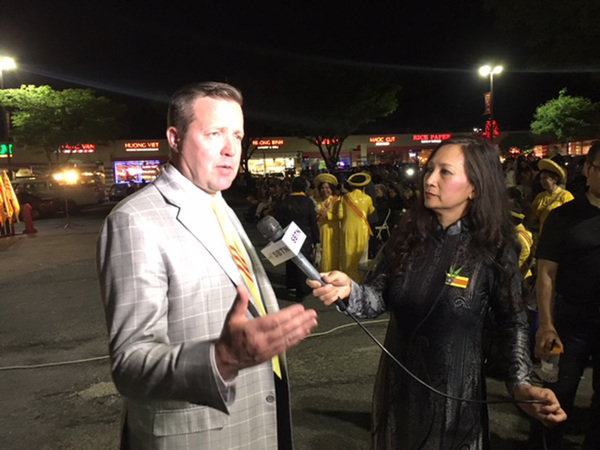
Last Saturday night, Stewart stopped in Falls Church to address hundreds of Vietnamese-Americans gathered to remember the fall of Saigon to Communist forces. Stewart donned a yellow tie with three red stripes, patterned after the South Vietnamese flag.
Stewart promised the crowd that he would recognize theirs as the "real flag" of Vietnam if he was elected governor.
Afterward, Stewart and his wife headed into the Huong Viet Restaurant for dinner. Two Vietnamese women chatted him up, asking where he went to school. When he mentioned his Minnesota background, one woman's face lit up.
"Minnesota!" exclaimed Tho Malkoun. "They're nice people!"