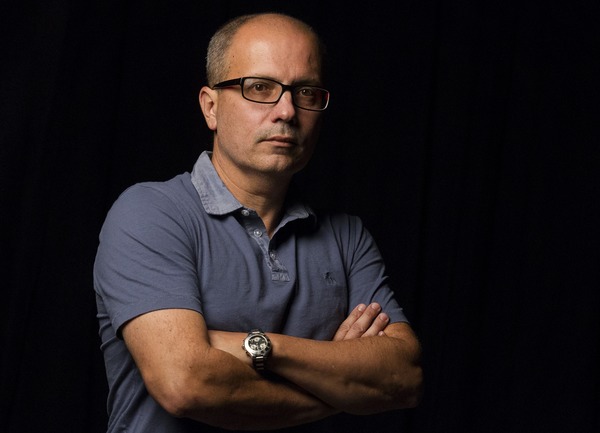
MIAMI _ The son of Miguel Rodriguez Orejuela, former head of Colombia's powerful Cali drug cartel, says he was never a hit man and worked for his father as a lawyer, fighting a legal battle against the U.S. government that he lost.
"I was my father's lawyer," said William Rodriguez Abadia. "At that time, the United States was pushing a string of counter-drug proposals (in Colombia) like money laundering, illicit enrichment, seizures of properties and extraditions. In the end, they won everything."
The confessed drug trafficker granted el Nuevo Herald an interview to criticize "Narcos," the popular Netflix series about Medellin cartel chief Pablo Escobar, which Rodriguez Abadia said paints him as an "assassin" and "glorifies" drug trafficking.
"I was not an assassin for my father. I cannot accept their portrayal of me as a criminal, ruthless assassin and psychopath," he said.
He acknowledged that his duties within the Cali cartel included handling the legal fight in Colombia to avoid the possibility of extradition, lobbying and bribing politicians and administering the cartel from 1995 to 1997.
But Rodriguez Abadia complained that the TV series is turning drug lords into heroes. "What's the difference between Netflix and us," he asked.
The Colombia native, who spent five years in U.S. federal prisons and has lived for seven years in Miami under parole, said his lawyer had complained to Netflix, which answered that he was a public figure and that it obtained the information about him from court documents.
Netflix did not response to a request for comment.
Rodriguez Abadia, 53, said he's considering filing a lawsuit but does not have the money needed to fight "a monster like Netflix." He added that it's "more important to clarify all the misunderstandings" and the more than 10 lies he said were broadcast during the third season of "Narcos," which has a global audience of more than 3.2 million people.
"I do not run away. I have always admitted the mistakes I made. I surrendered, accepted, served my sentence _ short or long, it was what the judge ruled," he said.
It's not the first time relatives of former drug traffickers have complained to Netflix about "Narcos."
Roberto Escobar, 71, brother of Pablo Escobar, is seeking $1 billion from Netflix for the use of the late Medellin cartel chief's image. He told The Hollywood Reporter that if Netflix does not pay up "they will shut down the series."
Pablo Escobar's son, Sebastian Marroquin, told the Mirror that the TV series is full of errors. The series said his father signed a peace agreement with the Cali cartel, Marroquin said, but, "Pablo never gave the Cali cartel to buy a truce."
Rodriguez Abadia also told el Nuevo Herald how drug trafficking permeated Colombian politics and argued that the drug cartels became powerful because of "help from society and the political branch."
"We went through Pablo Escobar, the Rodriguez, the Norte del Valle cartel, the paramilitaries, the guerrillas, and the people in power are the same," he said. "They were our partners, our allies. We were not the only bad guys."
He added that he fears returning to Colombia because of the possible "legal vengeance" in retaliation for his informing on "that bunch of criminals, Samper and Serpa."
Rodriguez Abadia referred to former Colombian President Ernesto Samper, current Sen. Horacio Serpa and the 1994 scandal sparked by the Cali cartel's $10 million donation to Samper's successful presidential campaign in 1994.
"What we sought was a deal to surrender, to legalize our economic empire, for my dad and my uncle to go to jail but with a limited sentence," he said. "That's why we got close (to Samper), which was a disaster in the end."
He added that he will take some secrets to his grave to protect his wife and daughters and other relatives in Colombia.
But Rodriguez Abadia added that he has no relationship at all now with his father and uncle, both now serving 30-year sentences in U.S. prisons.
He last visited his father four years ago in a federal prison in South Carolina. "It was difficult, seeing him after more than 10 years. At that time he looked strong, good. Today he looks older, changed."
He also acknowledged that his father is upset with his book, "Yo Soy el Hijo del Cartel de Cali," or "I Am the Son of the Cali Cartel."
"He believes that we have to stay silent, to keep a low profile," Rodriguez Abadia said of his father. "What bothers him the most are the criticisms I have for him, for his brother, for the mistakes we made."
Rodriguez Abadia said the "Cali cartel" brand has been a curse for him and his family that he's paid with tears, attempts on his life (he suffered eight bullet wounds during a 1996 attack), four years hiding as a fugitive and then more years in a U.S. prisons.
"I believe my father should suffer every day for the damages he caused his family _ destroyed, jailed, in legal battles," said Rodriguez Abadia, who is hoping to obtain a special U.S. immigrant visa, which could take three years to determine if it will be granted.
He never changed his name out of respect for his wife and daughters, he said, concluding his interview with a defiant declaration. "I am William Rodriguez Abadia. Here I am. I live in Miami and I am not afraid of that."