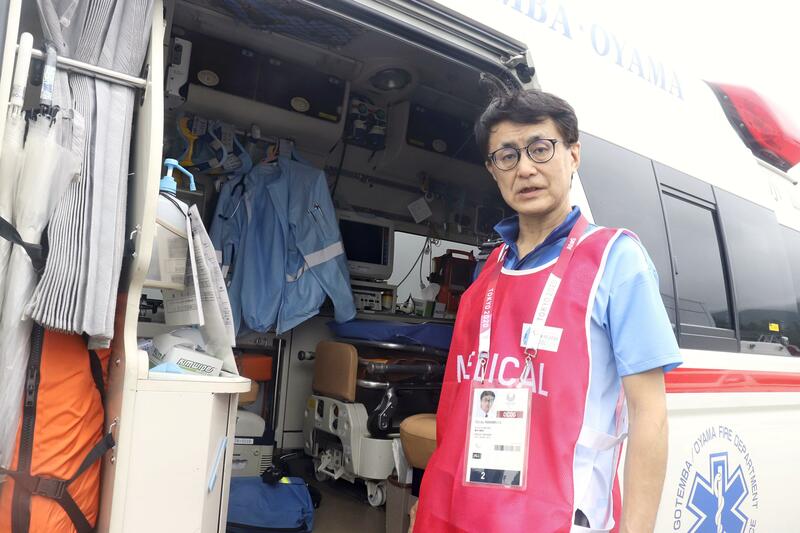
The will of 'the father of Paralympic movement' in the 1964 Tokyo Games lives on through his son, a member of the volunteer medical staff in this year's festivities.
"The seeds my father sowed have now blossomed, and the time for athletes [with disabilities] to shine has come," said Eijiro Nakamura, 59, an orthopedic surgeon and the second son of late Yutaka Nakamura, a key player of the 1964 Paralympics. "I'll continue to support the Games to the best of my ability to fulfill my father's wish."
In the cycling road's time trial held on Aug. 31 at Fuji International Speedway in Shizuoka Prefecture, Nakamura was seen gently talking to an athlete suspected of having heatstroke on an ambulance standing by on the race's course.
He sent the cyclist off to a nearby medical center after making sure the condition has improved. Then he promptly returned to the first-aid station.
About 2,000 doctors stood by at the ready during the Tokyo Olympics and Paralympics, according to the Games' organizing committees. Nakamura volunteered his services as part of a rescue relief team at the Speedway.
-- 'Father of Paralympics'
Yutaka Nakamura (1927-1984) traveled to England in 1960 to study rehabilitation therapy for the disabled under Dr. Ludwig Guttmann -- known as the founder of the Paralympics -- at Stoke Mandeville Hospital on the outskirts of London.
In Britain, sports had already been incorporated into rehabilitation as a means of improving patients' independence. In Japan, on the other hand, it was deemed necessary to keep the disabled quiet in bed, giving them few opportunities to go out, let alone participate in any sports. During his time in England, the elder Nakamura was shocked to see the disabled being gainfully employed and actively enjoying their daily lives with their family.
Upon his return to Japan, Nakamura worked hard to advocate for sports for the disabled, scrambling for funds and seeking support to make the 1964 Paralympics a reality. He also served as the head of Japan's national team for the five consecutive Games.
In 1965, Nakamura founded the social welfare corporation Taiyo-no-ie (Japan Sun Industries) in his hometown of Beppu, Oita Prefecture, and worked with companies to increase the number of job opportunities for the disabled and support their independence.
As a result, those with disabilities would often come to visit the Nakamura home, and young Eijiro grew up dining and sleeping alongside them. Eijiro said he remembered how his father would serve them sukiyaki to lift their spirits when they were depressed.
-- Smile seen in 2020 Games
The elder Nakamura treated everyone equally and advocated the social importance of sports. Eijiro, who grew up watching his father, has walked along the same path.
Officially becoming a doctor in 1987, he has worked at the orthopedic department at Oita University Hospital and other institutions. He is also a qualified sports doctor and in 2018 became the president of Akeno Central Hospital, established by his father in Oita.
His older brother, Taro, is also an orthopedic surgeon who has served as a doctor for Japan's national team for both the Sydney and Athens Paralympic Games. During the Tokyo Games, Taro worked as a general manager in medical relief for badminton.
While the 2020 Games were Eijiro's first experience working for the Paralympics, he has thrown his support behind many sporting events for the disabled as a doctor, including more than 30 years of volunteering for the Oita International Wheelchair Marathon, which held the world's first event for wheelchair marathoners.
On Aug. 24, Eijiro watched the televised Paralympics' opening ceremony with the staff at his hospital. While video from the 1964 Tokyo Games shows the Japanese Paralympians as tense and stiff, the athletes in the most recent Games appeared to be shining with bright smiles. As he watched the scene unfold before him on TV, Eijiro said he was overwhelmed, feeling that his father's activities took hold after half a century.
There were those who were opposed to holding the Paralympics amid the COVID-19 pandemic. "The number of infected people is not decreasing, and the situation is unpredictable," Eijiro said.
But he also said he thought it must hold some significance. "Some disabled people still face marginalization. Holding the Games despite the pandemic would mean something if it's helping more people engage in sports for the disabled and deepening their understanding of them."
Read more from The Japan News at https://japannews.yomiuri.co.jp/