The last minute U-turn by the Phayao Provincial Administration Organisation (PAO) in not allowing the Pheu Thai Party to use a district sports stadium for a campaign rally raises suspicions of possible foul play by state authorities.
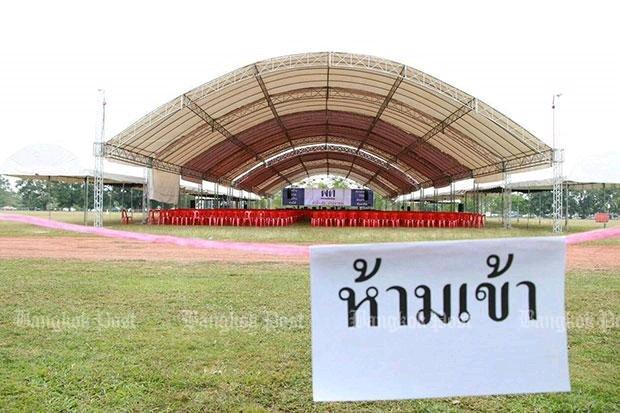
On Jan 10, Pheu Thai executives and members who were to rally at the sports stadium in Dok Kham Tai district were dumbfounded as the PAO reversed the permission only hours before the event, giving them no time to find an alternative venue. Hundreds of residents who arrived at the sports stadium found themselves barred from entering as the arena was cordoned off with rope and a sign which read "no entry''.

In a letter to the party, dated Jan 9, the PAO said it had to withdraw the permission because it was afraid "allowing the Pheu Thai Party to hold a rally at the sports stadium would give the party an unfair advantage over other parties". The deputy PAO president who signed the letter also claimed it would be inappropriate for a party to use state infrastructure for a campaign as bureaucrats are required to observe political neutrality. On the same day, the pro-government Palang Pracharath Party (PPRP) organised a poll campaign at the compound of a privately-run college also in Phayao's Dok Kham Tai district.
Unable to enter the stadium, the crowd, largely from in Dok Kham Tai and Phu Kam Yao districts, had to gather on the road in front of the stadium while Pheu Thai executives led by Ladawan Wongsriwong, the party spokeswoman, took turns making speeches from the back of a pickup truck, which had been converted into a substitute campaign stage.
Ms Laddawan criticised the PAO decision, saying it was an act of "political persecution". The Pheu Thai heavyweight has every right to interpret it as such.
Deputy Prime Minister Prawit Wongsuwon, who is also a powerful figure in the National Council for Peace and Order (NCPO), distanced the regime from the matter, while saying he believed the Phayao PAO "acted according to the law". The deputy prime minister also said it was a local issue for each area to decide on. In short, what he wants to say, albeit unconvincingly, is that the military regime had no hand in it.
The law Gen Prawit cited must be a directive that prohibits bureaucrats from political partiality.
There is no dispute about political neutrality. In fact, it's a noble principle that must be observed stringently and without discrimination by all concerned.
But by trying to maintain political neutrality, the PAO needs to do the opposite, by allowing Pheu Thai to use the facility and giving similar permission to other parties wishing to use the venue for similar activity. This is for the sake of fairness.
Over the past months, members of the public have had every reason to question the neutrality, or lack thereof, practised by certain state elements close to the PPRP. In fact, there are allegations that some bureaucrats and the PPRP got involved in quite a few incidents that appear to compromise such a noble principle, if not violating vital election laws. One incident was a Chinese-styled banquet organised by the PPRP to raise funds on Dec 19 which saw key state agencies taking part. The Election Commission is probing the case.
Not to mention the fact that four cabinet ministers, including Industry Minister Uttama Savanayana, are doing a double job in representing the PPRP. They have staunchly defied calls for them to resign. But canvassing for voters' support while maintaining cabinet positions gives Mr Uttama and co an upper hand over their rivals.
Today, the PPRP is scheduled to stage a campaign event at a state venue in Chiang Rai's Muang District. Some anxiety has arisen about whether the authorities will practise double standards by giving the pro-regime party the green light, which would be unfair.
While Gen Prawit, as he tried to sidestep the controversy, said that each province can act on its own, he must see to it that such neutrality be relevantly practised, and every party is equally treated, with no double standards. This is a crucial start and also a prerequisite for a free and fair election. Anything less is not acceptable.