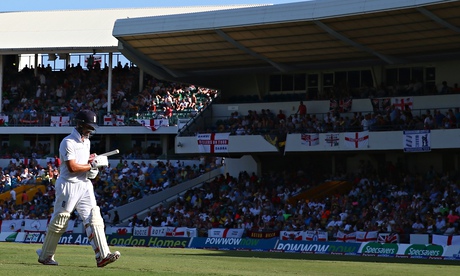
Three Tests into the 17 they have scheduled in this 12-month stretch, and England have already lost one player. It’s not a fresh bout of fatigue that has caused Jonathan Trott to quit international cricket, rather the fact the 16 months since he flew home from the last Ashes series in Australia has been too little time for him to recover from his burnout. It’s possible Trott’s illness was so severe he would never have felt comfortable making a comeback to Test cricket, however long he left it. Given that, it was brave of Trott to test himself, knowing full well he may fail. And if little else these three Tests in the Caribbean will serve at least to give him some peace of mind. He will never have to wonder “what if”.
You could say, and some do, that Trott’s was a unique case. Certainly the intensity with which he approached his cricket made him vulnerable. In a revealing interview with George Dobell last March, Trott spoke about the summer of 2013, when England’s schedule had allowed the players to take a three-week break. He took four days off. On every other day, he spent two-and-a-half hours batting in the nets. He set himself impossible standards. “I averaged 90 against [Australia] so, in my head, I needed to score 180 runs a game to sustain that. And that meant, if I made 100, I was still left thinking: ‘Oh no, I need to score another 80 in the second innings just to break even.’”
While Trott’s symptoms were his own, some of the issues that caused them were common to the team. England ground all their best players down, it’s just that the strain showed in different ways. Take Graeme Swann. In the five years of his Test career, Swann bowled 2,558 overs. Outside of his own team there wasn’t a bowler anywhere in the world who even came close to taking on that kind of workload. Next on the list was Peter Siddle, who bowled only three-quarters of that amount. In between all the toil, Swann had two separate surgeries to try to fix a chronic elbow problem which led, ultimately, to his quitting the game at the age of 34 with a joint that was so shot he could hardly spin the ball.
Then there is Matt Prior, still only 33. During his career, Prior fielded in 146 Test innings, and spent 9,498 minutes batting. Next best this time, MS Dhoni, with 89% of Prior’s workload as a wicketkeeper and four fewer hours at the crease. By the time Prior stepped down he needed an operation on his achilles, and his hands were pulverised, pounded into uselessness by all the deliveries he had fielded.
Others are still standing, but only just. Since he became a regular member of the team in 2007 Jimmy Anderson has bowled – incredible this – 3,435 overs in Test cricket. Next on the list is Stuart Broad, with 2,697. After that, Dale Steyn, with 2,476. Put another way, in the past eight years, Steyn has had 72% of Anderson’s workload, and 91% of Broad’s. And we wonder why Anderson and Broad both seem to so often be bowling within themselves, why, during this series in the Caribbean, the speeds of England’s senior bowlers were so often down around the 80mph mark.
Circle back to Trott. Until he dropped out of the team in Australia in 2013 he spent 10,422 minutes batting in Tests, and faced 7,939 balls. Precious little time there, between travel, training, media work, county matches, and one-day internationals, to stop and take stock, to allow injuries to heal, or the mind to revitalise. The only man who batted more than Trott was, inevitably, Alastair Cook, who has spent the last two years in a slump, trying to effect running-repairs to his game in between innings. No coincidence his recovery in the Caribbean came after three months away from the sport, made possible only by sacking him from the one-day captaincy.
Long ago as it all seems now, this was a great team, once. And England, thanks to a combination of avaricious scheduling and an overreliance on the same group of senior players in Test and ODI cricket, ran it hard until it broke. Add to that the suffocating environment – more regime than team, as Kevin Pietersen described it – fostered by Andy Flower. The upshot was that three – four including Pietersen – senior players dropped out of the team within six months of each other, which is one reason why England are struggling now.
And it is not going to get any better. There are 14 Tests in the next eight months, along with 20 ODIs and five T20s. It would be a minor miracle of modern medicine if Anderson and Broad make it through all of the Tests, much less any of the limited-overs matches. The mistake England made with Trott was not with these last three matches in the West Indies but in the 49 Tests and 68 ODIs they made him play in the four years between his debut and the moment he quit the Ashes. They either need to cut back the matches, or start rotating their players, or else Trott won’t be the only one who suffers.