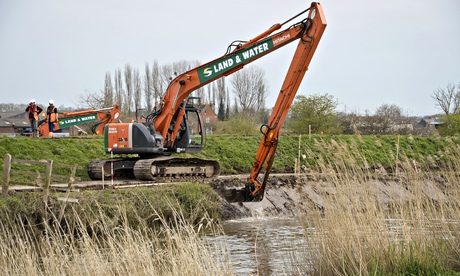
The fluorescent jackets are still everywhere: construction workers are building up the banks of the River Parrett, builders are hammering away in scores of homes, teams of selfless volunteers are doing their bit to help householders who were uninsured when the murky floodwater poured in.
“There’s still a lot to do,” said Bryony Sadler, one of the scores of residents forced to evacuate the village of Moorland on the Somerset Levels almost a year ago and now finally back in her home. “It’s been tough, really tough.”
The government’s announcement on Tuesday that £15.5m will be spent on flood defences in Somerset in the next six years was welcomed by the likes of Sadler, who suffered the heartbreak of leaving her dream house – a former rectory that had never flooded before – with husband, two children, mother and numerous animals and pets in tow.
“But it all seems to take such a long time,” said Sadler. Environment Agency workers have been busy dredging the Parrett to try to make floodwater flow off the low-lying moors more efficiently. Bunds – embankments – have been hastily built around some homes to try to keep the next inundation at bay. Somerset county council has carried out improvements to roads to try to stop whole communities being cut off next time the rain-heavy winter storms sweep in from the Atlantic.
What is seen as the really big game-changer in these parts – a barrage at nearby Bridgwater – still seems many years away. The government announced that funding would also be available to “complete the appraisal, scheme development and design” for the barrier – but gave the timescale as five to six years.
“That’s two governments,” said Sadler. “Who knows what will happen in that time? Things seem to take such a long time. They seem to spend a lot of time talking about making the big improvements we need but they need to just get on with it.”
Retired army major Mark Corthine, who in February donned a diving suit to return to his flooded home in Fordgate to retrieve cherished family photographs, is still living in a mobile home.
“We had hoped to be back in by now but there was a problem with the hot water. We’ll be in for Christmas, I’m sure,” he said.
Corthine is one of those who spoke to David Cameron when the prime minister bowed to pressure and visited the Levels at the height of the devastation. “I do feel we were fobbed off,” he said. Corthine said he had told Cameron 3m tonnes of silt needed to be removed from the Parrett to get it flowing properly again.
So far, five miles of the Parrett and its sister River Tone have been dredged. “The last I heard it was about 163,000 tonnes they had removed. That’s not enough. That will create pinch points and next time it floods there will be problems in other areas.”
Corthine is also frustrated at the time the barrage will take. “They’ve been talking about it for decades. They are still just talking about it.”
Some local politicians are more sanguine. Ian Liddell-Grainger, the Tory MP for Bridgwater and West Somerset, said the government had listened to those stricken by the floods. He said the £15m would be spent by a new local rivers authority to be formed within the next few weeks – rather than the Environment Agency. The idea is that better, more informed decisions will be made by people with local knowledge.
Liddell-Grainger, who has long campaigned for a barrage, said he was pleased that money had been promised to drive forward the proposal. “The people of the Somerset Levels are really good people who acted with great forbearance over the last year. I’m determined that they won’t have to go through all that again.”
Lib Dem councillor, Gill Slattery, said the barrage plan could not be rushed through. “Five to six years seems reasonable,” she said. Solving the problem of the low-lying Levels is not a simple process. “We’ve had a lack of maintenance for 20 years on the rivers; it’s going to take some sorting out.”
Back in Moorland, Cindy Yandell’s described how her home just about escaped flooding – but she spends four days a week doing volunteer work for those who were not so fortunate. “It’s very rewarding when people move back in.
It’s been a very hard year or so but we’re getting back on our feet.”
Down the road in Moorland Neill Mellor had just moved back into his home. A merchant sailor, he was somewhere off the coast of west Africa when water flooded into his home. “I haven’t worked since all this happened. My only job has been to get the house straight and get us back in. We haven’t had a party to celebrate yet; we’re waiting for Christmas for that.” He said he was confident the government was now listening to the concerns of residents. “But I’m not overly confident that we won’t flood again. I’m not going to go to sea again in the winter so I’ll be here next time.”