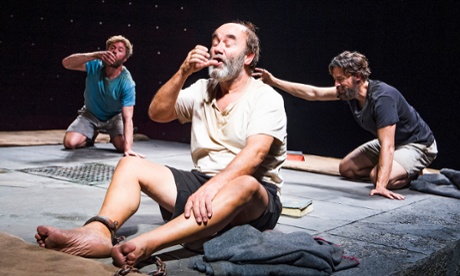
Inspired by the experiences of Brian Kennan and John McCarthy who were held captive by associates of Hezbollah in Lebanon in the 80s, Frank McGuinness’s 1992 three-hander offers both a heightened variation on the old stuck-in-a lift scenario as well as a riff on the cultural stereotypes of the Englishman, Irishman and Scotsman jokes. Although, in this case, the Scotsman is a US doctor called Adam (Adam Rayner), confined with an Irish journalist Edward (Rory Keenan) and Michael (David Haig), a earnest English academic, in a dank prison. Even the puddles are edged with green slime in Robert Jones’s effective design.
This is very much a play of its time but also a universal exploration of strategies of survival and a reminder that we are always stronger together, whatever the circumstances and however many cultural differences exist. These men may all speak English, but it doesn’t mean they always find it easy to understand each other. The play looks dated in a 21st century where IS hold so many captive – and not just westerners – and beheading is more likely than release. It is also short on recognising the political complexities that lead to hostage taking with scant acknowledgement of how the chickens come home to roost on Western foreign policies, often generations after they are instigated.
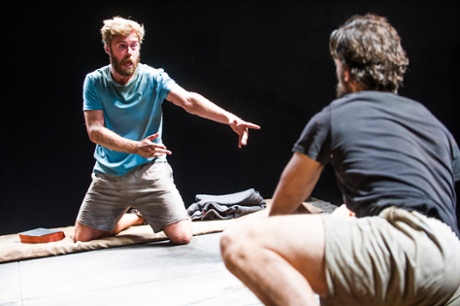
What can’t be doubted is the power of a play that celebrates the instinct for survival, doesn’t shirk the possibilities of despair, and demonstrates how the power of the imagination can take the men beyond the four walls of their imprisonment, whether it’s through re-enacting the 1977 Wimbledon women’s final or serving imaginary cocktails. The pacing in Michael Attenborough’s production is sometimes slipshod, and on occasion he needs to rein in the emotion, but it’s a play that reminds that whatever our differences, hell is not other people – it’s their absence.
- At the Minerva, Chichester, until 10 October. Box office: 01243 781312.