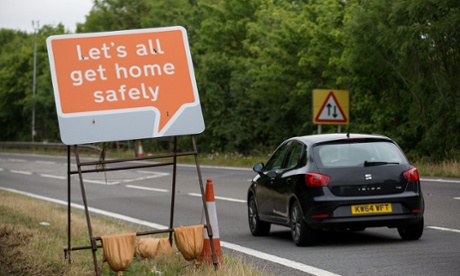
Some road signs have been troubling me lately. There are a few new signs on the A21, on a stretch of roadworks where trees and a couple of old houses are making way for a dual carriageway. One reads: “Someone loves you, drive carefully.” It makes me wonder: how do they know? Have they been reading my emails? I mean, he says he does, but …
Another urges you to drive carefully, saying, “Our dad works here”, with a picture of two smiling children wearing hard hats. Are they the actual children of an actual dad, here in high-vis? If so, which one? Does anyone’s mum work here too? Is this sexist? The signs are certainly thought-provoking, but I’m not sure if these thoughts are the ones the highways authority intended.
The signs – others include “nobody likes a tailgater” – are being trialled at roadworks on four roads (the others are the M1 and M3, and the A40 in Gloucestershire). A Highways England spokesperson says they were developed with the help of psychologists and are intended “to improve the customer experience through roadworks”. There is no official end to the trial – “some of these projects are going on for a number of years” – but he says they will monitor the response.
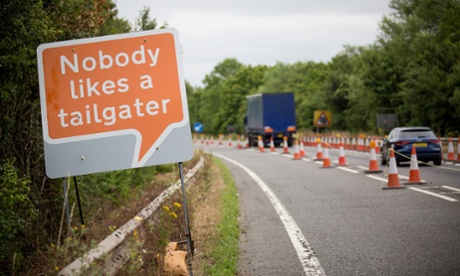
The informal, friendly tone is an attempt at “emotionally intelligent signage” that the American writer Daniel Pink, a self-confessed sign obsessive, likes to collect (he believes empathetic signs are more effective than authoritarian ones). But it is also an example of how the so-called “wackaging” trend – the infuriatingly infantilising and chummy way that twee smoothie makers and their imitators speak to consumers – has infected all areas of our lives to the extent that not even the most dry and serious of governmental authorities is immune.
Ben Hamilton-Baillie, a traffic and movement specialist, thinks the signs come across as “patronising”. “It’s a common mistake – assuming that signs can be friendly when they’re clearly standardised.” A handwritten blackboard at a restaurant, for instance, is different “because the receiver understands there is an individual behind it, but when it’s the state or an agency, it has the opposite effect”.
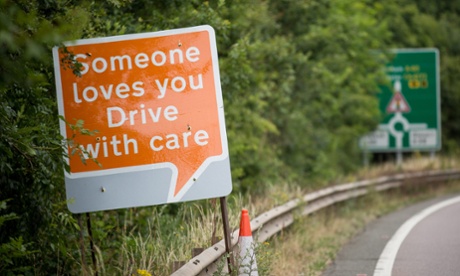
Others disagree. “I’m a fan,” says Dr Lisa Dorn, director of the Driving Research Group at Cranfield University. “What this does is bring the information to life. It relates it to [drivers] personally.”
Does she think it will have an impact on drivers’ speed or concentration? “I think it will make drivers process the information more deeply. Research has shown that people tend to ignore road signs because we are confronted with them all the time, and are generally pretty bad at noticing them. This will capture people’s attention, and it’s therefore more likely to have an influence.”