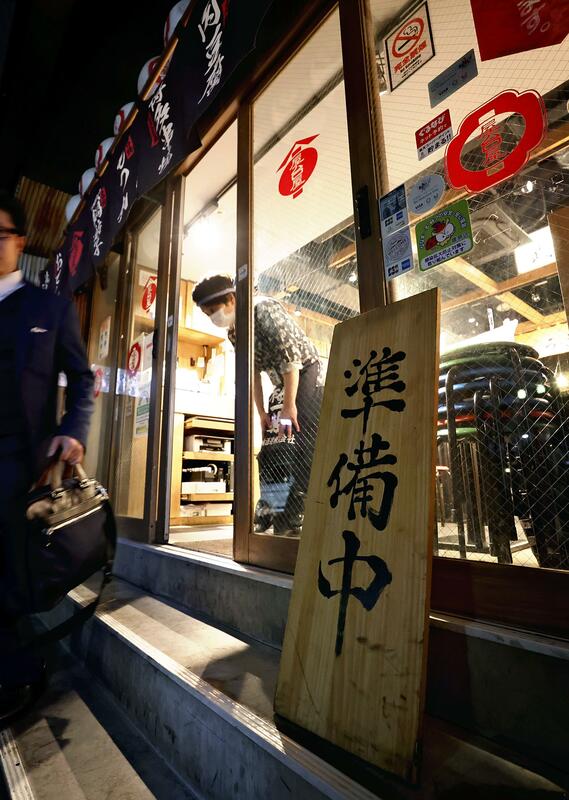
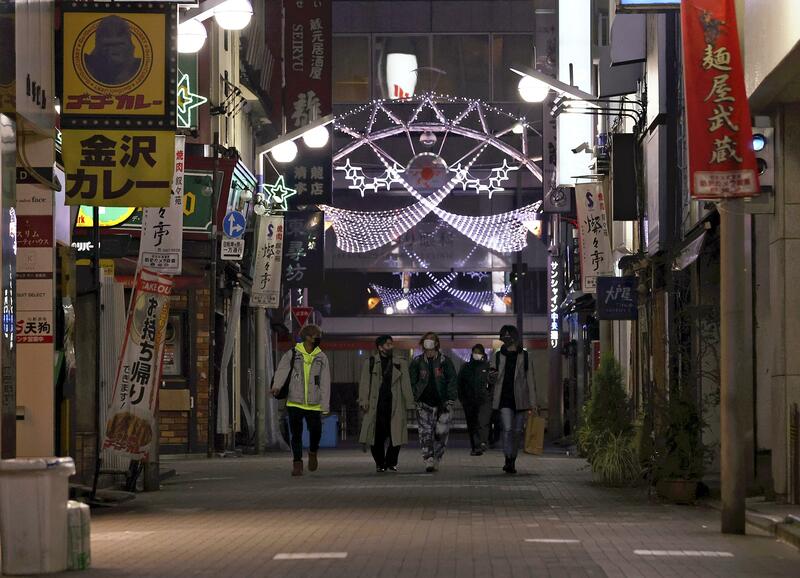
Three weeks have passed since a state of emergency was declared again for Tokyo because of a resurgence of the novel coronavirus. Walking through the busy area of Ikebukuro in Tokyo's Toshima Ward, I saw people walking around at night looking for places to eat, as major restaurant chains have had to shorten their business hours or temporarily close.
Some business operators have complied with government requests to their hours to do their part in preventing the further spread of the virus. However, others have disobeyed the requests and continued to operate late into the night to keep their business afloat. Both sides are struggling.
-- In the red
Shortly after 8 p.m. on Jan. 22, the last customer of the day left the Yataiya Hakata Gekijo's Ikebukuro Higashiguchi store, an izakaya pub operated by a major restaurant chain.
"Until yesterday, the place was packed with customers during these hours," said a 32-year-old store manager. "It's kind of upsetting."
Under the state of emergency, which was reissued on Jan. 7, the Tokyo metropolitan government has requested restaurants and certain other entities to only serve alcoholic beverages until 7 p.m. and close at 8 p.m. Business operators that comply with the request are provided 60,000 yen per day, but major businesses were initially not eligible for this financial aid. Ikka Dining Project., Ltd., a company based in Chiba Prefecture that operates 70 stores in the Tokyo metropolitan area, including Yataiya Hakata Gekijo, had initially complied with the request, but soon had its restaurants and pubs -- mainly in Tokyo -- return to normal business hours, calling the request "unfair."
The metropolitan government then changed its policy, making major restaurant chains eligible for the financial aid like small and midsize businesses, from Jan. 22. As a result, the company shortened business hours again. However, as of this past Sunday, it has chosen to temporarily close many of its shops. The rent for the Yataiya Hakata Gekijo's Ikebukuro Higashiguchi izakaya alone is about 1.2 million yen a month. As more than 70% of their customers come in after 7 p.m., the shop's losses are greater than its earnings if they close early.
The company has a total of about 1,160 employees and works with about 30 suppliers to get ingredients and other products.
"The impact on our employees and business partners is great, but we also have a responsibility to prevent the spread of infection," an official said.
-- Wanting businesses to endure
After 9 p.m., the lights went out at many stores and there were fewer people were on the streets.
According to a survey conducted by metropolitan government officials from Jan. 18 to Tuesday, 95% of eating and drinking establishments in Ikebukuro were closed at or around 8 p.m. When I looked inside some eateries and pubs that were still open, they were all packed.
"I can't make a living unless I open my shop," a man who owns an izakaya pub said. "That's all."
There was a line of customers outside of an izakaya, and an employee said it would be at least 30 minutes before they were seated. Customers were frequently seen coming to the izakaya but would leave after seeing the line.
"It's hard for me to start drinking after work when places close at 8 p.m.," said a 24-year-old company employee, who was drinking with his friend from university. They then left the izakaya, looking for the next place to go.
An appetizing smell drifted out from the izakaya Ikebukuro no Kaze as an employee in the kitchen grilling meat for a delivery order. To make up for a drop in sales because of the shortened business hours, the izakaya has focused on deliveries by using such services as Uber Eats and takeout orders. These services account for 20% of its total sales.
"We want to build our business so it can endure this difficult situation," said a 59-year-old owner of the izakaya.
-- More trash on streets
A park at the west exit of JR Ikebukuro Station has been chained off after 8 p.m. every night since Jan. 8. This was a decision made by the Toshima Ward Office to prevent people from drinking and making noise at the park. As a result, many young people were seen drinking beer and other alcoholic beverages on the streets around the park instead.
The scene was unchanged when I visited the park again on Tuesday night. I saw a woman wearing a convenience store uniform picking up empty cans scattered around the area.
The woman works below an izakaya that closes at 8 p.m. and said the number of discarded cans has increased since the state of emergency was declared.
"It can't be helped," she said. "People don't have anywhere to go to drink."
-- Izakaya sales halved in 2020
The combination of the growing public reluctance to eat out amid the pandemic and government requests to shorten business hours has increased the hardships for eateries and other such businesses.
According to the Japan Foodservice Association, sales at its member business chain operators fell 15.1% in 2020 compared to the previous year. It was the largest drop since the survey began in 1994. By category, the biggest fall in sales was at izakaya and other types of pubs at 49.5%.
"The situation of small businesses could be more serious compared to large businesses," said a person at the association who is knowledgeable about the situation. "If the state of emergency is prolonged, the situation is likely to worsen."
According to Teikoku Databank, Ltd., the number of izakaya bankruptcies hit a record high of 189 last year. By prefecture, Tokyo had the largest number with 36, followed by Osaka with 33 and Aichi with 13.
Read more from The Japan News at https://japannews.yomiuri.co.jp/