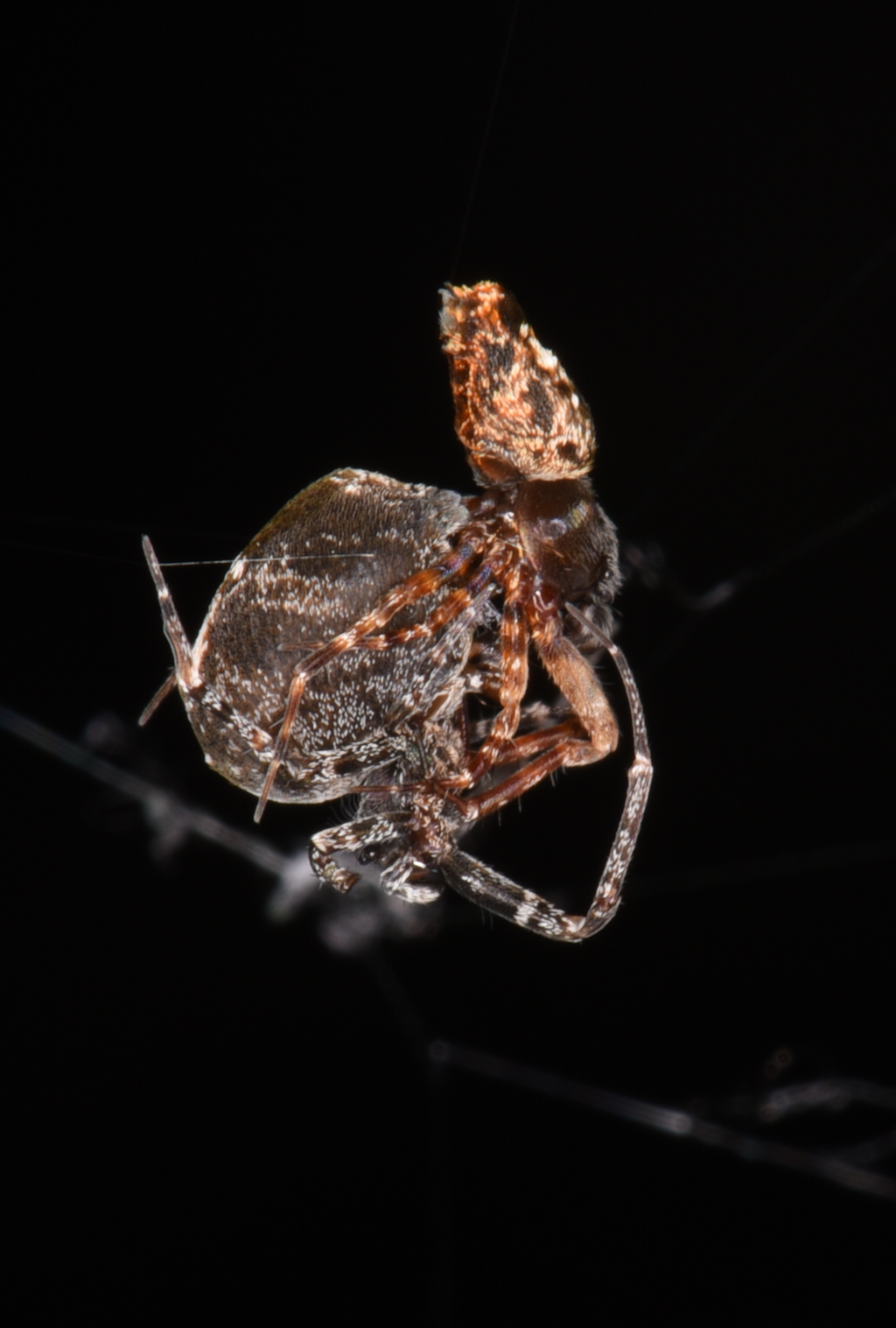
Some male spiders will catapult themselves into the air faster than cameras can detect in a bid to flee their mate before she eats them, researchers have found.
After males of the orb-weaving spider Philoponella prominens mate with a female, they quickly launch themselves away using a mechanism that has not been described before.
The eight-legged creatures use a joint in their first pair of legs to immediately push off the female in a split-second action, flinging themselves away from their partners at speeds clocked at up to 88 centimetres per second (cm/s).
We observed that males that could not perform the catapulting were cannibalised by the female
The study suggests the female spiders may even judge the male’s suitability as a mate based on its ability to pull off this move.
Researcher Shichang Zhang of Hubei University in Wuhan, China, said: “We found that mating was always ended by a catapulting, which is so fast that common cameras could not record the details clearly.”
Researchers say the reason for this manoeuvre is simple, to avoid being eaten by the female in an act of sexual cannibalism.
In the study the few males that were not seen catapulting were promptly captured, killed, and consumed by their female partners.
When the researchers prevented males from catapulting, they also met the same fate.
With high-resolution video cameras, the researchers calculated an average peak speed of about 65 cm/s.
Speeds ranged from about 30 cm/s to almost 90 cm/s.
They also accelerated at an average of about 200 m/s2.
Dr Zhang said: “We observed that males that could not perform the catapulting were cannibalised by the female.
“It suggests that this behaviour evolved to fight against female’s sexual cannibalism under strong predation pressure of females.
“Females may use this behaviour to judge the quality of a male during mating.
“If a male could not perform catapulting, then kill it, and if a male could perform it multiple times, then accept its sperm.”
The findings are published in the journal Current Biology.