While the government is advocating international exchange through the Host Town Initiative for the 2020 Olympic and Paralympic Games, local municipalities are struggling to realize the initiative's objectives.
The program looks to reinvigorate local municipalities by having them interact with the participating countries and regions by hosting pre-Games training camps and mutual exchanges. However, problems have arisen as some local authorities have been in a quandary over how to carry out their programs.
"They might be comparing us with other municipalities, or they're thinking it's too early to decide on a host town," a city government official of Kasama, Ibaraki Prefecture, said in a confused tone. "Honestly, I have no idea what they're thinking."
Although the city sent emails to an organization related to the Thai national golf team in March, asking for their thoughts on a schedule of inspection visits and negotiations, there has been no response at all.
There are nine golf courses in the city, which boasts of being "a town for golfers." Considering it difficult to interact with professional golfers touring worldwide, the city decided to register as a host town for Thailand, with which Kasama had already developed cultural exchanges through pottery, a well-known traditional craft of the city.
City officials prepared to visit Thailand, and registered the city with the government as a host town in June 2016. The city government allocated 1.6 million yen (14,000 dollars) for fiscal 2016 and 2017 for expenses to send staff to Thailand as well as accepting a Thai inspection team. However, such activities ultimately did not take place.
335 entities registered
In the Host Town Initiative, municipalities select counterpart countries and regions and draw up exchange plans with specific programs for each fiscal year. Once a host town is registered after examination, its expenditures for implementing the program are subsidized by the central government. As of Sept. 7, the number of host town registrations was 335, and that of counterpart countries and regions was 104.
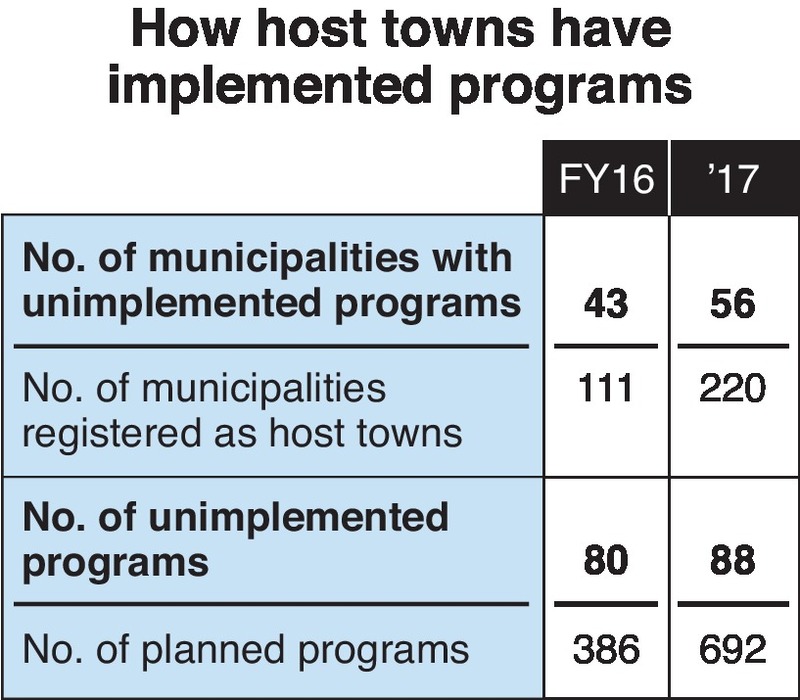
However, according to the report issued by the Board of Audit on Oct. 4, there were 80 programs that were not carried out in fiscal 2016, reflecting a total of 45 million yen worth of operating expenses that was not spent. This involved 43 out of 111 municipalities. The number increased in fiscal 2017, when 88 programs, with a budget of 82 million yen, went unimplemented in 56 out of 220 municipalities.
About 30 percent of the municipalities that submitted programs have not yet achieved actual exchanges with counterparts or invited them for training camps.
As for the reasons for the situation, 45 percent said they were "unable to consider concrete schedules within the municipality." Twenty-nine percent said they were "unable to finalize schedules with the counterpart," and 4 percent said there were "sudden changes on the counterpart's side."
Revitalizing regions
On the other hand, there are municipalities that have been successful in their exchange programs.
Nagaoka city, Niigata Prefecture, has been holding exchanges with the Australian national swimming team, which will participate in the Olympics.
In the city, there is a prefecture-run large-scale swimming facility that includes a 50-meter pool. It has equipment to control and coordinate the water temperature of the pool and air temperature of the facility.
The city succeeded in inviting the Australian team to the city as a training camp site by utilizing a network including a senior city official who had been dispatched to the Australian government.
Australian swimmers interacted with local elementary and junior high school students in a swimming competition held in the city in October last year. In July and August this year, Australian swimmers had a training camp in the city for the 2020 Games.
Another senior city official said with confidence, "We have been able to deepen our interactions continuously."
Among municipalities that could implement their exchange programs in fiscal 2017, many of them obtained cooperation from domestic friendship organizations and coordinators.
Sixty percent of municipalities that signed memorandums on hosting training camps for the Games cited as the reason for the signing "having facilities and the environment to meet the needs [of counterpart countries or regions]."
For the 2002 soccer World Cup, Nakatsue village (now part of Hita city), Oita Prefecture, was chosen as a training camp site for the Cameroon national team. For the sake of inviting a national team to the village as a training camp site, it decided to plant professional-level soft turf on its pitch.
Since the World Cup, the pitch has been used by J.League clubs as a practice ground and by other clubs for training camps. The number of people who used the ground came to around 30,000 in fiscal 2017.
A 64-year-old former employee of the village government said: "The area has been revitalized. There is still an atmosphere of supporting Cameroon and the ground has become a symbol for the area."
With one year and nine months left before the 2020 Games, an official of the Secretariat of the Headquarters for the Tokyo 2020 Olympic and Paralympic Games, said: "There are difficult aspects in how to deal with a counterpart country, but municipalities need to promote in detail to counterpart countries such things as the practice environment and the preparations made by host towns. We hope their efforts as host towns will lead to a rediscovery of their own attractiveness and mounting momentum for the Games while they listen to the opinions of their local people."
Read more from The Japan News at https://japannews.yomiuri.co.jp/