It’s hard to decide who is the most frustrated with the way the country’s biggest banks are faring these days.
Investors, who watch banks stocks lagging?
Regulators, who wonder why on earth bank CEOs and directors don’t just give up the battle and break up their institutions into bite-sized pieces?
Or outraged critics of the banking system like Massachusetts Senator Elizabeth Warren, who argues that banks still have far, far too much input into the process of determining just how (and how much) they are regulated?
What is interesting, however, is that in spite of all the hostility and controversy that banks seem to attract the way that flypaper does flies, banks still have their fans. There are plenty of people who want to buy those stocks.
“Right now, the valuation opportunity is staring me in the face – it is in the hated regulated big banks, the things that no one really wants to exist any more,” says Sam Peters, a portfolio manager with Clearbridge Advisors.
Peters has the freedom to put his investors’ money anywhere in the market where he believes there is a good tradeoff between risk and reward, and right now believes that this list includes the largest “megabanks” and investment banks, most of which are trading at a discount to their historic levels and to other, smaller financial institutions.
A regional bank – an entity that might have a presence in a number of states and have tens of billions of dollars of assets – might trade for as much as 16 times its annual earnings, Peters notes. A megabank? Well, that’s closer to 10 to 12 times earnings, he says.
As an investor, Peters says, that means he is “getting paid to take regulatory risk”.
There is even a bonus. If interest rates go up in 2015, as some economists predict they will, this will be a boon for banks. That’s particularly true of some of the biggest, who will benefit twice over: collecting more income on the spread between interest income and deposits and on any uptick in fixed income trading.
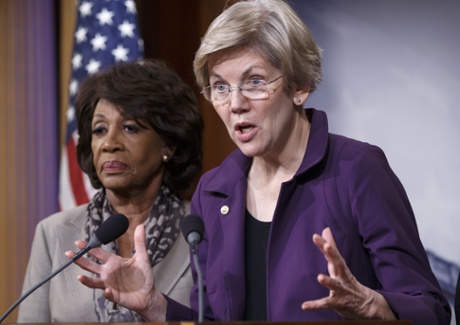
True, sluggish trading revenues and lackluster loan growth have dented banking revenues and profits in recent years. Banks believe that regulators are preventing a permanent return to pre-crisis levels of profitability. (Cue a laugh from Warren’s camp, which may wonder: what regulation?)
Chris Lee, manager of Fidelity’s Select Financial Services Portfolio, says banks are under-earning compared to their potential.
A big reason for that is the controversy that still surrounds banks, he says, and the area where the controversy is the greatest is where the banks are biggest.
“Will the deluge of regulation ever let up? Will litigation risk ever subside?”
Some value investors have been willing to bet that it will. This year, Tony Coniaris, a portfolio manager at Oakmark Select, one of the best-performing mutual funds of 2014, noted that one of the areas in which the fund has recently found value is in some of the largest banks, including Citigroup, JP Morgan Chase and Bank of America.
Their balance sheets are stronger, Coniaris pointed out, and the quality of their assets has improved.
“The businesses are performing fine, and the question is when will the negative news drumbeat subside,” he said. For some companies too, Coniaris said, the regulatory cloud has made it difficult for shareholders to understand just when some banks will be able to return excess capital to shareholders.
Citigroup is probably the poster child for disillusioned and disenchanted megabank investors. It looked like it was really turning things around.
Of the surviving banks, Citigroup came the closest to complete collapse, and it wasn’t until last year that the Federal Deposit Insurance Corporation sold the last chunk of its stake in Citi, ending the five-year bailout.
But early this year, Citigroup flunked the Fed’s stress test, meaning that it wasn’t allowed to follow through on its plans to buy back $6.4bn of stock or quintuple its minuscule 1 cent per share quarterly dividend. (JP Morgan Chase pays a quarterly dividend of 40 cents per share.)
Then last week came the announcement by Michael Corbat, Citigroup’s CEO, that the bank will take a $2.7bn charge against its fourth-quarter earnings for litigation costs (as well as $800m for restructuring).
Together they will pretty much wipe out the bank’s expected earnings, analysts calculate. That’s the second time in less than two months that the bank announced big legal charges. The government is also probing Citigroup in connection with manipulating foreign exchange markets and other offenses.
Still, Citigroup ranks well below industry “leader” Bank of America in terms of either the number of suits it has settled so far, or the dollars it has had to fork out to resolve the litigation.
According to Keefe, Bruyette & Woods, Bank of America has paid nearly $58bn in a total of 24 settlements, with JP Morgan Chase coming second, with $31.6bn paid in 15 settlements. In contrast, Citigroup has forked over a relatively meager $12.9bn in 12 settlements.
The litigation risk may finally be dwindling, as more banks reach settlements on the biggest legacy issues from the financial crisis: the question of mortgage mis-selling and fraud. In August, Bank of America reached a massive $16.65bn agreement, for instance.
But litigation isn’t the whole story.
There is also the ongoing burden of regulation to consider: one study calculated the costs of complying with new banking regulations doubled from 2007 to 2013 to hit $70.2bn for the six largest US banks, thanks to new rules aimed specifically at institutions with assets of more than $50bn.
In a recent 2015 outlook for the sector, the analysts at Keefe, Bruyette & Woods warned that the largest banks might not see any relief in the new year, as regulators are likely to resume pushing for them to hold still more capital on their books to guard against future crises.
“The giant banks are being given huge incentives not to exist any longer,” says Peters, at Clearbridge Advisors.
Will investors want to own their shares? Regulators – and politicians like Senator Warren – clearly hope not, and that directors will get the message and act to break up the megabanks.
But some are still attracted to the tremendous bargains on offer among the biggest banking stocks. Would they rather buy Bank of America at about 0.8 times book value?
Then, too, there’s the question of whether you really want to bet against the banks. Look at what Jamie Dimon, CEO of JP Morgan Chase, just managed to pull off, to the fury of Democrats: he convinced the Obama administration that it would be OK to once again allow banks to conduct some of their riskiest activities using their own balance sheets. That’s something that was banned as part of the Dodd-Frank Act, and the bankers just succeeded in getting it rolled back as part of the $1.1tn budget bill. The language in the bill was literally drafted by the good folks at Citigroup.
That may not be great news if you are worried about the future of financial regulation. If, however, you are looking for a sign that the shares of the country’s megabanks are great values rather than just value traps – well, you couldn’t ask for anything better.