Soldiers who survived a fatal SAS mountain march have described how they succumbed to heat illness after running out of water in soaring temperatures and had to be helped by civilian hikers.
Giving evidence at the inquest into the deaths of three colleagues who fell ill during the 16-mile exercise on the Brecon Beacons, one soldier claimed he was told to complete the march even after a medic had warned him he could die if he continued.
Another told how he pretended to be fine when he approached checkpoints manned by instructors because he was determined to finish, but finally collapsed on the mountainside and was found by two hikers. A third said he was forced to pull out after becoming so confused by heat illness that he could not satisfactorily tell a medic his date of birth.
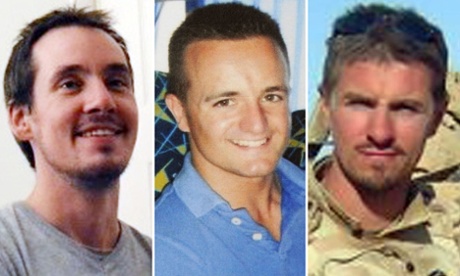
Three army reservists – Lance Corporal Craig Roberts, 24, Lance Corporal Edward Maher and Corporal James Dunsby, both 31 – died after suffering hyperthermia during the test in July 2013.
The inquest heard that the soldiers who took part in the test on the Brecon Beacons in south Wales were reluctant to leave voluntarily even when they were suffering badly because they were not allowed to retake the test if they did so.
Some of the soldiers said they had been given little advice about how to cope with the heat and not all of them knew where they could refill their water bottles.
The coroner’s court in Solihull, West Midlands, has heard a claim that the test march was not called off because of the paperwork that would have resulted.
Seventy-eight soldiers carrying backpacks weighing at least 22kg (49lb) set out on the march, which they had to complete within eight hours and 48 minutes. At least seven, and possibly up to 10 candidates – all reservists – suffered heat illness as temperatures reached reach 27C (80.6F).
Among them was a soldier codenamed 1W. He said he could not recall being advised about the heat and he was unaware that there would be no water at two of the five checkpoints. “My understanding was there would be water at each checkpoint,” 1W said.
He said he began to struggle early in the march. He rapidly got through his water and noticed that his urine was dark – a sign of dehydration.
At the next checkpoint, he was asked by directing staff how he was and replied by drawing his hand across his neck, indicating he was not feeling good. No water was available at the checkpoint and he was not asked if he had any left.
Later, a fellow soldier found him slumped on his rucksack. “I felt dizzy, weak, sick, my nose was bleeding, I felt confused ... I wasn’t thinking straight,” he said. The other soldier lay him in a pool of stagnant water and he revived.
When 1W reached the next checkpoint, he was examined by a medic. He said he felt relieved when the medic pulled him off the march, telling him: “You want to wake up in the morning; you don’t want to die.”
But 1W carried on after the chief instructor on the exercise was consulted. “I was told to continue on the march,” he said.
The soldier collapsed as he approached the peak of Pen y Fan, the highest mountain in southern Britain, and was given water by a civilian walker. “I fell on the floor and was out,” he said.
He was taken to hospital in the same ambulance as Dunsby and was treated for damage to his kidneys and heart caused by heat illness, but has suffered no lasting health problems.
Another soldier, 1X, who also suffered heat illness, told the inquest that he always tried to look better than he felt when he went through the checkpoints. He said that the “usual answer” to the question: “Are you OK?” was: “Yes, staff [sergeant]”, even if you felt dreadful.
The soldier told the inquest how he had set off quickly; no one had advised him about pacing himself. He told how he began to feel sick and dizzy and stopped sweating. When he sought shelter from the heat, still intending to finish the course, 1X fell unconscious. After being found by two civilian walkers, he was evacuated to hospital. “I pushed myself hard; I just wanted to get to the end,” he said.
A third soldier, 2J, was medically withdrawn at 12.14pm after becoming so confused that he could not give his date of birth properly. One of the issues the inquest is to explore is why the exercise carried on until late afternoon after soldiers such as 2J began to suffer.
Yet another soldier, 2P, said he was “perturbed” at how he was dealt with at a checkpoint after “hitting the wall”. He said his eyes were “rolling around my head” but he was not assessed by a medic. Soldier 2P carried on slowly. “For every one step forward, it was two back,” he said.
When he finally collapsed, colleagues came to his aid and used a civilian’s mobile phone to call for help. “I was completely out of it, completely delirious,” he said.
The inquest continues.