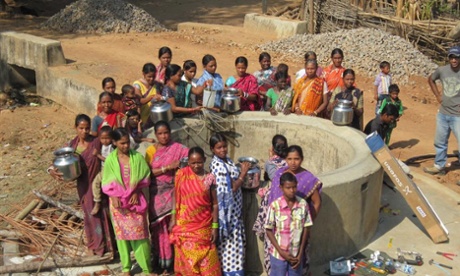
In Mandapathiara, a small farming village in the east Indian state of Orissa, women and children are eagerly filling metal pots and buckets with water that is flowing from a new storage tank for the very first time.
Until now, they had to walk up to six hours every day to collect enough drinking water for their families.
With the help of a new solar pumping system donated by the Grundfos Foundation, they can now draw fresh water from a local well, pipe it to a storage tank and then distribute it to each house.
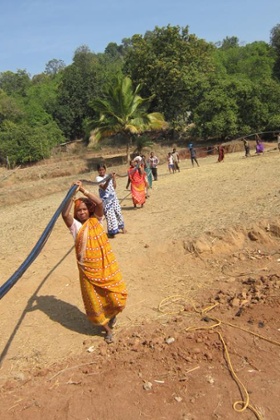
For Rishi Kapoor, director of Sunlit Future, the company responsible for the installation of the pump systems, this is his favourite part of the job.
“It’s wonderful to see the smiles on their faces and amazement at the water flowing for the first time,” he says. “Before the solar pump was installed, women and children walked long distances to collect drinking water. The physical strain was unimaginable. Now they have water taps in each of their homes.”
Mandapathiara is not alone. 100 villages will receive solar pumping systems this year through a project run by Sunlit Future, local NGOs with expertise in sanitation and health and the Grundfos Foundation. The first phase of the 100 Pumps for 100 Villages project is due to complete at the end of March, bringing drinking water to nearly 13,000 people in 28 villages.
An estimated 700,000 villages across rural India face similar challenges accessing drinking water. While many of these communities have manual hand pumps linked to local wells, the hot summer season causes the water table to drop and the pumps to run dry for three months each year. With temperatures soaring to 45C in the height of summer, the daily task of collecting drinking water becomes even more arduous.
“When the hand pumps run dry, women and children have to walk even farther to find water in an open well or a stream. With open sources of water, there is a high risk of contamination, which can lead to many health problems,” Kapoor explains.
Even in areas with conventional electricity, large storms and other hazards can shut down pumping systems for months at a time.
For Kapoor and his team, solar energy is the clear solution. He hopes the “100 Pumps for 100 Villages” project will make local and national government take notice of the low-cost pumping system and adopt similar methods to deliver drinking water to these areas.
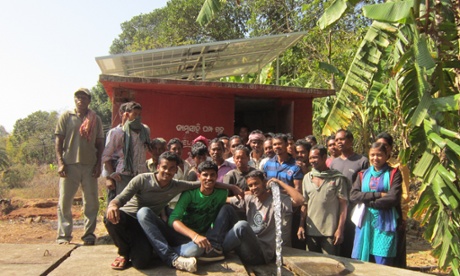
“We are demonstrating in a very short time that there is a localised solution to the drinking water and sanitation issues facing rural communities,” he says. “India is blessed with an abundance of sunshine to run the pumping systems and deliver drinking water. There is no need to wait for conventional electricity to reach these areas.”
Kapoor points out that the villagers’ participation is key to the project’s success. “Being involved at the village level is what makes this model work. Instead of a solution being forced upon the community by agencies and government, it is the people’s decision and there is a sense of ownership.”
The NGOs work with villagers to build the necessary infrastructure and deliver training so people in the community can maintain the pumps, he says. Villagers also contribute a small amount to create a maintenance fund that will cover the cost of repairs.
With drinking water available in homes year-round, the project partners hope the increase in free time will allow women to spend more time with their families and expand economic opportunities in the villages.
“In some cases, women are using the extra time to help in the fields. We are also looking at models for small-scale industry that could be viable in remote areas,” says Kapoor. “Each village and project is unique with its own set of challenges. However, bringing drinking water to people who faced such hardship is a very rewarding experience.”
Read more about the “100 Pumps for 100 Villages” project here.
Content on this page is paid for and provided by Grundfos, sponsor of the water hub