The Environment Ministry plans to add solar power plants to a list of projects subject to the government's environmental impact assessments (see below), as an increasing number of plans for large-scale solar power plants has led to a series of troubles between operators and residents over deforestation and landscape damage, The Yomiuri Shimbun has learned.
Aiming to implement the plan as early as next year, the ministry will hold the first meeting of an expert panel on Thursday.
Residents' concerns
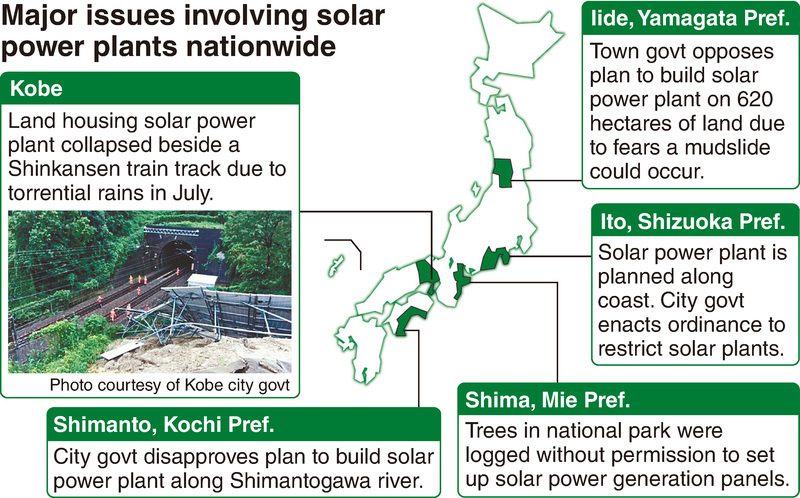
A Tokyo-based business operator is moving forward with a plan to set up solar panels in Ito, Shizuoka Pref., on 45 hectares of land, which is part of a 105-hectare forest it purchased.
"They do not have concrete measures to prevent landslides," a 50-year-old local resident said, expressing distrust in the plan. "I wonder if they are making light of residents' lives."
A source knowledgeable about the plan expressed concern over the fact that the solar panel site is close to a diving site.
"If mud flows into the sea, no one will come here for diving," the source said.
An Ito city ordinance entered into effect in June to regulate the installation of solar power plants. Its main provision bans the construction of a power plant with solar panels that occupy more than 1.2 hectares.
The municipal government says it will not allow the construction of the planned power plant because it is against the ordinance. But the operator says the project is not subject to the regulation because the ordinance came into force after the project was launched. The operator started relevant work, including land development, this month.
In July during the torrential rains that hit Western Japan, land housing a solar power plant collapsed in Kobe causing West Japan Railway Co. to temporarily suspend its Sanyo Shinkansen train services due to concerns that solar panels may have come into contact with overhead electric lines for the high-speed railway.
The Kobe municipal government aims to enact an ordinance that requires businesses to submit prior notifications if they set up solar panels with an output of at least 10 kilowatts for business purposes.
In Shimanto, Kochi Prefecture, the municipal government disapproved twice of a plan to construct a solar power plant in the city based on Kochi Prefecture's ordinance on the nearby Shimantogawa river, citing that the site for the planned plant is located in an area which had been flooded in the past.
Local regulations differ
According to the Environment Ministry, as of June, 32 prefectures and 17 cities -- including ordinance-designated cities -- regulated solar power plant installations through their environmental assessment ordinances.
However, the specific methods differ among municipalities, resulting in the ministry's judgment that a unified evaluation method would be needed. The ministry will begin discussing relevant issues at the Thursday expert panel meeting.
Under the electricity business law, businesses planning to construct solar power plants are required to submit their plan -- detailing such information as the output -- to the Economy, Trade and Industry Ministry at least 30 days before they start construction. They may be subject to other regulations based on the forest law, the agricultural law and other laws, depending on their locations.
Disputes have occurred over the construction of large-scale solar power plants as a conspicuous number of newly entering businesses carry out their plans without sufficiently explaining them to local residents. When solar power plants become subject to environmental impact assessments, their operators will be required to conduct close examinations and provide explanations for residents.
"Solar power plants should be made subject to environmental impact assessments as early as possible so their operators will be obliged to thoroughly work to protect the environment," said Mitsuru Tanaka, a professor of environmental policies at Hosei University.
Offsetting energy deficit
The recent rapid increase in electricity generated from solar power across Japan has significantly contributed to the stable power supply, with no requests to save power even during this year's record-hot summer.
Solar power is believed to provide 10 percent to 20 percent of the peak power demand.
Behind the hike in solar power generation was the introduction in 2012 of a "feed-in tariff" scheme that requires power companies to buy electricity from renewable sources such as solar power at government-set prices. Solar power generation in the fiscal 2012-16 period was about six times as high as before the introduction of the scheme, according to the Natural Resources and Energy Agency.
Tokyo Electric Power Company Holdings Inc. has released the ratio of actual electricity use to its maximum supply capacity. According to the statistics, the demand-supply balance has been relatively loose. It peaked at 93 percent on July 2 and was less than 93 percent on all other days in July and August, including extremely hot days of 35 C or more.
This is mainly because the peak demand time around 2 p.m. coincides with the height of solar power generation.
"Solar power generation has significantly contributed to securing electricity during daytime in summer," a TEPCO official said.
--Environmental impact assessment
A system to reduce impact by conducting prior examinations and assessments for projects that could affect the environment, and by hearing opinions from residents, local governments and others. It looks into such aspects as ecosystems, landscapes and topographic changes. Thermal, hydroelectric, nuclear, geothermal and wind power plants are currently subject to the assessment.
Read more from The Japan News at https://japannews.yomiuri.co.jp/