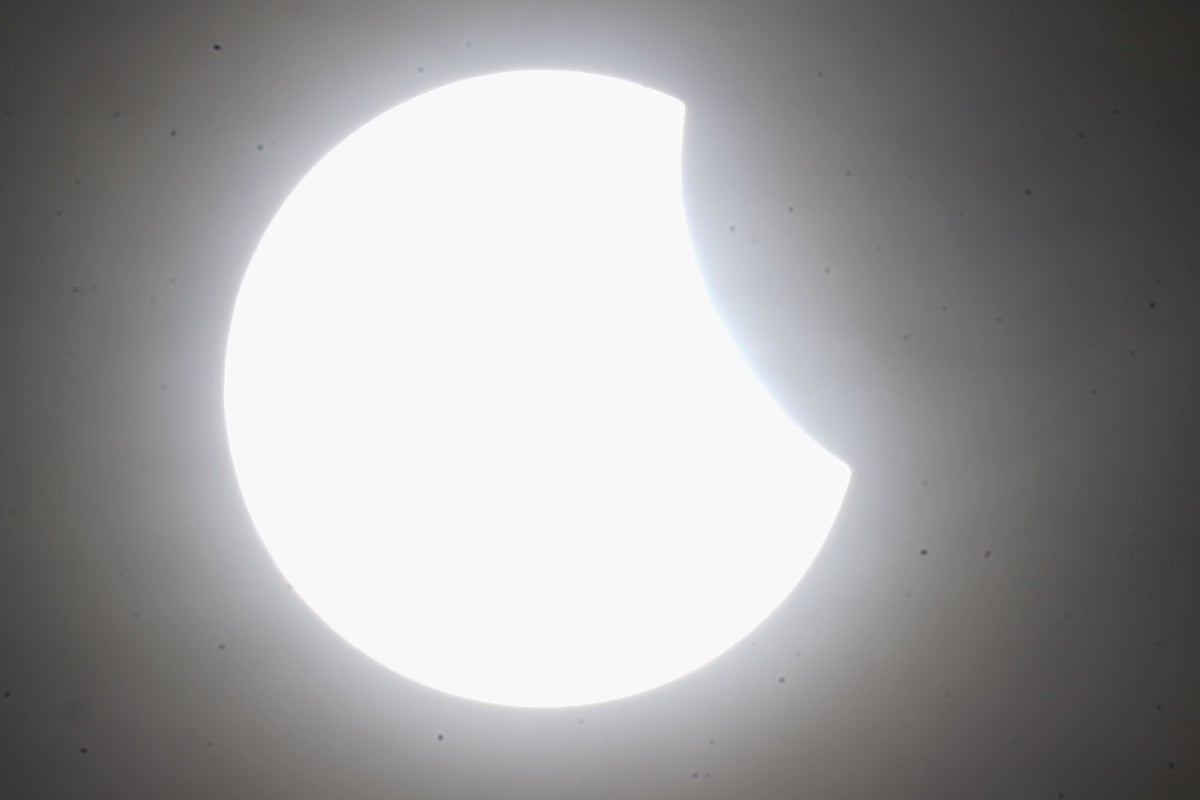
The best solar eclipse over the UK in decades is set to take place on Wednesday evening, as the Moon passes in front of the Sun.
People around the country are preparing for the rare spectacle – with travellers taking holidays, and the glasses that are required to see it safely causing long queues and quickly selling out.
While experts have urged the public to try and see the major astronomical event, they have warned that people should do so safely. Looking straight at the Sun, even during an eclipse, can cause significant damage to the eyes and even to phones, and viewers are warned to only do so using special equipment.
Swimmers and drivers have also been issued warnings ahead of the celestial spectacle, as tides surge and the sky darkens.
Follow here for all the latest and live updates on the times, places and best ways to see the eclipse, as well as the most stunning images from the rare display.
Key Points
- How to safely watch today's eclipse
- The best places to see the eclipse in the UK
- Long queues form for solar eclipse glasses
- Swimmers and drivers issued warnings
The best places in the UK to see today's solar eclipse
14:36 , Anthony Cuthbertson
The best place to see today’s eclipse is either in Iceland or Spain, though for those not fortunate enough to be under the path of totality, the UK still offers some great viewing opportunities.
The total solar eclipse sweeps down from the Arctic Circle across the North Atlantic to the Iberian Peninsula. It is only a few hundred miles off the coast of the UK, giving more than 90 per cent coverage throughout the country.
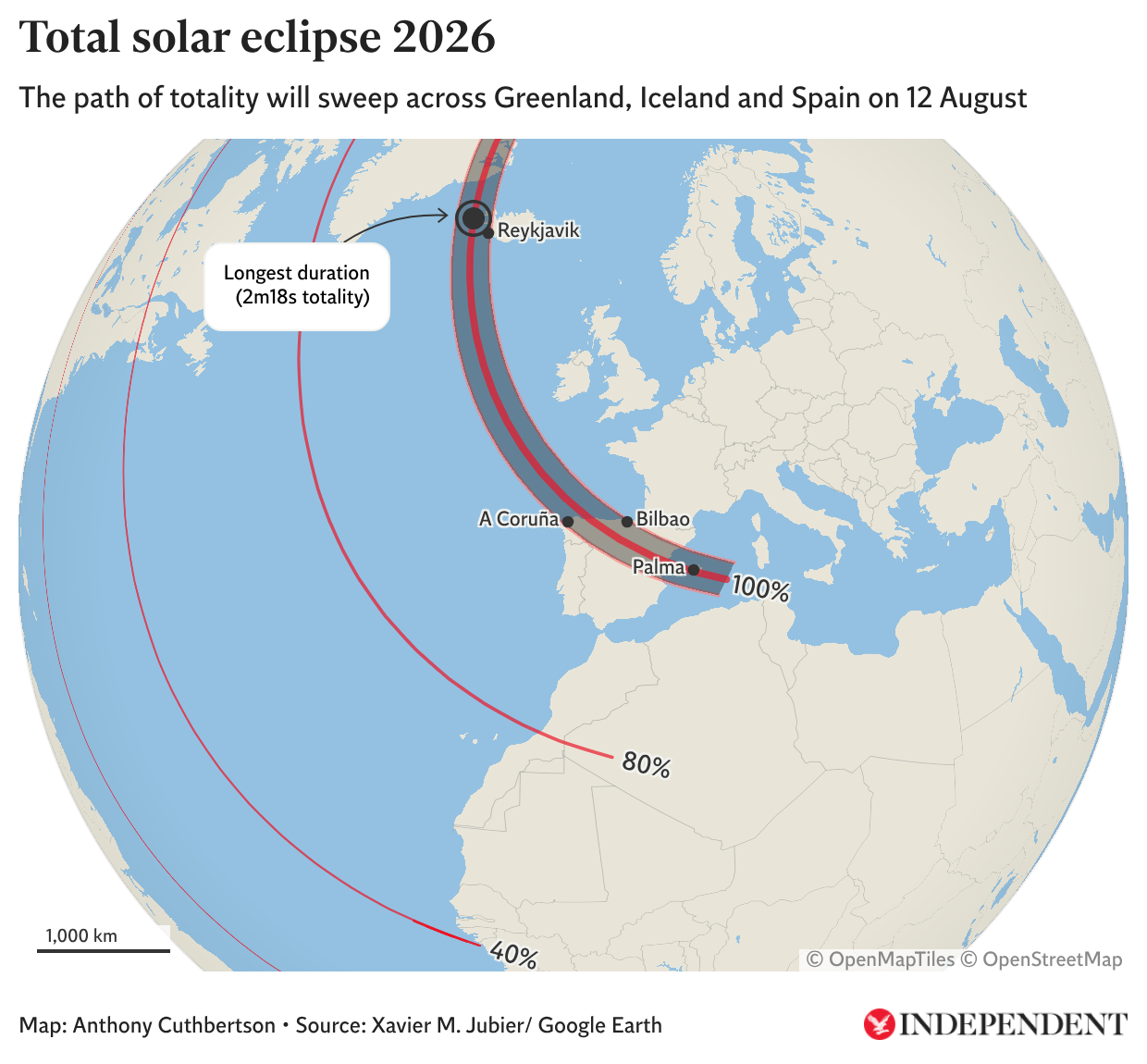
The Met Office has shared a map of the best places to witness the celestial spectacle, pinpointing Devon and Cornwall as prime locations.
You can find out more about the best times to view it here.
.png)
Swimmers and drivers issued solar eclipse warnings
14:06 , Anthony Cuthbertson
The RNLI has advised people to avoid swimming in the sea during this evening’s partial solar eclipse in the UK.
The charity said that strong tides meant that it would not be safe for swimmers, though this is not the result of the eclipse itself. Instead, the celestial phenomenon always coincides with a new moon, which is when tides are at their peak.
Motorists have also been warned about driving during the eclipse, with the reduced sunlight impacting visibility.
“While total darkness is unlikely, those with vehicles that don’t have automatic headlights or daylight running lights may need to switch on their dipped beams to ensure they are easily visible to other road users,” said RAC head of policy Simon Williams.
“The best advice to enjoy this rare event is to pull over somewhere safe and watch with specialist glasses.”
Drivers issued solar eclipse warning by RAC
The difference between a 99% partial eclipse and a total eclipse
13:29 , Anthony Cuthbertson
If you’re in mainland Europe (or Iceland), and anywhere near the path of totality, it’s worth making the trip to get under it.
Atmospheric scientist Matthey Cappucci has shared two images showing the difference between a 99.5 per cent partial eclipse and a 100 per cent total eclipse, and it’s night and day.
There is apparently a 10,000-fold dropoff in light as you enter totality, allowing you to stare directly at the fully-blocked sun with your naked eye.
“That's the only time when humans can EVER directly observe the corona, or the sun's atmosphere,” he says.
EUROPE GANG – If you're deciding whether to drive to totality for Wednesday's eclipse, I IMPLORE YOU – DO IT.
— Matthew Cappucci (@MatthewCappucci) August 11, 2026
This difference between a 99.5% partial eclipse and totality is night and day – literally!
There is a 10,000-fold dropoff in light as you enter totality. Only during… pic.twitter.com/0QjjmdoD69
How the solar eclipse could destroy your phone
13:07 , Anthony Cuthbertson
It’s not just your eyes that are at risk from the solar eclipse – your phone could also suffer from being exposed to the Sun’s intense rays.
Experts have warned that pointing a lens directly at the Sun, even when partially covered by the Moon, could cause permanent damage to a device.
Pointing a smartphone or digital camera at the Sun for a prolonged period could burn the photodiodes within the internal sensor, creating dead pixels that cannot be repaired.
The advice from Nasa’s space photography team is to “hold a pair of eclipse glasses in front of your phone’s lenses when photographing the Sun at any point other than totality.”
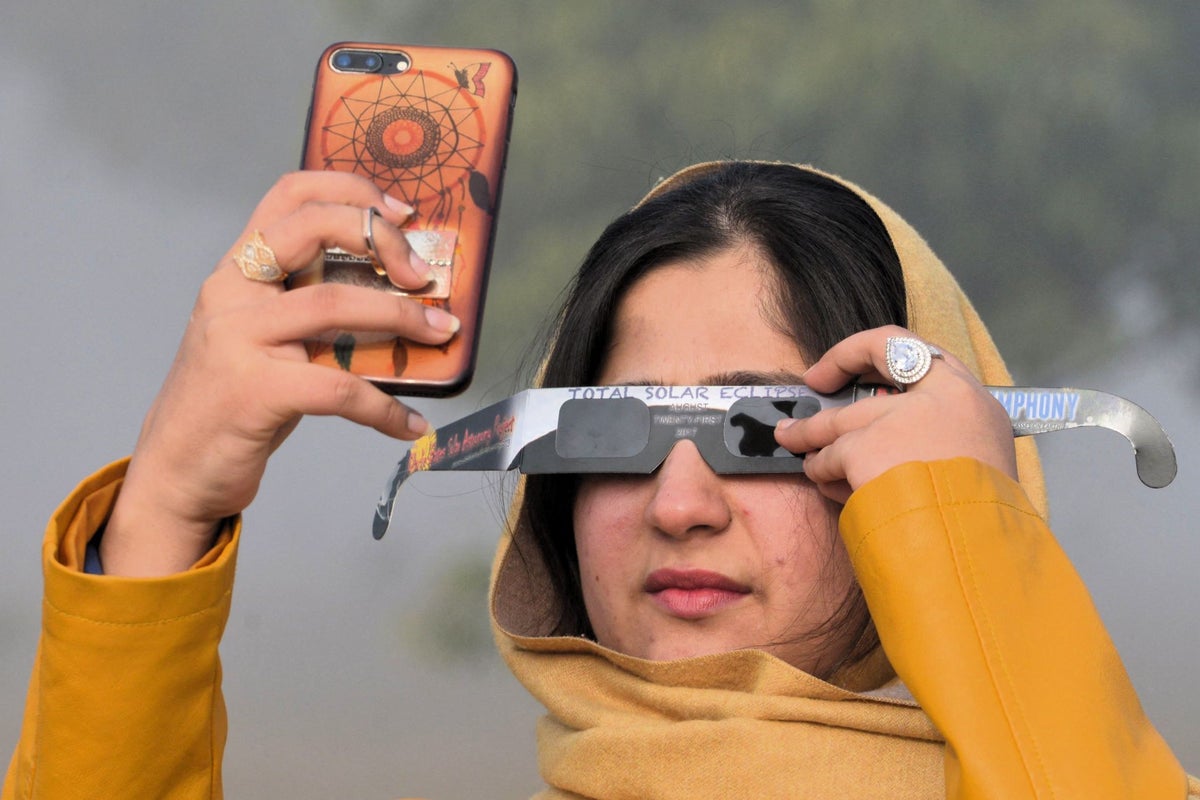
How to take a photo of the solar eclipse – without destroying your phone
What happens to your eyes if you look directly at the solar eclipse?
12:41 , Anthony Cuthbertson
A long queue may be a relatively small inconvenience given the potentially disastrous consequences of taking an unprotected look at the solar eclipse.
Even with the Moon covering more than 90 per cent of the Sun, it can still cause serious damage to people’s eyes. The light that remains is incredibly bright and looking straight at it could cause lasting issues, including blindness.
Any damage done may also not be immediately obvious, with the pain that results sometimes taking hours to set in.
“When you look directly at the sun, the bright light and ultraviolet radiation can damage retinal cells,” said Alex Ionides, a consultant ophthalmic surgeon at Moorfields Eye Hospital.
“This condition is known as solar retinopathy... Symptoms can include blurred vision, distorted vision, reduced colour perception, difficulty reading, or a dark spot in the centre of vision. In some cases, the effects improve over time, but permanent vision loss can occur in some cases.”
After the last comparable UK solar eclipse, in 1999, at least 70 cases of eye damage were

Why looking directly at the solar eclipse is even more dangerous than you think
12:28 , Anthony Cuthbertson
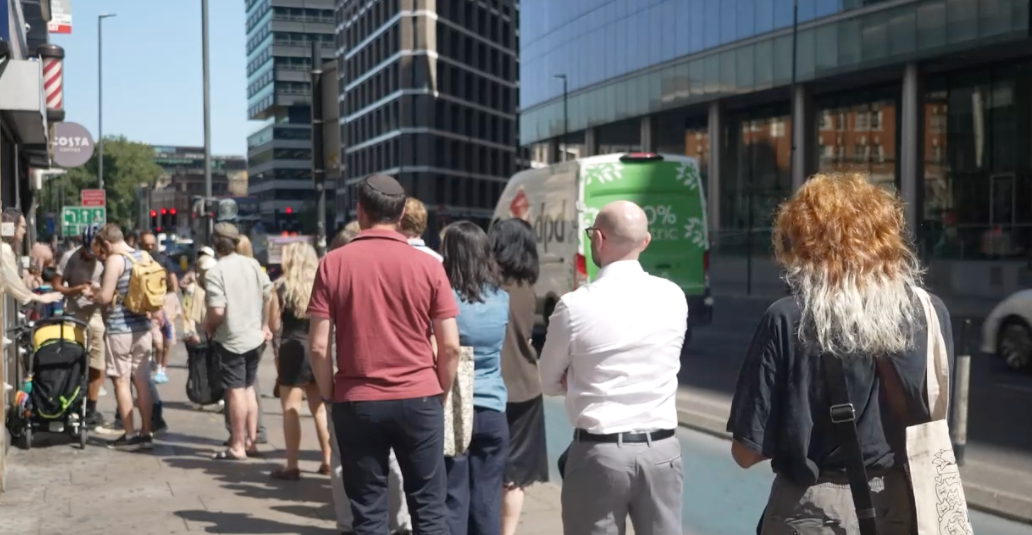
There have been reports of lengthy queues at retailers in the UK that still have solar eclipse glasses for sale.
Many shops and major retailers have already run out of stock ahead of this evening’s event, with some people travelling as far as Southampton and Birmingham to locate the specialist glasses at convenience stores in London.
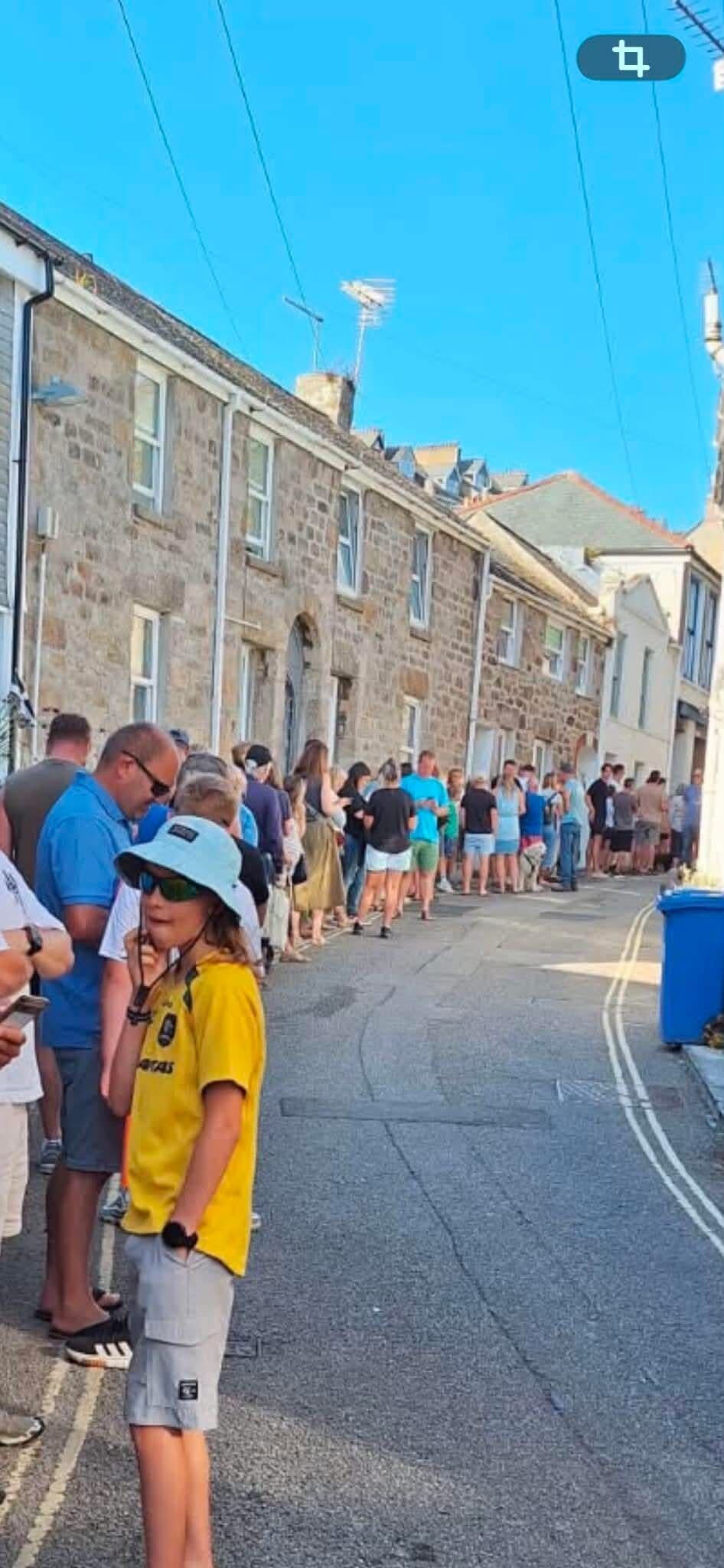
In St Ives this morning, a queue for solar eclipse glasses stretched nearly 200 metres from Techie mobile phone shop.
You can read – and watch – our very own Helen Coffey’s quest to get her hands on a pair of the coveted eyewear here:
.jpg?trim=140,55,294,341&width=1200&height=800&crop=1200:800)
Secret WhatsApp groups and mystery drops: My mad quest to get solar eclipse glasses
Watch partial solar eclipse live as UK and Europe witness once-in-a-generation spectacle
11:26 , Andrew Griffin
No glasses? No equipment? In the wrong part of the world.
Don’t worry – you can watch the solar eclipse live and online. Here’s a live stream that will let you do just that.

Watch partial solar eclipse live as UK and Europe witness rare spectacle
The best place to watch the solar eclipse? Airline reveals flight routes that will give a front row seat
11:25 , Andrew Griffin
Fancy watching the sky – from the air? Here are the flights that will give you perhaps the best view of the eclipse.
The best place to watch the solar eclipse? Flight routes that give a front row seat
Millions of people prepare for total eclipse
10:55 , Andrew Griffin
The UK won’t get a total eclipse this time – though in some parts, it will be quite near to total. However, in Spain and Iceland – where the eclipse will be total – millions of people are preparing for the spectacle, including travelling thousands of miles to get there.
Here’s a report from Reuters on what they’re up to:
Millions of people across Spain and Iceland geared up to witness a total solar eclipse on Wednesday, packing their protective glasses and travelling to areas where the rare astronomical event can be observed in full.
Humans' fascination with eclipses is well-documented. Historically, the sudden darkening of the sky was often interpreted as an omen, a cosmic struggle or a sign of divine power.
Modern-day skywatchers seek to experience the same uncanny sensation when day briefly turns into twilight and some animals fall quiet as the Moon passes directly between Earth and the Sun.
"I hope that tonight will see the emergence of a wonderful generation of astrophysicists," said Juan Cruz, Spain's Secretary of State for Science. "It's such a special moment."
Authorities were expecting up to 6 million visitors in mostly rural areas within the eclipse's path across northern Spain and the Balearic Islands, Cruz said. In Spain, the eclipse will be quickly followed by the sunset, making the event particularly alluring. Since this year's eclipse coincides with one of the highest-risk periods for wildfires, Spain has rolled out a massive police operation and public safety campaign. The government also views it as a chance to showcase seldom-visited regions and help address concerns about overtourism on the coast by redistributing crowds away from saturated beach resorts.
The Iberian Peninsula last saw a total solar eclipse in 1912. It is set to experience another one on August 2, 2027, and an annular eclipse in January 2028, completing the so-called "Iberian Eclipse Trio."
In Iceland's capital Reykjavik, eclipse glasses have been sold out for days as the Nordic country of roughly 400,000 people expects to welcome up to 80,000 visitors.
A narrow path of totality will reach Iceland's westernmost coast at about 5:44 p.m. (1744 GMT), before the Moon's shadow races east.
Totality will last up to 2 minutes and 13 seconds in the far west, though most cities will see shorter periods of darkness. Authorities have warned of heavy traffic and urged viewers to arrive early.
Singer Björk was due to perform a DJ set at an eclipse-themed event south of Reykjavik.
U.S. space agency NASA plans to fly a high-altitude WB-57 aircraft from Iceland to follow the Moon's shadow, and NASA-funded teams will launch balloons to study how the sudden darkness and cooling affect the lower atmosphere.
"Oh man, it's so cool," said Krista Kern, a visitor from North Carolina who described her expectations of totality as a "whole-body feeling," adding though she was nervous about the Icelandic weather.
Aside from casual observers, the event also draws "eclipse chasers", enthusiasts who crisscross the globe to be in the path of totality whenever an eclipse occurs.
Gordon Telepun, a retired plastic surgeon and amateur astronomer from the U.S. who has photographed six total eclipses, said he would watch from the island of Mallorca because Spain checked all the boxes for eclipse chasers.
"It has pretty reasonable weather chances in August, a decent totality duration at over one-and-a-half minutes and is easy to travel to," he said.
Reviewing the viral glasses that everyone wants to get their hands on
10:39 , Andrew Griffin
Eclipse glasses are today’s hottest commodity. Everyone wants some; very few people can get them. So our colleagues on IndyBest have reviewed the low-tech glasses that have become accidentally and unfortunately viral.
You can find it, on Instagram, here, or watch it below.
How, when and why to see the solar eclipse
10:19 , Andrew Griffin
Here's a helpful rundown from Daniel Brown, an astronomy expert at Nottingham Trent University, on what exactly is going to happen today.
“Deep partial eclipses of this scale are uncommon from the UK, and the next comparable event will not occur for many years. Even though we won't experience totality in the UK, this is still a wonderful opportunity to experience a remarkable astronomical event. With a bit of planning and some clear skies it should be a memorable evening for anyone who takes the time to look up safely,” he said.
“For this eclipse, totality – the length of time the Moon will cover the Sun – could last up to one minute and 40 seconds. It will begin in the UK at 6.06pm in Scotland and 6.17pm in Cornwall, when the Sun is only 22 degrees above the horizon. It will end at 8pm in the North and 8.06m in the South, with the Sun just five degrees above the horizon. Maximum coverage will occur at 7.02pm in the North and 7.16pm in the South.
“Because the maximum coverage will be 89% in the East and 95% in the West, for most of the UK we will notice a marginal dimming, similar to an impending thunderstorm. One of the most striking sights will be the shape of the remaining visible Sun, which will appear as a thin crescent with its points, or ‘horns’ facing downward.
“This isn't the easiest eclipse to observe because the Sun will be close to the horizon and cloud cover could easily get in the way. However, that low position also creates some fantastic photography opportunities. Think about how you might include a landmark, building or landscape feature in your photographs. If conditions are right, you'll be able to capture a beautiful crescent Sun above the horizon.
“It is important to observe safely, never to look directly at the sun with the naked eye, never use binoculars, telescopes or cameras without the appropriate solar filters, and to use certified eclipse glasses or indirect viewing methods such as pinhole projection.”
How to safely watch the UK’s most complete solar eclipse in 27 years
10:11 , Andrew Griffin
Tonight is going to be astonishing. But not if you cook your own eyeballs.
Here are some tips for how not to do that – and to watch the solar eclipse safely.
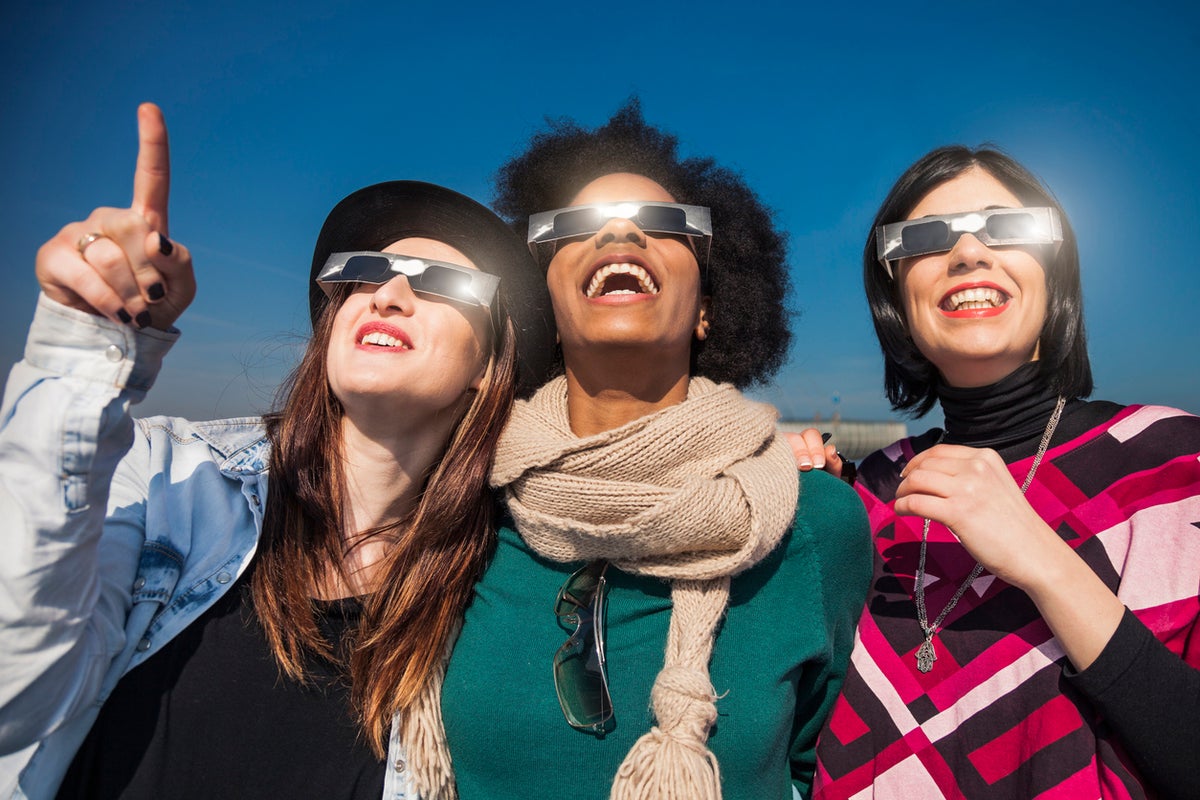
How to safely watch the UK’s most complete solar eclipse in 27 years
The stunning fireball Perseid meteor shower twinning with the solar eclipse
10:10 , Andrew Griffin
The solar eclipse isn’t the only thing to see tonight. We’re also right in the middle of the Perseid meteor shower, which happens to be one of the best of its kind, because there are lots of very bright “shooting stars”.
Here’s everything you need to know about that meteor shower, if you want to make tonight into a double bill:
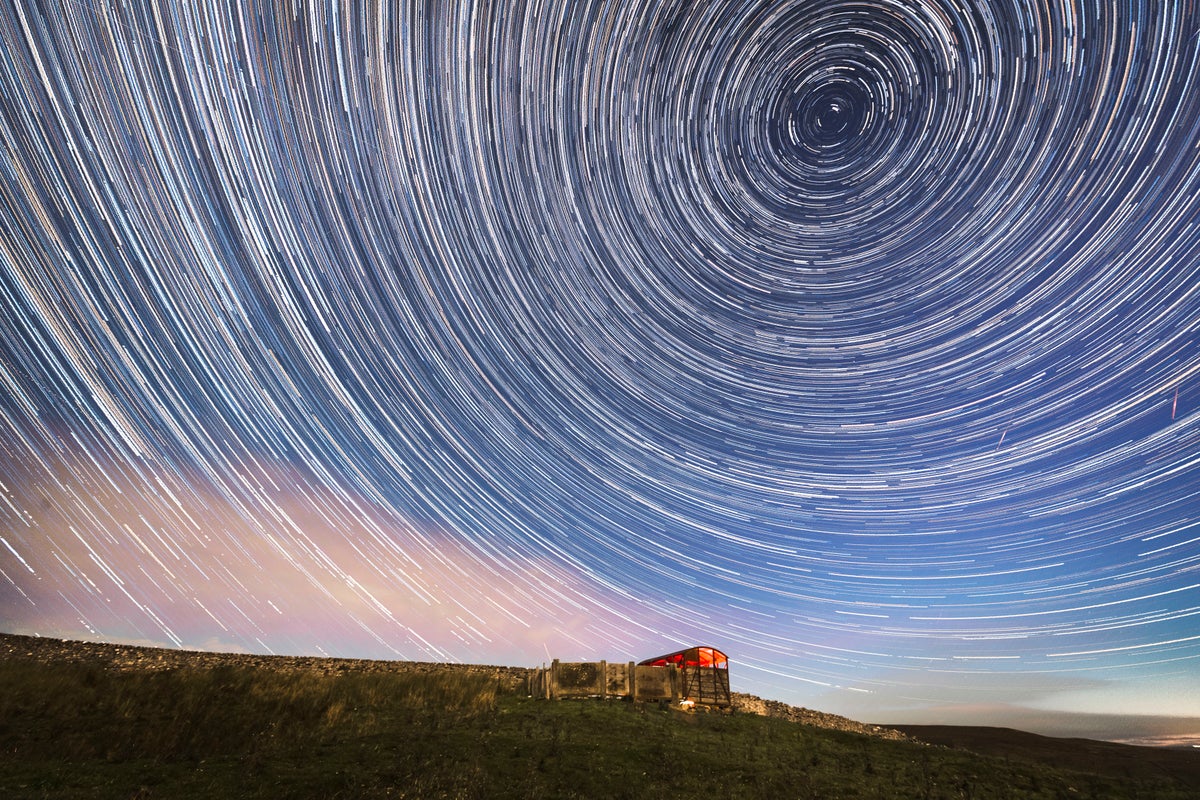
The stunning fireball Perseid meteor shower twinning with the solar eclipse
Don’t use electricity during the solar eclipse, Octopus Energy warns
09:51 , Andrew Griffin
Hopefully, when the eclipse arrives you’ll be out and watching it anyway. But if you aren’t, please don’t use your washing machine, says Britain’s biggest energy supplier.
The eclipse will lower solar-powered electricity generation just as people get off work and go home, when electricity demand often surges.
You can find the full explanation – and instructions on what to do – here:
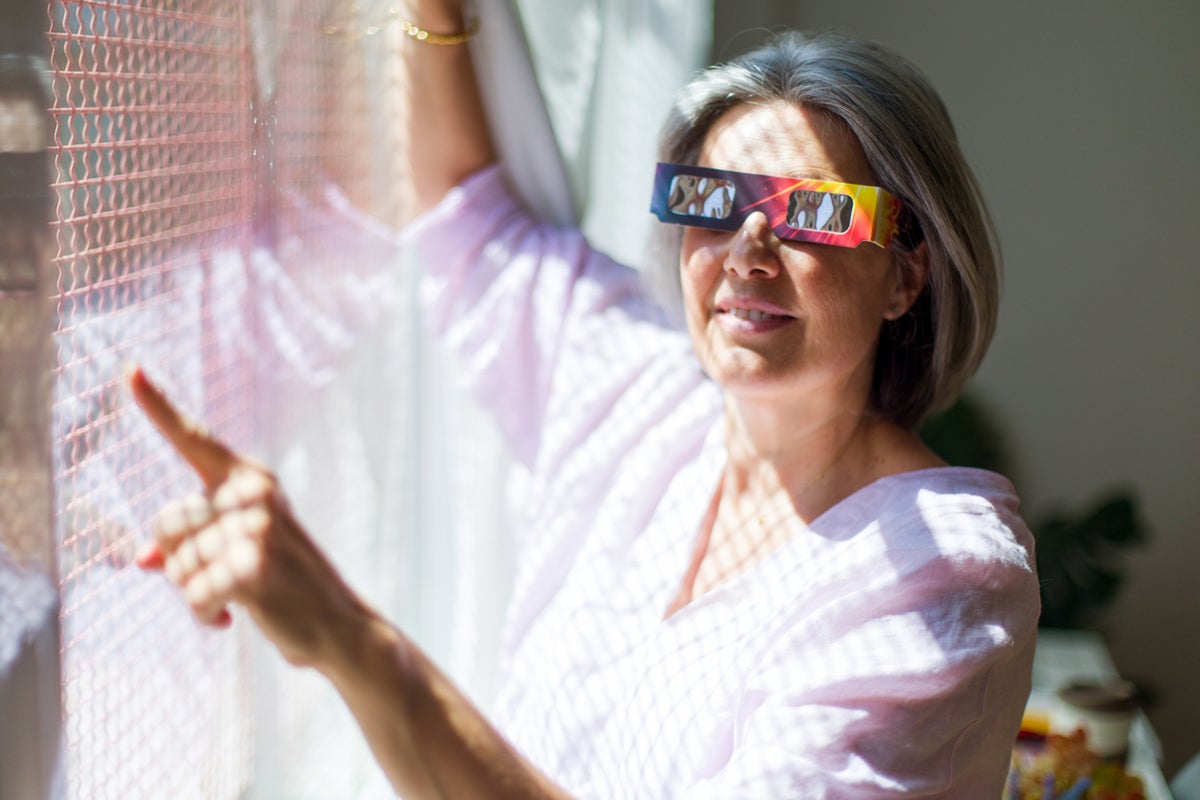
Don’t use electricity during the solar eclipse, Octopus Energy warns
What time is the solar eclipse? How and when to see today’s spectacular display
09:49 , Andrew Griffin
Working out exactly when the solar eclipse will arrive is slightly complicated: because it moves across the Earth at different times, and because of time zones.
Thankfully, my colleagues have pulled together a series of helpful maps that make working it out easy. You can find them here:
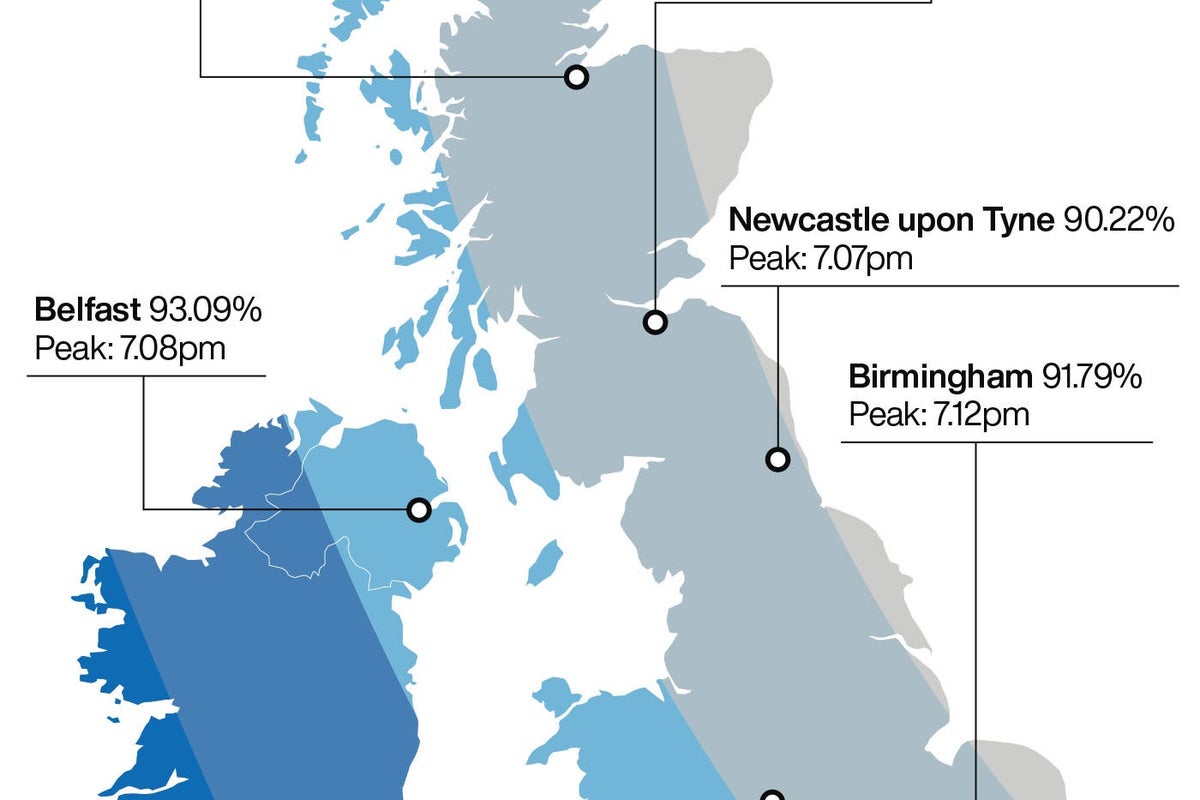
What time is the solar eclipse? How and when to see today’s spectacular display
Hello and welcome...
09:33 , Andrew Griffin
... to The Independent’s live coverage of today’s solar eclipse.