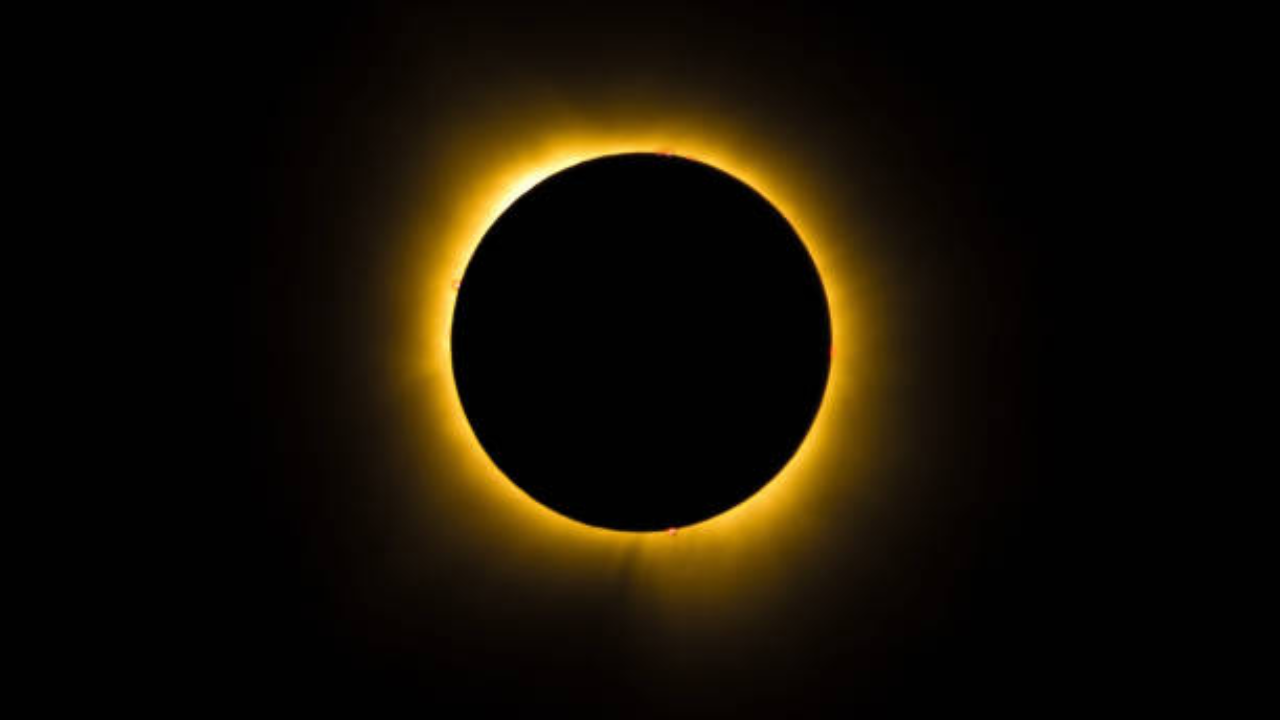
A celestial phenomenon is about to happen very soon. Solar eclipse will occur on October 2. "On Oct. 2, 2024, the Moon will pass in front of the Sun, casting its shadow across parts of Earth," NASA has confirmed.
This solar eclipse is being popularly called the "ring of fire". This annular solar eclipse happens when the Moon passes between the Sun and Earth while it is at its farthest point from Earth. Because the Moon is farther away from Earth than usual, it appears smaller than the Sun and does not completely cover the Sun. This creates what looks like a "ring of fire" in the sky.
So, at what time will the solar eclipse start? As per the Indian Standard Time, it will occur at 9.12 pm and it will end at 3.17pm.
Will the solar eclipse be visible to India?
No, the solar eclipse or the ring of fire will not be visible to India. "An annular solar eclipse will be visible in parts of South America, and a partial solar eclipse will be visible in parts of South America, Antarctica, North America, the Atlantic Ocean, and the Pacific Ocean, including Hawaii," NASA has said.
Specifically, the annular solar eclipse will be visible in parts of Argentina and Chile. The partial solar eclipse will be visible in all or parts of American Samoa, Antarctica, Argentina, Baker Island, U.S. Minor Outlying Islands, Brazil, Chile, Christmas Island, Clipperton Island, Cook Islands, Falkland Islands, Fiji,
French Polynesia, Hawaii USA, Mexico, New Zealand, Niue, Palmyra Atoll U.S. Minor Outlying Islands, Paraguay, Pitcairn Islands, Samoa, South Georgia and South Sandwich Islands, Tokelau, Tonga, Tuvalu, Uruguay, Wallis and Futuna.
As per Space, the moon's shadow during the solar eclipse will move faster than the speed of a fighter jet. "The moon's shadow will appear to travel at vastly different speeds depending on your location. In some places, it will move faster than 6 million mph (10 million km/h); in others, it will travel as slow as 1,278 mph (2,057 km/h), or about the speed of a fighter jet."
Is it safe to see the Sun during a solar eclipse even when the eclipse is not visible to your area?
Even during a solar eclipse that is not visible in your area, be cautious when trying to look at the Sun. During a solar eclipse, total or partial, direct observation of the Sun's rays is extremely dangerous to the eyes. But if the eclipse is not observable at your place it does not mean that you can see the Sun directly. Gazing at the Sun directly naked-eye at any time, apart from an eclipse, can permanently damage the retina; a condition termed as solar retinopathy.
However, when the eclipse is not visible in your locality, you may not need special solar viewing glasses or filters; however, other precautions must be taken if you are observing the Sun. Never look at the Sun directly as it can damage your eyes. The Sun should be viewed through specialized solar filters, eclipse glasses, or indirectly through pinhole projectors.
Precautions to take during solar eclipse
During a solar eclipse, it's crucial to take precautions to protect your eyes from permanent damage. Never look directly at the sun, even during the partial phases of the eclipse, as the intense sunlight can cause retinal damage. Always use proper solar viewing glasses, which are specially designed to block harmful ultraviolet and infrared rays. Regular sunglasses are not sufficient for this purpose. Alternatively, you can use indirect viewing methods like pinhole projectors to safely observe the eclipse.
It's also important to supervise children closely, ensuring they use protective eyewear when viewing the eclipse. If you plan to take photos, use a solar filter for your camera or telescope to avoid damaging the equipment and your eyes. In some regions, temperature drops may occur, so it's wise to have appropriate clothing. Remember, safety comes first during a solar eclipse to avoid long-term eye injury or other hazards.