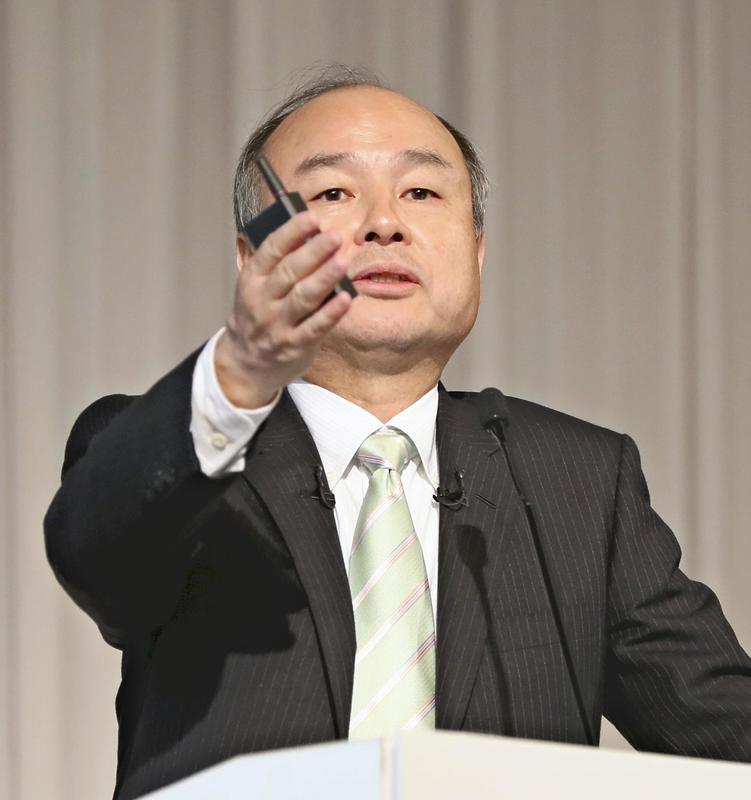
Most companies that sell products or services focus on sales or operating profits, which indicate the returns from their main business, but Masayoshi Son, chairman and chief executive officer of SoftBank Group Corp., takes a different approach. He insists that the value of the shares held by his company is more important, an outlook more typical of an investment company.
"Operating profit and sales aren't relevant. What's important is the value of the assets we hold," Son said at a press conference in Tokyo on Wednesday, the same day the group announced its results for the April-December 2019 period.
Most of the group's sales come from turnover at two companies under its umbrella -- major mobile phone operator SoftBank Corp. and Sprint Corp, the fourth-largest mobile network operator in the United States. This formula is standard at other companies.
However, in 2017, SoftBank Group established the 10 trillion yen SoftBank Vision Fund for investing in promising startup companies. By autumn 2019, the fund had poured money into 88 companies, and the group has increasingly been taking on the nature of an investment company.
The value of shares held by the group increased from 26 trillion yen as of Sept. 30, 2019, to 31 trillion yen as of Feb. 12. Son suggested that, since the group is effectively an investment company, greater attention should be focused on the value of shares held by the entire group as a result of its investments.
How results are reflected
SoftBank Group recorded an operating loss of 12.9 billion yen for the nine months from April to December 2019, but Son suggested this was not a suitable yardstick for assessing an investment company.
Just how much the value of stock holdings are reflected in SoftBank Group's profits depends on whether the group holds the shares through the Vision Fund, or possesses them directly.
Companies in which the group has invested but that are performing particularly badly include The We Company, a major U.S. firm that provides shared workspaces, and Uber Technologies Inc., a leading U.S. ride-hailing business. Both of these companies are under the Vision Fund's wing, so under accounting rules, a drop in the value of the shares held must be reflected in the operating profit. Consequently, the fund business chalked up an operating loss of 797.7 billion yen. This deficit is included in SoftBank Group's settlement of accounts.
Conversely, the share prices of companies in which SoftBank Group has directly invested are not included in the operating profit, as regulations do not allow the group to be considered an investment fund. The group directly holds shares worth 16 trillion yen in major Chinese IT firm Alibaba Group Holding Ltd., but this figure is not reflected in SoftBank Group's settlement of accounts. This mirrors the fact that a typical company's business performance will not be affected even if the value of a subsidiary increases.
Vocal shareholder emerges
In early February, it was revealed that U.S. investment fund Elliott Management Corp. -- which is known as a shareholder willing to speak its mind -- had acquired about 3% of SoftBank Group's shares. Elliott's interest was piqued by the group's low market valuation. As of Wednesday, the group's aggregate market value was 12 trillion yen, based on its stock price. Subtracting liabilities such as loans from the 31 trillion yen value of stocks held by the group leaves 25 trillion yen -- making the aggregate market value still about 13 trillion yen too low.
Share values can fluctuate quickly. If an unexpected event occurs, such as the recent emergence of the new coronavirus, the performance of companies in which SoftBank Group has a stake could rapidly deteriorate and their share prices could plummet.
According to sources, Elliott is pressing SoftBank Group to sell shares in Alibaba, which have surged in value, and other stock, and to make stock buybacks of up to 20 billion dollars (about 2.2 trillion yen).
At Wednesday's press conference, Son remained bullish and said the share prices of startup companies were trending upward. "The tide has changed," he said.
Despite this, a planned new fund worth 10 trillion yen has been put on ice for now, and Son indicated a wait-and-see approach would be taken with a smaller fund. Following the arrival of a stockholder vocal about what it wants, the group will need to provide greater transparency in its investment policy and management setup.
Read more from The Japan News at https://japannews.yomiuri.co.jp/