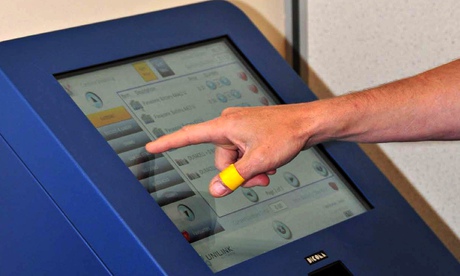
Sodexo, one of the big winners in the government’s scramble to privatise probation, intends to make hundreds of probation staff redundant (Report, 31 March). This flies in the face of research from around the world, including ours in Jersey, which shows that skilled probation staff are up to twice as effective as less skilled staff in reducing offending by the people they supervise. Kiosk reporting, as used by some American jurisdictions, may free up some staff time to concentrate where they are most needed but should not be used as a substitute for skilled staff. Probation officers have argued for years that privatising probation risks putting profits before safety. Is Sodexo about to prove them right?
Emeritus professor Peter Raynor
Emeritus professor Maurice Vanstone
Department of criminology, Swansea University
• Biometric reporting kiosks have already been piloted in a very limited way in one area in London. Of the three kiosks purchased, only two have ever functioned and only one has ever worked consistently, with a very low take-up rate. They have proved to be extremely unreliable and expensive. An evaluation concluded that savings across London from probation staff time would be approximately £49,000 but the costs of deploying them would be £500,000. As for call centres, can you can imagine service users phoning a call centre and being asked to select option 1 if they have committed an offence or option 2 if they are suicidal?
Pat Waterman
Chair of NAPO Greater London Branch
• The proposed compulsory redundancies of probation officers and staff will no longer be counted as a public-sector cut, but as private-sector cuts. The effect will be the just as severe but deliberately hidden. Not just a risk to jobs, these hasty and rash cuts, proposed after just eight weeks of ownership, place the public at risk in ways that Sodexo seems unable to grasp.
This is what rolling back the state looks like: public money allocated for the rehabilitation of offenders in the community, now transferred to the private sector so that they can choose the cheapest way of complying with short-term targets. The next government faces an urgent challenge to hold these new owners to account for public safety while urgently reviewing the sustainability of the opportunism so quickly demonstrated by some.
Helen Schofield
London