Todays top Society Guardian stories
Gordon Brown announces public sector pay freeze
Child protection reforms will cost millions
Political parties clash over cost of care for the elderly
Failure to reduce reoffending rates of short term prisoners costs £10bn, says report
Evaluation of Jon Venables prior to his 2001 release concluded be posed 'trival' risk to public
All today's Society Guardian stories
Highlights from today's Society Guardian
Tom Clark asks if social mobility has ground to a halt
Glasgow council is making massive cuts - can others learn from their experience?
Profile: Joe Gerstein, the addiction campaigner who says AA doesn't work
Eric Allison on new starts for ex-offenders
All today's Society Guardian stories
Other news
* Confidential patient records are being placed online without consent, the Daily Telegraph reports
* A psychiatric report prepared ten years ago that led to the release of Jon Venables concluded that he posed a "trivial risk" to the public, according to the Times
* The civil servant who headed the government's programme of personalised social services, John Bolton, is quitting to set up his own consultancy, reports Community Care
Apathetic eating
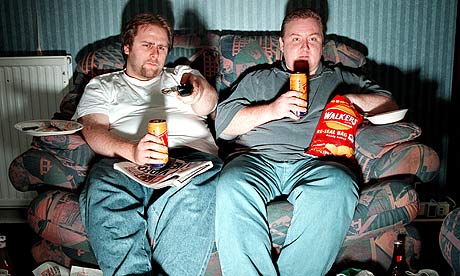
Why are the very poorest and most socially excluded people most likely to be unhealthy? Apathy it seems, plays a big part. When asked by researchers in a study published today what were the main barriers to a healthy lifestyle, over half answered: "laziness." The study, Reaching Out, also found "lack of money" was blamed by half the respondents for preventing them getting fit. One in five believed their unhealthiness was genetically inevitable, because all their family were in poor health too. And most didn't see their sedentary lifestyles and poor diet as risks to their health: 84% said "they did not really worry about their health at the moment."
The study of 258 "hard to reach" individuals in the North west of England (where 50% of the population is classified as 'deprived') by ourlife, Pfizer and NHS north west, suggests that this group was unaware that they were in poor health (or in denial about it). While rates of clinical obesity were high (26%) only 7% believed themselves to be overweight. When it came to alcohol there were similar findings: 40% regularly drank to excess; just 6% believed they were binge drinkers. There was slightly more self awareness when it came to nutrition: of the 72% that had an unbalanced diet, 59% realised they were eating badly.
But being unhealthy, suggests the report, didn't feel particularly out of the ordinary to many respondents: over half of those who were clinically overweight regarded themselves "as being as healthy as others in their community."
The NHS has struggled to improve the health of the worst off, and the report suggests it may not be best placed to conduct health promotion campaigns. Respondents felt the health service had little overall influence on their general health and lifestyles: most went rarely to their local health centre, believing the GP to be someone they go to only when acutely ill - not for health advice. Of the 16% who had visited their GP in the past year, the majority went to get certification for illness benefit payments.
Those surveyed were stubbornly ignorant of conventional health promotion campaigns. But they were receptive to the idea that financial incentives could change their lifestyles: the offer of free swimming and fitness classes was popular, as was the concept of fee vouchers for food and vegetables.
Society Guardian events
The Public Procurement show. The UK's leading event for public sector procurement. 15-16 June, ExCeL, London
Society Guardian links
Sign up to Society daily email briefing
Public - The Guardian's website for senior public sector executives
Get ahead: the Guardian's public and voluntary sector careers page
Hundreds of public and voluntary sector jobs
Email the SocietyGuardian editor: society@guardian.co.uk