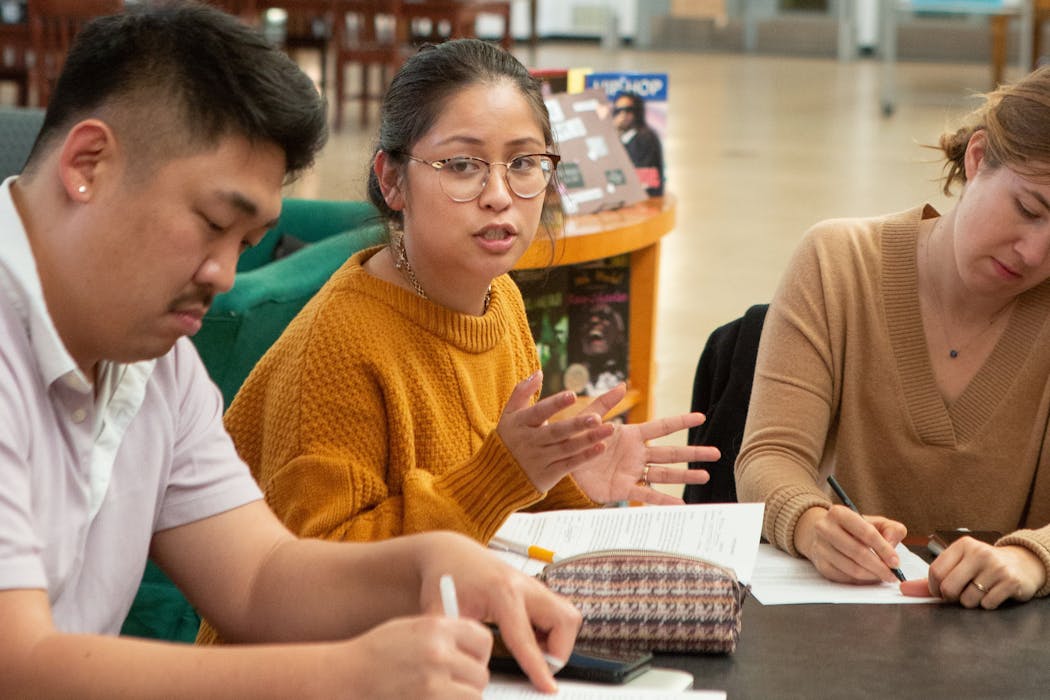
With a world literally and figuratively burning around them, high school social studies teachers are charged with engaging students in sensitive topics.
Social studies curricula today, for example, is concerned with themes like residential schools and racism. It’s also important to understand that beyond following explicit pre-set curricula, student-centred education calls for teachers to attend to students’ experiences in the social world.
This means making space for students’ observations or questions about current events like the ICE raids in Minnesota and inquiring into how unfolding events fit into larger social and historical patterns or themes. These conversations are a legitimate and everyday part of many social studies classrooms.
Social studies education demands sustained engagement with difficult knowledge and a heightened sense of obligation to both students and society, even as neoliberal and neoconservative pressures call for a stance of neutrality, which is neither possible nor desirable.
The weight of difficult knowledge
While teaching is widely recognized as stressful and teachers struggle with burnout, the relationship between that stress and specific subject curriculum is under-explored.
Social studies teachers are often required to dwell in the dark places of what Deborah Britzman, who researches the history of psychoanalysis and education, calls difficult knowledge. This pertains to traumatic histories that expose human vulnerability or violence — knowledge that is too much to bear or “make sense” of.
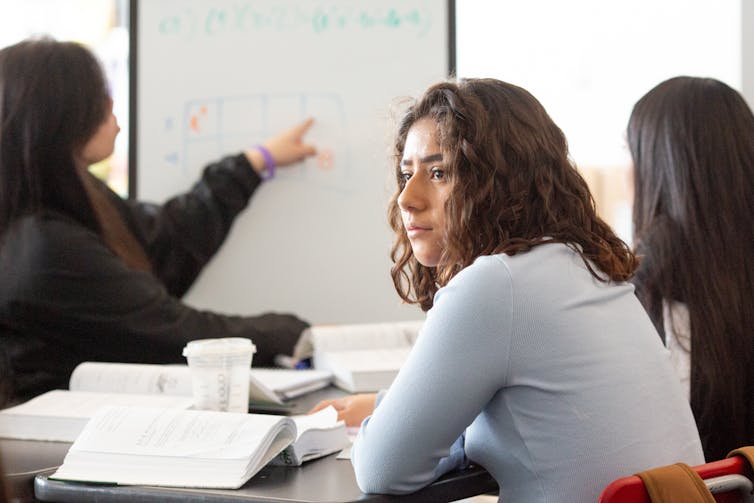
While teacher stress, burnout and demoralization are well-studied, the weight I’m thinking about in my doctoral research and as a social studies teacher comes from social studies’ teachers’ sense of obligation to their students in this moment, to their discipline and to democracy — and the way carrying this weight exacts an emotional toll.
In this way, teaching social studies differs from other subjects. While all teachers are burdened by increasing demands, overburdened systems and rising public attacks from the “parental rights” movement, social studies teachers face the distinct additional task of guiding students through difficult knowledge, pressing global issues and contentious dialogue.
Pressures outside the classrooms
For example, immediately following the Hamas attacks in Israel on Oct. 7, 2023, and Israel’s subsequent military assault on Gaza, students in my rural Manitoba high school social studies class approached me with the expectation that I could help them understand what was happening.
In that moment, I became acutely aware not only of the obligation I felt to help my students, but also of the simultaneous contexts and pressures shaping how I might respond. I knew how deeply divisive this issue was in the public sphere, and consequently how any discussion that included Palestinians, Israeli state violence or historical context could be interpreted as taking sides beyond the classroom.
Read more: Flawed notions of objectivity are hampering Canadian newsrooms when it comes to Gaza
It would have been simpler to just not engage with the topic. Yet, as a social studies teacher, I carried what I experienced as an emotionally weighty obligation to my students, the curriculum and to act in a way that reflected a broader moral responsibility. This led me to seek to understand, in my current doctoral research, how other high school teachers in Manitoba were experiencing their work.
My early findings from focus groups and qualitative interviews with approximately 20 Manitoba social studies teachers suggest these teachers experience a significant emotional toll linked to their sense of obligation to students and to the betterment of humanity.
Throughout this early research, Israel/Gaza has frequently been named as a flashpoint in classrooms, with many teachers expressing hesitation about engaging with the topic due to fears of backlash from parents, administrators or the broader community. In this sense, the weight of teaching difficult knowledge is not only personal, but collective and structural.
A ‘neutral space’ isn’t possible
A factor shaping pressures teachers perceive in how they guide and support difficult discussions is a dominant misinformed belief that the classroom is, or should be, a “neutral space” — an expectation that is neither possible nor desirable.
Read more: How to curb anti-Black racism in Canadian schools
Teaching is inherently political insofar as it explicitly or implicitly validates or excludes certain perspectives and voices. The social studies classroom is never a neutral space.
What is taught — what some researchers call the explicit curriculum — is the result of political decision-making by curriculum developers appointed by politicians. What is left out (what some have called “null” curriculum) is equally political.
Myth of neutrality
Even the expectation of neutrality is political: choosing not to take a stance is itself a decision with ethical and political consequences. Teachers’ classroom choices, their responses to students, the framing of discussions, the arrangement of the classroom and even the ways they present themselves are all laden with values.
Read more: Education for reconciliation requires us to ‘know where we are’
Expecting teachers to remain neutral ignores this reality and creates a false tension between “being impartial” and fulfilling professional and ethical obligations. Allowing a student’s derogatory or historically false comment to pass unchallenged, for example, is a political choice.
The myth of neutrality pressures teachers to self-censor and avoid contentious issues, contributing to emotional and professional strain.
Engagement with contentious issues required
Contemporary curricula increasingly emphasize global competencies, with critical thinking as a central goal.
Because the classroom is inherently political, teachers must make choices about how to engage. One approach, described by education scholar Thomas E. Kelly as “committed impartiality,” encourages teachers to share their own beliefs while welcoming all opinions and fostering dialogue.
This framework helps teachers respond thoughtfully when students express ideas carelessly or provocatively, guiding classroom discussion in ways that promote critical thinking.
Read more: 4 ways to empower students to spark social change
Whichever approach is taken, classroom interactions take place within the “lived curriculum,” — how students experience what happens in a class.
Sharing weight, creating hope
If teachers feel unable to address the deaths of more than 70,000 people in Gaza or to critically look at the American government’s excessive use of force that has resulted in the deaths of civilians or to recognize the impact of human-caused climate change, what does this say about our collective ability to confront urgent crises and foster informed, empathetic democratic citizens?
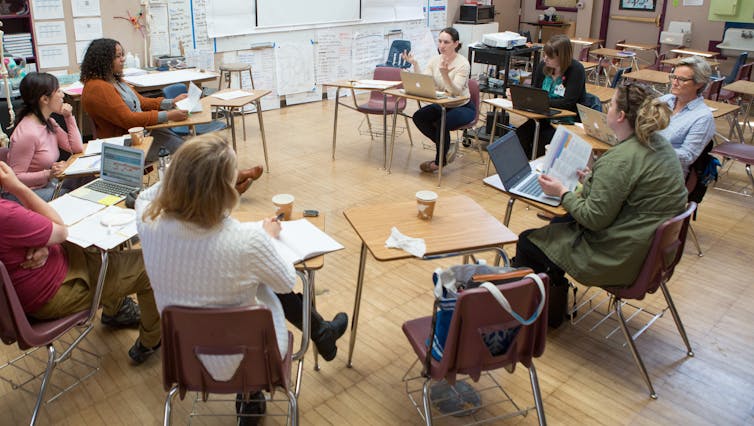
By creating space for social studies teachers to share how they experience their work, feelings can be acknowledged and named. This can be part of offering teachers tools to practise self-inquiry to help inform responsible and sustainable classroom practise.
Like teachers’ work with students, these conversations may be messy, emotional and deeply human, and they may even make us want to retreat into isolation. But we are better when we can recognize and name the weight, lean into the collective and remain in the work together.
As I begin to analyze my research with social studies teachers, I am struck by a sense of hope in the ways they continue to engage in difficult conversations. What stands out is not denial of the darkness, but a persistent commitment to hope through teaching that encourages students to act, respond and participate in shaping a more just world.

Kevin Lopuck is affiliated with the Social Studies Educators Network of Canada.
This article was originally published on The Conversation. Read the original article.