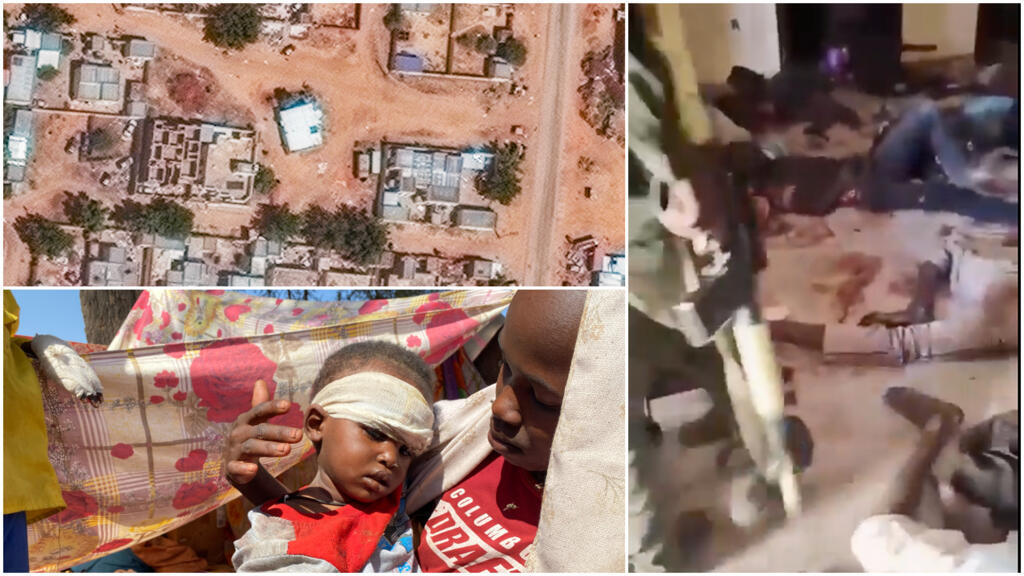
New analysis of online videos, satellite images and eyewitness accounts has painted a chilling picture of atrocities committed during the capture of El-Fasher, the capital of North Darfur, by Sudan’s Rapid Support Forces. The findings reveal a campaign of violence against civilians that researchers say could constitute war crimes.
Investigations by the Sudan War Monitor and Yale University’s Humanitarian Research Lab drew on open-source material shared on social media by the paramilitaries themselves. Their findings offer damning documentation of the brutality that followed the RSF’s assault on 26 October.
One video shows RSF fighters moving through the Saudi Hospital in El-Fasher, stepping over bodies strewn across the floor.
At one point, a wounded patient tries to sit up before being shot at close range. A fighter can be heard shouting, “There’s one still alive – kill him!”
Then the person filming walks outside, where dozens more corpses in civilian clothing lie scattered in the hospital courtyard.
These videos weren’t leaked by whistleblowers – they were filmed and posted online by the RSF themselves.
Fighting spreads to North Kordofan as Sudan’s war turns deadlier
Rape threats, ransom demands
After analysing dozens of videos and gathering testimony from survivors, the Sudan War Monitor concluded that paramilitaries swept through neighbourhoods, hospitals and homes, executing civilians – sometimes along ethnic lines.
The collective of journalists and open-source researchers said that other footage filmed outside El-Fasher showed bodies dumped in mass graves or abandoned along rural roads, suggesting that victims were killed while trying to flee.
Among the most shocking clips is one showing a female RSF member urging her comrades to “go and rape the women”, an indicator of the sexual violence reported across Darfur since the conflict reignited in April 2023.
In another recording, RSF fighters taunt kneeling captives – including a man identified as Dr Abbas, a respected psychology professor from El-Fasher University – as they demand ransom money from their families.
Another video shows an officer, known by the nickname Abu Lulu, mocking civilians moments before executing them.
A video shared online apparently shows RSF fighter Abu Lulu, accused of atrocities in Darfur, going free after the paramilitary group claimed to have arrested him at the end of October.
France, UN call for a ceasefire in Sudan amid mounting reports of atrocities
Blood visible from space
Satellite analysis conducted by Yale’s Humanitarian Research Lab, published this week, adds another layer of evidence. Using news reports and social media to identify sites of potential abuses, its experts scanned satellite pictures of the areas and observed dark shapes and red discolouration that they believe are likely bodies and blood.
According to Nathaniel Raymond, the lab’s executive director, the images suggest that mass killings began immediately after the RSF entered El-Fasher, and may still be continuing today.
His team has been tracking the conflict since it erupted in April 2023 between the RSF, commanded by General Mohamed Hamdan Dagalo, and the Sudanese Armed Forces loyal to General Abdel Fattah al-Burhan.
Seizure of Sudan's El Fasher a 'political and moral defeat' for RSF militia: expert
Its research offers a glimpse into a war that the world is struggling to see. With several journalists missing or imprisoned in Darfur and communication networks collapsing, open-source intelligence has become one of the only ways to trace what’s happening on the ground.
Raymond notes that this kind of documentation could one day help international prosecutors build war crimes cases. “The nations of the world might be able to say that they could not have stopped it,” wrote the Humanitarian Research Lab, “but they cannot reasonably say that they did not know.”
“The paramilitaries are collecting bodies and placing them in mass graves”
Interview with Nathaniel Raymond, executive director of Yale University's Humanitarian Research Lab
RFI: How did your team use satellite images to identify victims of atrocities in El-Fasher?
Nathaniel Raymond: We reached these conclusions by analysing shapes between 1.3 and 2 metres long that appeared in our satellite images right after the fall of El-Fasher. These shapes were found in locations where RSF fighters filmed themselves killing civilians. The average length of a human body seen from space is around 1.3 to 2 metres, so we’re confident these are human remains. What’s more, the shapes stay in place for several days – and new ones keep appearing.
Were you able to determine where these bodies are located?
Yes. We confirmed that a massacre took place at El-Fasher’s Saudi Hospital. In our satellite images of that same site, we can clearly see these same shapes – so we believe they are bodies. Around the hospital, our images also show reddish areas consistent with bloodstains.
We also have evidence that the paramilitaries are now collecting bodies and placing them in mass graves.
How can you tell that from satellite images?
From one image to the next, we can see them digging holes, putting in objects that match the size and shape of bodies, and then covering them. As we speak, there are two new mass graves near a neighbourhood where massacres were recently reported.
These images are just 24 hours old. We’re gathering new imagery every six to 12 hours.
Does that mean the killings are still going on?
Yes. We’re seeing new stacks appearing in different parts of the city. There are still many civilians in El-Fasher, and we believe they remain in danger.
Have you been able to estimate the number of dead?
There are simply too many to count. We’re trying to develop a computer programme to help us, but often the bodies are piled on top of one another. So we try to calculate if the volume of these shapes changes over time.
In recent days, we’ve also observed trucks arriving – which suggests the paramilitaries are cleaning up the area.
These images are shocking. Could they serve as evidence of war crimes?
That will depend on the international community. So far, it hasn’t acted.
But yes, they could... We’ve already worked with the International Criminal Court on cases that involved satellite imagery.
This article was adapted from the original French version by RFI's Alexandra Brangeon.