Kick It Out has called for the football authorities, internet companies and the police to collectively consider the action they may take about the huge tide of racist and other discriminatory abuse spewing on social media but an initial reaction is surely basic despair.
Given what some black players and the former player turned broadcaster Stan Collymore have publicised of the vile racism they have been sent, we should probably not be shocked. However, to see the figure of 134,400 racist, homophobic, sexist and other discriminatory posts, possibly amounting to hate crime, sent by people from August to March this season, relating to the great clubs and players of the beautiful game, is profoundly depressing. What can be done about it is a difficult question that should be considered only after registering sadness and outrage that hate of such enormity is being generated in 2015.
It always felt askew that Mario Balotelli, who has suffered overt racism throughout his difficult childhood and football career in Italy, should have been himself disciplined by the Football Association, banned for a game and fined £25,000, for posting an image of racist content on Instagram. Balotelli argued in mitigation he had not realised the image was offensive and that he himself has”suffered from racism on a great number of occasions”.
In England, we tend to hug ourselves these days with smug satisfaction that such things rarely happen here; pointing in outrage to racism elsewhere, including the shocking remark by the former Italy manager Arrigo Sacchi in February that the country’s youth team had “too many black players.”
Yet the figures collated for Kick It Out by Tempero, the social media management agency, and Brandwatch, the social intelligence and analytics company, show what a storm of filth is aimed at Balotelli here, while he is playing for Liverpool in the Premier League. The search of social media using his name and racist and other abusive terms, refined to identify direct abuse in tweets or other messages, found that more than 8,000 were directed at him up to March this season. The research found that more than 52% of those posts, so well over 4,000 in seven months, were racist. That is what Balotelli endures and whatever criticisms are made at times of his performances or unconventional attitudes, it is remarkable he and other footballers endure it all with so little temper.
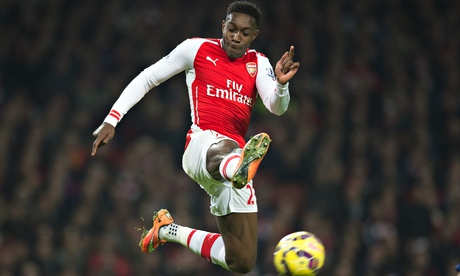
Danny Welbeck and Daniel Sturridge, excellent professional players and England strikers, were found to have been the subject of 1,700 and 1,600 discriminatory posts respectively, a vile discovery of the research we would not have learned from the players themselves, who put up with it as a new feature of modern life. Social media, with all its blessings, entertainments and miraculous global connectedness, further boosts the profile and status of footballers and celebrities but is a vehicle too for the amplification of hate and nastiness.
The police and other experts say anonymity is a large part of why people express hatred and personalised aggression on social media, as well as the privacy with which it can be sent out into the world. Of the relatively few people convicted of crimes for social media abuse, most have claimed it was an aberration, and that they did not behave like that in real life. Liam Stacey, jailed for 56 days for racist comments on Twitter following the collapse on the pitch of Fabrice Muamba, who was playing for Bolton Wanderers at the time, was studying for a biology degree, and claimed he “lost his head” when casually chucking out comments racist enough to send him to prison.
Police, experts and the internet companies themselves, when discussing their efforts to tackle all of this, can seem understandably overwhelmed by the scale of the job and the newness of the phenomenon. The figures of more than 134,000 abusive messages, possibly amounting to hate crimes, thrown in relation to the English Premier League, 8,000 to Balotelli alone, are deeply shocking, but still, mercifully, just a pond in the ocean of decent, funny, entertaining interaction which is transforming human communication.
Police powers are hampered by the anonymity of the internet, and the fact that Twitter, Facebook and Google are hosted in the US, where the supreme court will not grant subpoenas to identify a lone internet poster of racism in some corner of England. The abuse itself can be coming from all over the world, in which case the British police have no jurisdiction anyway. Kick It Out complains that some of the police forces which it deals do not seem to understand social media hate crime, do not seem to act strongly enough and too seldom communicate properly.
The internet companies, seeking to facilitate and reunite friends and followers, have seemed taken aback by their platforms being used for hate, and been heavily criticised for being weak and slow to act. Following Twitter’s chief executive, Dick Costolo, saying the company “sucks at dealing with abuse and trolls” in February and promising to improve, the company now says it has strengthened its procedures and tripled the size of the team protecting users. It admits, however, “there is still more to be done, by us, and the industry as a whole”.
Kick It Out hopes its exposure of the true scale of abuse will prompt football, the internet companies and police to work together to counter it. When sitting around the table as the “expert panel” they will have to consider, along with all the technological arcs of modern life, whether there is something specific to football, its tribal allegiance, conduct and high stakes, which is also at the root of some of this hatred.