Social franchising is a form of co-operative development, with member franchises owning the social franchise. It is similar to commercial franchising, but it has a social purpose and often the franchise is owned by the franchisees. Joint ownership and shared responsibility, makes it potentially a more powerful mechanism than commercial franchising where franchisors and franchisees are often in competition.
Social franchises can be found in 12 European countries, with the largest number being in the UK (36) followed by Germany (6) and Belgium (5). Although the UK has the most, the largest social franchises are in Belgium and Germany.
The promise of social franchising has always been that by replicating a proven business model, it can speed up the establishment of social enterprises by avoiding the repeated reinvention of the wheel. In the UK, Sunderland Home Care Associates, one of the countries best known employee-owned care providers, took more than 10 years to employ 200 staff. It set up Care and Share Associates to franchise its business model and in less than four years it has almost tripled the number of member employees to 570 people.
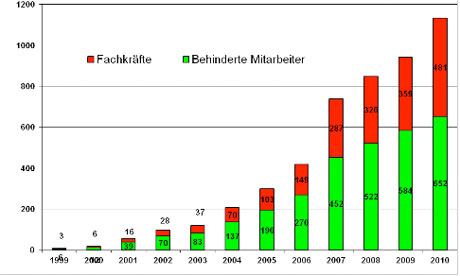
In Germany, the CAP supermarket set up its first social franchise in 1999 and opened it's second in 2000. Thereafter each year saw, on average, an increasing number of new CAP supermarkets, with 11 being opened in 2010 bringing the total to just under 100. The growth in employment, particularly of the disabled people it was set up to employ, shows an exponential growth curve.
The European Social Franchising Network (ESFN) has been collecting information on social franchises across Europe. For its first state of social franchising report researched in January and February this year, it identified 57 existing and aspiring social franchises across Europe and gained detailed information on just over a third (23). It found that they employed 6,776 people and have a combined turnover of just under €200m. Assuming that the 34 other existing and aspiring social franchises employ at least as many people and have as large a combined turnover, this would indicate that across Europe, social franchises are likely to employ 13,000 people and have a turnover of more than €400m.
Since the research, ESFN membership has grown to 30 and they have found a further eight aspiring and existing social franchises bringing the total to 65.
A Flemish social franchise, Komosie, is the biggest social franchise identified so far. Under the De Kringwinkel brand, locally owned re-use shops and recycling workshops have been set up across Flanders. They employ 4,500 people in more than 100 shops. Komosie is owned by its members and provides the brand, training, shop design and a wide range of other services that have enabled De Kringwinkel to grow rapidly.
In most cases, social franchises have been set up to allow for joint working and sharing of knowledge in the hope it would increase the speed of development of social franchises. Komosie, Casa and many others are beginning to demonstrate that this hope is becoming a reality.
Michael Lilley of My Time CIC social franchise explains how this happens. "It has taken us 10 years to develop a community based professional mental health service that is able to win contracts from public sector commissioners and meet professional standards and this has been replicated in a format that with training can enable qualified franchisees 12 months to get fully operational and set up."
As well as speeding up the business development process, social franchises also allow members to reduce costs by joint purchasing, sharing staff, jointly manage legislative requirement from organisations like the Care Quality Commission for care organisations such as CASA or developing and sharing costs for IT systems and procedures.
Social franchising allows social enterprises to benefit from local control and the accountability and entrepreneurial this brings together with scale and economies of scale and political clout and credibility of a large organisation. This allows the likes of CASA to retain local democratic control and compete with large private companies.
If the lessons learned by existing social franchises are also used and built on by other social enterprises then social franchising could become even more important to the social economy than commercial franchises are to the private sector economy. We might then be truly witnessing a step change in growth of the social enterprise across Europe and the impact they have on employing disadvantaged people and building a better, fairer society.
The full results of the research will be presented at the first European Social Franchising Conference to be held on 18 October in London with Nick Hurd, minister for civil society, as the keynote speaker.
Keith Richardson is a director of economic partnerships and co-ordinator of the European Social Franchising Network. Keith is chair of Community Renewable Energy (CoRE) and established their first social franchise, CoRE North West.
This content is brought to you by Guardian Professional. To join the social enterprise network, click here.