Winner: Plymouth University
In 2013, Plymouth University’s Peninsula schools of medicine and dentistry set up the Peninsula Dental Social Enterprise (PDSE) to oversee the education of its dental students and provide treatment and outreach services to the local community.
The university consulted with three NHS organisations to establish a mechanism for transferring activity, and there was also a consultation process with staff who would be transferring their employment to PDSE, which now employs 70 people. Patients were transferred from NHS waiting lists – people who, in many cases, might not otherwise have received treatment. The PDSE receives annual funding of £7.9m from Health Education England and a local contribution of £987,000 from NHS England.
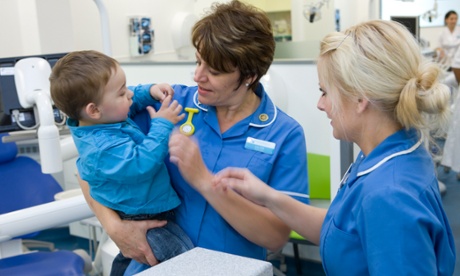
There are three main elements to the work of the PDSE. It runs dental education facilities in Plymouth, Truro and Exeter, where university students studying for a career in dental health treat NHS patients under the supervision of dental health professionals. It also improves awareness of oral health in the wider community, focusing on groups such as schoolchildren, the elderly, parents and the homeless. Finally, it ensures access to dental care for all, but especially to those groups who may feel excluded from mainstream dentistry.
The PDSE has helped the university address serious health inequalities in the region, and it is now replicating the model with medical and optometry students.
It is leading a transformation in dental education in the UK through its pioneering emphasis on community-based teaching. More than 16,000 patients are now registered to receive dental treatment – a significant contribution towards addressing one of the key indicators of health inequality in Devon and Cornwall. Last year, 235 students conducted 39,957 clinical procedures in 84,810 appointments.
The PDSE has more than 40 community partners, including local schools and authorities, but also charities and businesses. Activities have included working with Wrigley to produce a 12-minute animated film designed to engage five to seven year olds in the improtance of dental care and supplying e-learning tools to schools.
Runner up: University of Manchester
In the past 18 months, the university has provided critical support to three major international humanitarian events.
The university’s Humanitarian and Conflict Response Institute , established in 2009, has a partnership with Manchester’s UK-Med, which helps provide health workers from across the UK to work in areas of humanitarian crisis. UK-Med hosts the UK International Emergency Trauma and Medical Registers , funded by the Department for International Development (DFID).
Tony Redmond, professor of international emergency medicine, led a 21-strong medical and surgical team to help victims of Typhoon Halyan in the Philippines. Twelve medical professionals were deployed to treat injured Palestinians in Gaza, while 115 NHS volunteer clinicians have been deployed from the UK to help tackle the Ebola outbreak in Sierra Leone, rising to over 500 over the next six months. Humanitarian experts from the university are also working with DFID and the British military to set up an Ebola treatment centre in Kerrytown, Sierra Leone.
Runner up: University of Nottingham
The University of Nottingham is near areas of low educational attainment and low participation in higher education. To address this, the university launched Nottingham Potential, an approach that involves working with pupils in school and their families.
Nottingham Potential has created three community learning centres in less advantaged areas of the city in partnership with the London-based charity IntoUniversity. A child can begin to benefit from Nottingham Potential at the age of seven and continue to participate in activities tailored to their age, abilities and interests throughout school and college.
The Focus programme works with whole primary school classes, introducing higher education as an achievable goal and immersing children in a single topic.
In the last year, more than 4,000 children have participated in activities and feedback from teachers shows a very high level of satisfaction with the academic-related primary programmes. More than 80% of children attending Focus weeks say the experience has made them more likely to attend higher education.