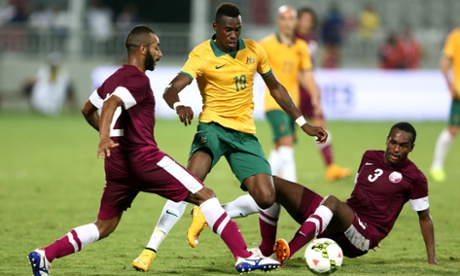
A clean sheet is positive but more are needed
For 60 minutes in their match against Qatar, it looked as if Australia would keep their second clean sheet in two games. It would have been only the third time their opponents failed to score during Ange Postecoglou’s time in charge of the national side. But it wasn’t to be, with Khalfan Ibrahim’s goal for Qatar condemning Australia to a 1-0 loss. Not for the first time, it was a defensive error coupled with single player keeping an opposition attacker onside which played a role in the goal.
While strikers and goal scorers often get the headlines, keeping a clean sheet can sometimes be an underestimated aspect of a football match. Going into a major international tournament where Australia are expected to go a long way, a solid, in-tune defensive unit will be vital.
In their book The Numbers Game: Why Everything You Know About Soccer is Wrong, Chris Anderson and David Sally were able to quantify the importance of keeping a clean sheet in football. “In top level football, a clean sheet or zero goals conceded is more valuable than scoring a single goal,” they wrote. “To put this in Numbers Game terms, then, an inequality central to understanding football is this: 0 > 1. Goals that don’t happen are more valuable than those that do.”
In the A-League, on average, a clean sheet is worth 2.735 points. As Sydney FC coach Graham Arnold stated aptly over the weekend, even if a side is below-par on a particular day, by remaining solid at the back they give themselves the opportunity to nick a win from one chance or a set piece.
Is it time to tweak the attacking system?
An often quoted statistic is that, apart from Tim Cahill, no one has scored from open play during Postecoglou’s time in charge of the national team. In two friendlies against the United Arab Emirates and Qatar, this remained unchanged. It is now the third time in four matches they have been unable to score.
Australia’s main attacking patterns of play are designed to get the best out of Cahill.
“With the way we play here with the boss [Postecoglou], he’s quite dependent on the wingers getting in behind and whipping in early cross,” winger Robbie Kruse said during the week. “It’s quite difficult to get into goal scoring positions particularly with the heat to get into the back post if you’re the winger on the other side of the pitch. The game plan is designed for the No9, so Timmy is usually playing there, to get the goals.”
By playing quickly through midfield, Australia look to release the wingers and fullbacks early into crossing positions. “Whip it in early and bank on Timmy [Cahill] being there,” was the message from Postecoglou early on, and it worked. But playing with a system so focused on getting the best out of its star attacker has its upsides and downsides. Cahill does little during the build-up phase, but with the right delivery, he is deadly in the box. With few other options, it is logical to direct the attacks as such – let’s not forget that Cahill holds Australia’s goalscoring record. But the downside is two-fold: crossing is an inefficient tactic, especially if the delivery is poor, and the other attacking options haven’t added to Australia’s goal threat in the current system.
When do questions get asked of the coach?
Pressure is mounting on Postecoglou as the Asian Cup draws nearer. A 0-0 draw against the UAE and a 1-0 loss to Qatar brings his record as national team coach to two wins, two draws and seven losses in 11 games in charge.
Since taking over, Postecoglou has undertaken an enormous rebuilding task. Not only on the field, bringing in a new playing philosophy and incorporating new players into the squad, Postecoglou has also been involved in a rebuild off the pitch. New scouting networks are being implemented, new roles are being formed within backroom staff and Postecoglou will also take a more active role in the youth national teams in order to take a longer term focus.
While ultimately the results are the main focus, context is important when passing judgment on the coach and players. But that is not to say criticism is unimportant. Constructive debate and analysis of performances and improvements play are necessary – as long as the context is there.
A-League needs to fit in with Fifa’s international calendar
Sixteen of Australia’s 23-man squad for the recent friendly matches have played in the A-League at some stage in their professional careers. With a lack of players plying their trades in top European leagues, the A-League has become important for players in national team set ups. Cutting their teeth at home, players then give themselves the option of moving overseas.
The A-League will continue to play an important role in this regard. Because of this, it is important that the league is not unnecessarily weakened. Nikolai Topor-Stanley, Mark Milligan and Bernie Ibini all missed the first round of the new season due to an international call up. Sydney FC were also without Ali Abbas and Marc Janko, away with Iraq and Austria respectively.
The A-League operates in a unique sporting market, where the popularity and media coverage of ‘other’ football codes make scheduling a difficult task. In its current format, the A-League has been able to work out a good spot in the calendar for itself – starting after the NRL and AFL grand finals and entering its peak during the start of the other competitions. It works well, and it won’t be easy to fit the A-League in with international breaks, but as the competition becomes more important for the national side, it is vital it is not weakened at the same time.
Australia lack a No10
It was Tom Rogic’s position to cement for the long-term future, but injury has robbed Australia of their only true No10. When announcing his squad for these October friendlies, Postecoglou confirmed that Rogic required more surgery to his groin after suffering another injury setback. “Same problem, he [Rogic] had to have another operation, he had a setback, so he’ll probably miss another three months so he’s unlikely for the Asian Cup,’’ Postecoglou said.
Despite being unproven outside of the A-League, there are few options below Rogic who can fill that creative midfield role. Veteran Mark Bresciano can play as a No10 but his passing range is more suited to linking defence and attack rather than providing assists – especially with Australia’s emphasis on crossing. Another option, Massimo Luongo, who played in the No10 role against Saudi Arabia, admitted that it wasn’t his strongest position and that he was more accustomed to playing slightly deeper.
Perhaps with that in mind, Australia lined up in both games as a 4-3-3, instead of a 4-2-3-1. If done correctly, this system can be one that works for Australia. It would see Bresciano and Luongo play in their more natural positions, while Milligan, James Troisi, Oliver Bozanic and Matt McKay are also suited to a system with two No8s. It can allow for more freedom in midfield, with these No8s given slightly more licence to attack with Mile Jedinak sweeping up behind them. Troisi had a glorious chance in the first half against Qatar, breaking into the box to receive a nod down from Cahill, only to shoot at the keeper.