
When the city of Buena Park held a town hall about a new shelter for unhoused people, discussions quickly became heated.
State funding and a recent lawsuit meant the Orange County city was under tight deadlines to choose a shelter site, and 7101 Lincoln Avenue seemed like a good fit for a type of shelter called a navigation center that includes on-site services. It was near a commercial intersection with a grocery store, pharmacy and other businesses, and along a major street with access to public transportation. It also partially bordered a residential neighborhood.
But one by one, community members at the February 2019 meeting told city officials that the shelter did not belong anywhere near their neighborhood. Some worried about property values; others said the location posed safety concerns for a nearby elementary school. “A shelter should not be near schools, shopping centers and major traffic areas,” one resident wrote on an index card. “Homeless shelters should be in an industrial area, not in a residential area,” wrote another.
“It probably just wasn’t the best location for something like that, and we got quite a bit of pushback from the community,” said Aaron France, city manager of Buena Park. “So we pivoted.”
Two months later, city officials came back with a second option in the center of the city’s heavy industrial zone. The Buena Park city council voted unanimously in favor of the parcel in the heavy industrial zone as their preferred shelter location.
Footage of the area outside a homeless shelter in Buena Park.
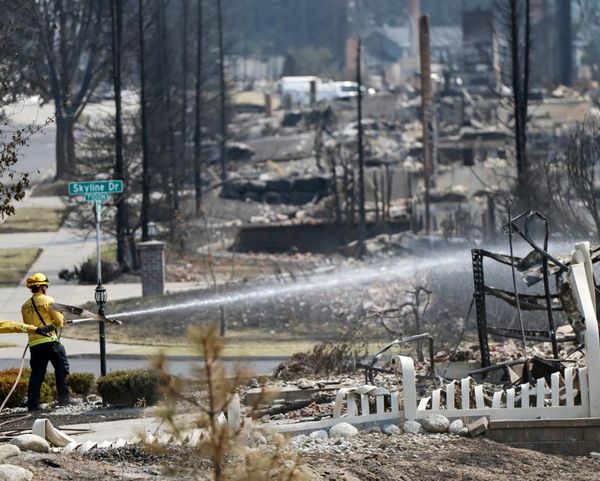
The city was not alone in its decision. A review of government records shows that polluted industrial areas are becoming go-to places for Southern California cities to locate shelters for unhoused people as the state pushes to increase the number of beds to address the homelessness crisis.
Over and over again, officials in cities big and small are choosing to site shelters in industrial locations, placing a population already more vulnerable to health issues in some of their most polluted areas, according to a review of zoning codes in 30 Southern California cities by Capital & Main. A total of 76% of those cities selected industrial or manufacturing zones as the only or primary area where emergency shelters are allowed.
As city officials grapple with where to place shelters, they face the threat of opposition in nearly every direction — except for industrial and manufacturing zones, which by definition do not usually allow housing or lighter commercial uses such as shopping centers. These zones are often among the most polluted and inaccessible areas of any community, intentionally mapped to be as far away from homes and stores as possible, leaving few residents or business owners to organize in opposition.
City leaders’ decisions to restrict new shelters to industrial zones mean that any new beds for people experiencing homelessness are, more often than not, being relegated to hard-to-reach areas with fewer services and greater environmental health risks.
These zoning decisions reflect what city leaders and their constituents think about people experiencing homelessness — a desire to keep them out of sight, said Katie McKeon, staff attorney at the Western Center on Law & Poverty, which focuses on legal representation for Californians experiencing poverty.
“But what they’re actually doing is really ensuring that these people who use emergency shelters don’t have access to the resources that could help them change the fact that they live in an emergency shelter,” McKeon added. “It’s incredibly short-sighted, and it really shows that local leaders don’t see poor people as their neighbors or as their constituents.”

Cities are accomplishing this using one of their most fundamental powers over land use: the codes that map out residential zones that allow single-family homes and apartments; commercial zones for businesses such as grocery stores, offices and restaurants; and industrial and manufacturing zones for factories and warehouses. Zoning is supposed to ensure that incompatible uses are kept separate. It’s designed to keep a power plant from opening in the middle of a residential neighborhood, for example. Industrial and manufacturing zones are often separated from residential areas because of pollution, noise, traffic, odor and other potentially harmful impacts.
Capital & Main’s review of local zoning codes found that many cities are putting emergency shelters for people experiencing homelessness in the same land-use category as polluting industrial facilities and large logistics centers. Advocates say this goes against the spirit of a nearly 20-year-old law that intended to overcome stubborn opposition to shelters and better integrate them within a wide variety of California communities.
Shelters ‘By Right’
When SB 2 passed in 2007, approximately 159,732 people were experiencing homelessness in California. The federal government had just started requiring jurisdictions to conduct an annual point-in-time count, shining a light on the scope of homelessness across urban, suburban and rural areas. And there was a growing understanding among policymakers and others that while homelessness was most visible in major cities, people were also becoming homeless in the suburbs where there were fewer shelters and services.
But at the time, service providers in California found “tremendous resistance” at the local level to getting shelters approved, according to an analysis of the bill prepared for the state Assembly Housing and Community Development committee in 2007. Supporters of the bill said in some cities it was impossible to even start the process because there were no areas in the zoning code that allowed shelters, “creating a de facto ban” and leading to unhoused people concentrating in places like downtown Los Angeles where shelters were available, according to the 2007 bill analysis.
SB 2 aimed to change that by requiring cities to choose at least one designation within their zoning code where shelters are allowed by-right, meaning without public hearings or discretionary approval by local officials, such as a vote by city councilmembers.
In one high-profile case in 2024, the state sued the city of Norwalk for violating SB 2 and other state housing laws by placing a blanket moratorium on emergency shelters, supportive housing and transitional housing. The two parties reached a settlement agreement last year.
But even when other cities have chosen locations where emergency shelters are allowed, Capital & Main’s review found that many have ignored the guidance of state officials and selected industrial and manufacturing zones. While SB 2 itself doesn’t explicitly bar cities from choosing industrial or manufacturing zones, both the state housing department and legal advocates have advised against choosing these zones due to potential health concerns.
Capital & Main reviewed the zoning codes of the 10 most populated cities in a six-county region of Southern California encompassing Los Angeles, Orange, Ventura, San Bernardino, Riverside and Imperial counties. Of those 10 biggest cities, eight selected industrial and manufacturing areas as the primary sites for shelters. Because SB 2 intended to spur more shelters outside of major cities, Capital & Main also reviewed the zoning codes of cities of different sizes, including the 10 cities with populations closest to the region’s median of 49,499 people and the 10 with populations closest to the region’s average of 87,905 people. The pattern was similar: Seven of the 10 median-size cities and eight of the 10 average-size cities chose industrial or manufacturing areas.
The areas where most cities chose to allow shelters are tucked between major freeways and giant logistics centers, surrounded by warehouses and industrial buildings. Their neighbors are auto salvage yards, rubber manufacturing facilities, even a quarry. Since 2011, Cathedral City, a city of just over 51,000 people near Palm Springs, has had a single site available for potential shelter development, a swath of undeveloped desert zoned for industrial use near Interstate 10, disconnected from any roads. The city is currently rewriting its zoning code and the new draft would allow shelters by-right in both industrial and medium-high residential districts, according to city spokesperson Ryan Hunt.
Inconvenient Shelters, With Less Public Pushback
In the Inland Empire city of Fontana, Tony Sanchez and Anahi Luviano spent most days this spring at Veterans Park, a large park with shaded picnic tables, lemon trees and baseball diamonds less than a mile from downtown.
Most places they need to go — grocery stores, government offices, a church offering free food and showers — are within at most an hour’s walk across the sprawling 52-square-mile city.
Both were unaware about plans for a navigation center about 9 miles away, in an industrial area of South Fontana known for having one of the densest concentrations of warehouses in the state. “That’s far — it’s almost to the line of Fontana,” said Luviano.
The navigation center, a joint effort between the county, Fontana, and several other cities, is also in a census tract with a pollution burden in the 96th percentile on CalEnviroScreen, a state environmental health mapping tool that assigns communities scores based on their exposure to diesel particulate matter, toxic chemicals and other health-damaging pollution. It’s down the street from a concrete plant.
Phil Burum, deputy city manager in Fontana, said the industrial area has large buildings at the size needed for the navigation center, reducing costs compared with building a new structure. But he also pointed to another distinction: less public pushback from residents and businesses.
“No new development is ever appealing to the guy that lives next door. I don’t care if it’s a park or a house or a shopping center or a homeless facility,” said Burum, a former housing developer.
Footage of Jasmine Street in Fontana, where city officials are planning to build a homeless shelter and services center.
Unhoused people already experience higher rates of pulmonary conditions, asthma and heart disease than the general population, and are also less likely to receive timely screenings or treatment for cancer symptoms and other illnesses, said Dr. Devora Keller, director of clinical services and program operations at the National Health Care for the Homeless Council, a nonprofit focused on the intersection of homelessness and health care.
Meanwhile, exposure to pollutants from industrial areas is also associated with cardiovascular diseases, pulmonary conditions and cancer risk, said Keller.
“[Those exposures] are being superimposed on the population that already have higher rates of those underlying conditions, so you’re layering exposure on top of vulnerability.”
Ending a ‘De Facto’ Shelter Ban
Advocates say SB 2 has forced more cities to actually think about shelters, and has likely led to more shelter beds than would have existed otherwise. But in many cases cities are choosing locations that go against the recommendations of the state’s housing department and legal advocates.
Cities should consider the “compatibility and suitability” of the zone they’re selecting, including “what other uses are permitted in the zone,” states a memo from the state’s housing department. “For example, an industrial zone with heavy manufacturing may have environmental conditions rendering it unsuitable for residential or shelter uses.”
Shashi Hanuman, executive director of the Public Interest Law Project, a California-based nonprofit focused on housing and homelessness, said the law was intended “to ensure that shelters are not excluded from residential areas.” A decade after SB 2 passed, as an attorney at Public Counsel, Hanuman worked on a guide commissioned by Los Angeles County in an effort to get more cities to comply with the law. Just like the state had years before, the guide reminded cities that industrial zones were likely not a good fit for shelters due to potential environmental impacts.
SB 2 required cities to choose at least one area where shelters are actually allowed, in part through the by-right requirement that promises an easier approval process. Many cities have added conditions that still require some shelters to receive a vote by city council, removing the by-right process. But regardless of whether there’s a city council vote or not, the goal often remains the same: keeping shelters separate from residential areas.
In the San Gabriel Valley city of Baldwin Park, where emergency shelters are only allowed by-right in one of the city’s industrial zones, the zoning code states that the purpose of zoning emergency shelters in specific areas is to ensure they “do not adversely impact adjacent parcels or the surrounding neighborhood” and to protect “the health, safety and general welfare of the nearby residents and businesses.”
The zoning designation provides larger lot sizes located near key transportation corridors, according to Baldwin Park City Manager Manuel Carrillo Jr. “This approach has proven highly effective, leading to the development of two tiny home villages,” Carrillo Jr. wrote in an email to Capital & Main.
The city offers a 25-bed tiny-home village and 16 “pod” units for families experiencing homelessness. As of 2025 there were 108 unhoused people in Baldwin Park, according to the annual point-in-time count conducted by the Los Angeles Homeless Services Authority.
In Anaheim, shelters are not permitted anywhere designated “for any residential use,” and also can’t be within 1,000 feet of any property designated for residential use. The city currently has two emergency shelters operating in industrial areas with a total of over 600 beds; there were 1,432 people experiencing sheltered or unsheltered homelessness in Anaheim in 2026, according to the latest count.
Footage of the area outside a homeless shelter in Anaheim.
Pollution in Orange County
In some cities, deciding what zones should allow shelters remains a hypothetical exercise: Cities are required to select sites for potential shelters, but aren’t required to actually build them. Two decades after SB 2, plenty of cities still have no shelters or navigation centers within their boundaries.
But there are some communities where the impacts of placing shelters in industrial areas are playing out on the ground.
In Orange County, a 2018 lawsuit on behalf of unhoused residents forced the region to quickly add shelters. In the past decade, 11 emergency shelters, navigation centers and bridge shelters (a type of emergency or transitional shelter with services) have opened across nine different Orange County cities. Nine of those shelters are located in industrial or manufacturing zones, including the Buena Park Navigation Center that opened in 2020 after residents opposed placing it elsewhere.
Those nine shelters are located in census tracts with an average pollution burden score of 92.8 on CalEnviroScreen. Some, like the Buena Park Navigation Center, score as high as 99, meaning the area ranks among the worst 1% of census tracts in California for exposure to pollution and other environmental hazards.
The navigation center is in the center of the city’s heavy manufacturing zone, next door to a company that melts metals to create airplane parts, a process that can emit toxic air contaminants.
“Right next to [us] was some sort of metal working thing, and there would be all sorts of weird smells and chemical fumes and stuff all the time,” said one woman in her 30s who previously spent about a year at the shelter before moving back outdoors, and who asked to not be named out of concern for potential retaliation when accessing services. She also recalled an ammonia leak at one of the nearby industrial facilities. A separate leak in 2023 sent 11 employees to the hospital.
The shelter isn’t easily accessible on foot or via public transportation. Sidewalks intermittently disappear and the street is punctuated with busy driveways serving heavy-duty trucks entering and exiting logistics centers and an Amazon warehouse. There weren’t any pedestrians in sight on a Thursday afternoon in February, just trucks.
While there was less resistance to the navigation center in the industrial area, the companies operating manufacturing plants and logistics centers nearby still had concerns. A resulting “good neighbor policy” included the stipulation that people experiencing homelessness wouldn’t be allowed to walk in and out of the shelter on their own, according to France. Pedestrian access isn’t allowed; people can only come and go via their own car, if they have one, or a shuttle specifically for shelter residents that leaves at set times.
“We wanted to ensure just that there wasn’t loitering or congregation outside the shelter that spilled into the adjacent businesses,” said France.
As for the potential health implications of placing the navigation center in a heavy manufacturing district, France said there’s “really nothing of concern.”
“We certainly wouldn’t have put a navigation center where we would put folks at risk,” said France.
Footage of the area outside a homeless shelter in Orange County.
The Costa Mesa Bridge Shelter, opened in a different Orange County city in 2021, faces similar conditions.
The shelter is in an industrial area hemmed in by freeways on three sides and an airport on the other; like in Buena Park, access into and out of the shelter is only available via shuttles a few times each day, or via personal vehicles and bikes, said Nate Robbins, neighborhood improvement manager for the city of Costa Mesa. CalEnviroScreen ranks the area’s pollution burden in the 96th percentile.
“Of course, we could never have built a shelter in a residential neighborhood. That’s just, it’s not even an option, right?” said Robbins.
Commercial zones were “off the table as well” due to how many residents use shopping centers, said Robbins. That left industrial areas, “away from residential and away from businesses.” Robbins estimates that “probably 99% of all municipalities” chose industrial areas for their SB 2 zones for the same reasons.
The ‘Easier’ Political Option
Alex Visotzky, senior California policy fellow at the National Alliance to End Homelessness, said these zoning choices “make it easier politically” for cities to add shelters while avoiding “neighbors coming with pitchforks and torches.”
“But it also means that your shelters are going to be less effective because they’re not connected to community. … When they’re not connected to the places where people are going to have their doctor’s appointment or meet their case manager, people are going to be less enthused about taking a bus all the way across town to the middle of nowhere just to sleep in a bed for a night,” said Visotzky.
California lawmakers have tried to encourage cities to allow shelters in more suitable places, including residential areas. AB 101, passed in 2019, specifically made navigation centers an allowed use in areas with a mix of businesses and housing.
AB 2339, passed in 2022, requires that if a city selects zones for emergency shelters that don’t allow residential uses, it must “demonstrate how the sites are located near amenities and services that serve people experiencing homelessness.”
But while these laws try to guide cities toward making different choices, there’s no law explicitly preventing them from siting shelters in industrial zones.

No Warnings Issued
Enforcement of SB 2 and other housing laws falls to the California Department of Housing and Community Development, mainly through the department’s reviews of each city’s Housing Element, a plan that outlines how a city will meet state-mandated housing goals every eight years.
It’s unclear how the department evaluates whether the zones that cities select are suitable; when asked whether the department has ever taken enforcement action against a city for choosing an industrial area, a spokesperson wrote in an email that without staff doing a “comprehensive review” of all enforcement letters, “program staff who have been deeply involved do not recall any on that specific issue.” A review by Capital & Main of the over 300 enforcement and assistance letters sent by the department about related state housing laws to Southern California cities since 2018 found no examples of the department warning or taking action against a city for choosing an industrial zone.
The department often relies on advocacy groups and others to report violations of state housing laws, and as recently as 2018, the department was still chasing down cities who hadn’t selected any zone at all where shelters were allowed as required under the initial 2007 law, according to the letters reviewed by Capital & Main.
In a few cases, state officials sent warning letters reminding cities to demonstrate they had selected a zone of any kind for shelters. Some of them took action, including the southeast Los Angeles County city of Paramount, which responded by adopting an ordinance allowing the siting of emergency shelters by-right, but only in its manufacturing zones.
The department wrote back that after reviewing the ordinance, “HCD is pleased to find the city has completed actions” to address the law.