Is it a worrying sign when a host nation’s coach talks about home advantage, and a big one at that, like it’s a burden?
On the last edition of the ABC’s Offsiders for 2014, the Socceroos coach spoke of the decades it’s been since a team lifted the Asian Cup at home. It’s tough being hosts, he argued, with all the additional pressure they face.
Maybe it was some pre-cup nerves getting to him, but it was an odd piece of self-doubt. The rare good omen for the Socceroos is just how big the tournament’s home advantage is.
Every time one of Asia’s big guns have hosted the cup, they’ve won it. Yes, that hasn’t happened since Japan 1992. But nearly every one of the low and mid-ranked nations to play host since then have gone on to better or match their previous best showing. For some, that meant making the final, for others it was their only way into the tournament. Either way, it’s undoubtedly a tournament that rewards its host.
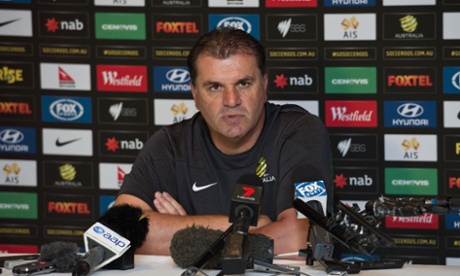
Yesterday though, with his squad in Melbourne and preparations getting more serious, Postecoglou was sweating for entirely different reasons - a 41-degree day.
“Maybe as we get closer to the tournament and the hype picks up, there might be some pressure and some nerves there,” he said after the session, which was moved forward to beat some of the heat. “But at the moment, they’re just enjoying being in Australia.
“I have noticed that the players feel very, very comfortable, and I guess that’s because we’ve been on the road for so long. [A lot of them don’t spend a lot of time in this country, and] I think it’s kind of a pleasing change for them to be in surroundings where they feel comfort and support.”
Part of Postecoglou’s masterplan for this campaign has been to throw his side into the hottest cauldrons he could find: Belgium in Liege; Japan in Osaka; Qatar and the UAE in the Gulf, which are hot enough to even make Melbourne sweat.
It’s a strategy that has seen the Socceroos follow up their worst showing at a World Cup with a slide into the badlands of the FIFA rankings. From a record low of 102nd, they have inched forward, and now sit in 100th place.
On the other hand, he’s hoping it has been a test of skill and character that will have hardened his side for a campaign in more familiar settings.
“It’s just great to be in a country where we can control things. I mean, it’s only simple things, but even training a bit earlier today, or me predicting the Melbourne weather, you know, all that kind of stuff.
“It just makes you feel a little bit more secure about the decisions you are making, so I’m enjoying being here and I’m looking forward to it.”
That said, playing in Australia might feel a little foreign too. As national coach, Postecoglou has coached in London as regularly as he has in Australia - twice. The match that opens the Socceroos’ campaign, in Melbourne against Kuwait next week, will be his home-town debut in the role.
Postecoglou was thrown an SOS by the Socceroos barely six months before the World Cup, and he believes the Brazil experience has helped get some organisational hiccups out of the way.
“The World Cup was very rushed in my opinion, even in terms of the staffing. A lot of the staff just sort of joined us on the eve of the World Cup, so the fact that the staff have been through a World Cup now (helps).
“From an organisational point of view, I think, again, we’ve progressed.
“Our processes and all the organisational stuff just runs a lot smoother now. And it’s great for the players. They don’t have to worry about anything but training and making sure they are doing the right things.
“So I just think we’re probably a more slick organisation than we were at the World Cup. But having said that, I think we handled that pretty well.”
The Socceroos were unlucky losers in the last Asian Cup, pushing Japan to extra time in the final. While the Socceroos are an almost unrecognisable side now, anything but making the final again will look, at best, like a statistical anomaly.
It took a home tournament for both Japan and Iran to break their ducks, but those wins sparked periods of domination. For Iran, it was the first of three consecutive titles, their only titles. Japan followed their triumph in 1992 by winning three of the next five cups, to overtake Iran as the confederation’s most successful team.
It’s another good omen for an Australian side that, despite all its recent promise, probably needs them.