TEXTBOOK OR T20?
Tom Graveney was a batsman who warmed the hearts of those who crave classical purity. Most of us do. But not everyone.
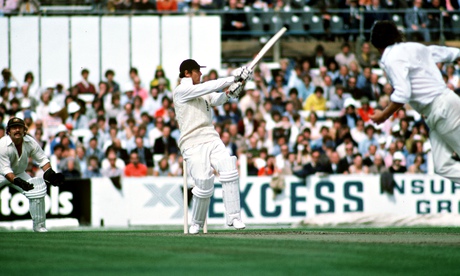
The sad news of Graveney’s death reminded me of a story involving Bill Alley, the great and garrulous Australian cricketer – indeterminate of age, rather like Basil D’Oliveira – who played for Somerset in the 50s and 60s before becoming a Test umpire. Alley was never silent and never short of an opinion. One day, about half a century ago, there was a discussion in the Somerset dressing room about Graveney. Everyone was debating why he was such a wonderful batsman: the purity of his textbook strokeplay on both sides of the wicket; his ability to take control against fast bowlers, medium pacers and spinners; his natural grace.
Praise of Graveney continued to echo around every corner of the dressing room and all the while Alley grew ever more exasperated, partly because he thought he was quite a good player, too (and he was), and partly because he had been compelled to stay silent for so long. Eventually there was a lull in the conversation. Immediately Alley, who always retained an uncut Aussie accent, piped up, “Ah, but he couldn’t bloody slog!”
Alley, who could slog, was right, of course. But whereas most in that dressing room thought that Graveney not being able to slog was a virtue, Alley thought this was a shortcoming in his game. In this regard perhaps, Alley was decades ahead of his time. You have to be able to slog to maximize your income in the 21st century.
In the early days of one-day cricket it was tough even for the greatest of players to change a mindset that had been ingrained for decades, one that demanded that your wicket should be protected at all costs. Hence I have this memory of Colin Cowdrey, who, like Graveney, was perfectly capable of playing decisive one-day knocks in a classical manner.
Facing the last ball in the first innings of a Lord’s final (in the B&H competition of 1973 when Kent played Worcestershire) Cowdrey struck a perfect drive to the right of the boundary fielder at cover. He scampered one run as fast as he could, which at the age of 40 was not very fast. He turned, assessed the situation and then concluded that there was a possibility that he might not be able to complete a second run.
So sticking to the habits of a lifetime, he said “No” and stayed in his crease. As a consequence Alan Knott, his partner, was startled and stranded in the middle of the pitch, the scoreboard soberly telling us that he was run out for 12 as this Kentish pair headed for the pavilion.
By the same token, Geoffrey Boycott was not inclined to take too many risks, though in 1965, cajoled by captain Brian Close at the other end, he hit a masterful and impish 146 for Yorkshire in the Gillette Cup final against Surrey. The aforementioned – with the exception of Close – never slogged.
Batsmen who decline to slog or who are unable to do so, grow scarcer by the year. This certainly does not mean that they are surplus to requirements in 50-over cricket but they have to be very adept to dominate in T20 cricket.
In the 90s Mike Atherton and Nasser Hussain played some fine one-day innings, but I’m pretty sure they would have fitted into the Alley category of non-sloggers. Oddly enough one of my old mates, Chris Tavaré, acknowledged as one of the biggest blockers of all time, could slog. While his reputation as the archetypal blocker is immutable the fact is that in one-day cricket for Kent and Somerset, and just occasionally for England, he hit the ball as ferociously as anyone.
In this generation the best English non-sloggers have been Alastair Cook and Jonathan Trott. Both suddenly look like club hackers when they try to heave to midwicket. Yet both have had their moments in ODI cricket. Last time England were in the UAE Cook led the way with consecutive, match-winning hundreds at the top of the order, with his opening partner, Kevin Pietersen, looking on admiringly – and subsequently scoring a couple of hundreds himself.
Some “non-sloggers” have been denied access to ODI cricket. The most startling example is Mark Butcher, who played 71 Tests for England yet not a single ODI. This was odd and probably unjust. Butcher had a few shots in his armoury as that magical 173 not out at Headingley against Australia demonstrated; he could bowl a bit and he could field. Yet to his exasperation he was never asked to play ODI cricket.
In Australia the same applied to Chris Rogers and Ed Cowan, but probably with more justification. Justin Langer played 105 Tests but just eight ODIs. Meanwhile in the Caribbean, there is a very good chance that Kraigg Brathwaite, still only 22 yet with 24 Tests to his name, will never play an ODI unless he undergoes a metamorphosis of Glenn Turner proportions. Turner was the arch-blocker from Otago, who remodelled his game so that he would be effective in one-day cricket, whereupon he kept playing his shots in Test cricket.
These transformations are rare. But when heading off for the UAE, I packed with much anticipation Colin Schindler’s book on Bob Barber. Barber changed his approach significantly in mid-career, becoming far more aggressive in outlook – I’ll know more detail shortly. Or was it that he often had Boycott – who rarely repeated the twinkle-toed pyrotechnics of that 146 against Surrey – at the other end, thus creating the illusion that Barber was a barnstorming batsman? My guess is that Barber was the real deal.
A MORE POSITIVE SPIN
There has been much agonising about the paucity of English spinners since the Test series defeat against Pakistan. But surely we knew about that already.
I have become quite a fan of Moeen Ali – and a defender of him, too. He is having to learn how to become the main spinner in the side in the goldfish bowl of Test cricket, which must be almost unprecedented. By and large he has made a good fist of it.
As I’ve mentioned elsewhere, he is at his most vulnerable when bowling on turning pitches, where expectations are raised. Moeen has never experienced the peculiar pressure of being the primary spinner on a helpful surface, not even when playing for Worcestershire.
The blunt reason why England’s spinners have been outgunned is this: they are not accurate enough; they bowl too many bad balls. Moeen has an excellent stock delivery, which is half the battle, but too often it lands in the wrong place.
Adil Rashid is also too inaccurate, albeit when faced with the trickier task of bowling out of the back of the hand. In addition there is much talk about the pace that Rashid bowls, some of which is unhelpful. Rashid has a natural pace, which is just below 50mph. He struggles to bowl much quicker. It might be preferable if he could bowl three or four mph faster like Yasir Shah. Test batsmen would have less time to attack him. But this can be a fruitless discussion. It would be great if Mark Wood could bowl three or four mph faster (this would take him to around 93mph, which is seriously quick) but he can’t at the moment. I think the same applies to Rashid.
It is not difficult to explain the poverty of English spin bowling. In the Championship, which now has a spate of fixtures in the first month of a season, starting at the beginning of April, spinners are often redundant. Later on in the year there are very few turning tracks about as counties trust in their seamers for a quick fix on green pitches.
It is no coincidence that England’s two best spinners in recent times, Graeme Swann and Monty Panesar, began their careers at the turn of the century at Northampton, where the ball gripped consistently. They bowled a lot and they learnt not to be intimidated by a turning pitch. And they were damn good.
This is an extract taken from the Spin, the Guardian’s weekly cricket email. To subscribe just visit this page, find ‘The Spin’ and follow the instructions.