The SNP has lost its overall majority in the Scottish Parliament as a resurgent Tory party made gains and Labour was hammered.
On a disastrous night for Jeremy Corbyn north of the border, Labour slumped to third place, and though the SNP won by a large margin, it unexpectedly lost its overall majority in parliament and will have to rely on the support of other parties to pass legislation.
Labour ended the night with just 24 MSPs, shedding 13 from its 2011 election results – while the Tories became the largest opposition party with 31 seats, up 16.
Follow the latest live updates here
The SNP won 63 seats, slightly down on its previous result despite long bookies’ odds of just 8/1 on it losing its majority.
In a humiliating turn of events for already struggling Scottish Labour, the party’s leader Kezia Dugdale failed in her bid to win a constituency seat in Edinburgh and was forced to enter parliament through the regional list.
By contrast, Conservative leader Ruth Davidson pulled off a shock victory in Edinburgh Central, taking her party from fourth place to first there and ousting the area’s SNP representative.
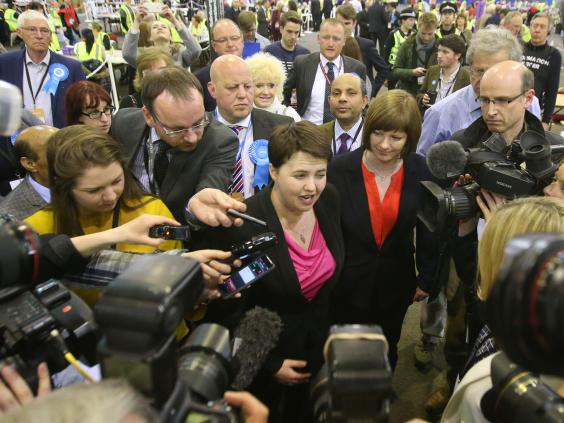
Ms Davidson was visibly ecstatic, telling the count at Edinburgh’s Highland Centre that voters across Scotland had “sent a message” to the Scottish National Party.
She featured heavily in the Tory campaign, with the party’s ‘Conservatives’ branding practically absent from literature, replaced by the slogan “Ruth Davidson for a Strong Opposition”.
The leader said after the result that she had been elected to do “a very specific job” – “hold the SNP to account”.
“I fully recognise and understand there are many people that have given us their vote for the very first time, not because they're true blue Conservatives, but because there's a job of work they want us to do,” she said.
Ms Dugdale told a dwindling crowd who had stayed up for her election via the list at the Edinburgh count that the contest was “always going to be tough” for Scottish Labour.
Despite losing its majority the SNP was still the undisputed winner of the night – though it will now face the choice of either going into coalition government, operating as a minority government, or doing a formal deal with another party.
The SNP captured all nine seats in Scotland’s largest city, Glasgow, wiping out the remaining four Labour constituencies there. Across the country Labour gained just one seat from the SNP – in Edinburgh Southern.
The party’s leader Nicola Sturgeon told supporters that they had “made history” with the result.
“What is now beyond doubt is that the SNP has won a third consecutive Scottish Parliament election – that has never been done before in the history of the Scottish Palriament. We have tonight made history,” she said in a speech while ballots were still being counted across the country.
“It is a vote of confidence in the record in government of the SNP and it is a vote for trust in the SNP to lead our country forward.”
But University of Strathclyde political scientist Professor John Curtice said the nationalists had possibly been “the victims of exaggerated expectations” at the elections – with a widely-predicted majority not materialising.
The dark horses of the election were the Liberal Democrats, who also made unexpected gains from the SNP in Edinburgh Western and North East Fife, where the party’s leader Willie Rennie was elected.
The Scottish Greens, too, had a strong showing in the Glasgow Kelvin constituency, where its leader Patrick Harvie came second to the SNP.
Overall, the left-wing environmentalists tripled their representation from two MSPs to six, all elected under regional lists. As the only other pro-independence party in the Scottish Parliament they are now prime candidates to cooperate with an SNP-led government – as they did after the 2007 elections.
The Greens backed that government, which was led by Alex Salmond, in exchange for a Climate Change Bill and Green MSPs on a key parliamentary committee.
Smaller parties RISE, Solidarity, and the Women’s Equality Party failed to make an impact.
Turnout in Thursday’s elections was around 55 per cent, marginally up on 2011.
Labour had a better night in England’s local elections, where it exceeded expectations by retaining control of key councils in the south – Harlow in Essex, Crawley in Sussex, and Southampton on the south coast.
It had a mixed night in Wales, losing the Rhondda to Welsh nationalists Plaid Cymru, but keeping an overall strong first place.