Afternoon summary
-
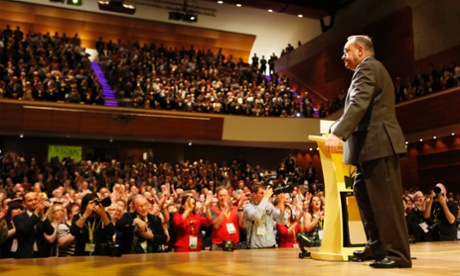
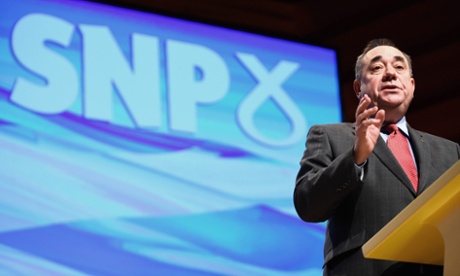
Alex Salmond has used his last speech to the SNP conference as first minister to claim that independence is inevitable and that Scotland has discovered self-belief, and to launch an excoriating attack on Labour. In an upbeat and emotional performance, he said that Scotland had “changed utterly” as a result of the independence referendum and that what was most important was that Scotland had changed its perception of itself.
Twenty Four years ago we were locked in the Tory trap.
Ten years ago most Scots still looked to Labour for salvation.
Now we understand that the solution will not come from on high, but from within.
But Labour did not understand this, he said.
Labour didn’t trust Scotland, and now Scotland doesn’t trust Labour.
- Salmond has said the party should set itself a target of winning the Westminster elections in Scotland (ie, winning more seats than Labour.)
-
SNP delegates have backed a move to encourage leading figures from the Yes Scotland campaign who have not been members to stand as election candidates. In his speech Salmond backed the proposal.
We are a party renewed. Let us resolve to involve each and every member in the work that lies before us. In the selection of candidates, in the election to come.
And let us be open and generous - to allow some shining stars of the Yes movement to stand under the SNP banner reflecting the historic shift that has taken place.
The groups that emerged from the grassroots were wonderful - Women for Independence, Business for Scotland, National Collective and many many more.
Let us embrace them as candidates.
-
Labour and the Tories have both criticised Salmond for not acknowledging the fact that Yes Scotland lost the referendum. Anas Sarwar, Labour’s interim leader in Scotland, said:
Alex Salmond’s 20 years as leader of the SNP is a remarkable achievement. But what we got today was his gripes of the last 20 months.
Sadly, this was a missed opportunity from the first minister. It’s clear from his farewell speech to the SNP conference that Alex Salmond does not take defeat very well. His comments about the result of September’s independence referendum are an insult to every Scot who voted No. It was his failure to answer key questions about currency, Europe, defence and the economy that led to him losing the argument.
And this is from John Lamont, the Scottish Conservative chief whip.
Alex Salmond had an opportunity today to act like a statesman and show some humility by fully accepting the referendum result.
It’s disappointing he remained true to form by making a speech that was both divisive and belligerent.
The reality is that the people of Scotland were offered the choice in September of whether they wanted to leave the UK, and they rejected it out-of-hand.
Alex Salmond’s refusal to acknowledge the democratic will of the people of Scotland is an insult to those who cast their vote in good faith.
-
Jim Murphy has marked the close of nominations in the Scottish Labour leadership contest by saying he has the support of 34 constituency Labour parties, almost two thirds of those voting. He also has the backing of 100 councillors and two unions. Neil Findlay, his main rival, has the support of 20 CLPs and most unions expressing a preference, including Unite, Unison and the GMB, the largest and most powerful.
That’s all from me for today.
I’ll be blogging from the conference again tomorrow.
Thanks for the comments.
Updated
And here is what some journalists are saying about the speech on Twitter.
Big problem for Salmond haters is that Salmond has walked off laughing. Even when he lost he won.
— James Maxwell (@jamesmaxwell86) November 14, 2014
Is it just me or is @AlexSalmond spending a lot of time talking about @scottishlabour when he usually ignores them. #snp14
— mandy rhodes (@holyroodmandy) November 14, 2014
Loudest cheer of the day comes when Salmond criticises UK broadcasters, obviously. #SNP14
— Jamie Ross (@JamieRoss7) November 14, 2014
salmond's brilliantly picking apart scottish labour, here.
— euan mccolm (@euanmccolm) November 14, 2014
A final typographical insult from @AlexSalmond to the ex Labour leader on his #snp14 speech pic.twitter.com/g9LO9CwHUb
— Tom Gordon (@HTScotPol) November 14, 2014
Alex Salmond making a victory speech. What would he have sounded like if he'd actually won?!
— Andrew Neil (@afneil) November 14, 2014
Salmond bows out, only to bow back. He'll have to stand for WM after his speech. Tease has gone on long enough.
— Iain Macwhirter (@iainmacwhirter) November 14, 2014
Tom Gordon says the standing ovation came in at eight minutes.
@AlexSalmond gets 8 min standing ovation for valedictory #snp14 speech, ending with surreal reference to "#sexysocialdemocracy"
— Tom Gordon (@HTScotPol) November 14, 2014
Alex Salmond's speech - My snap verdict
Salmond’s speech - Snap verdict: It was a good speech, with a clear message (“they thought it was all over ... well it isn’t now”), some sharp lines and a tone that managed to convey confidence without toppling into triumphalism, but somehow it didn’t quite feel like the grand statement that you would expect at the end of a glittering career. Why was that? Partly it was because the key lines were briefed in advance. Partly it was because it was more backward-looking than forward-looking. Nicola Sturgeon is in charge now and Salmond acknowledged that by leaving it up to her to determine what the party does next. But mainly, I suppose, it is because Salmond is not leaving politics, and he does not see himself as someone who’s career is over. If it did not sound like a finale, it’s because it wasn’t one. We’ll be hearing from Salmond again.
My colleague Libby Brooks has posted a Vine from within the hall.
Huge applause for Alex Salmond as he leaves stage after #SNP14 speech https://t.co/TBkBWVdWPm
— Libby Brooks (@libby_brooks) November 14, 2014
Salmond seems to be doing an encore.
Hashtag sexysocialdemocracy, he says.
(That’s a joke. He told a interviewer recently he sometimes replies to the spoof Twitter account @angrysalmond, who uses the hashtag #sexysocialism, using the hashtag #sexysocialdemocracy.)
In his resignation speech he said the dream shall never die, he says. (He would have been quoting Ted Kennedy.)
Today, he says, the dream is alive and well and will prosper under Nicola Sturgeon and Stewat Hosie.
Absolutely bananas scenes here. This standing ovation feels like it will go on all afternoon. #snp14
— Jamie Ross (@JamieRoss7) November 14, 2014
And here’s Salmond’s peroration.
We have put Scotland back on the global map - the eyes of the world were fixed on Scotland this year.
And Scotland did not stand transfixed in the headlights of the international attention.
We rose instead to the challenge of change.
The people will not disappear back into the political shadows and the nation will not fade into the dark.
This country has changed and changed utterly.
And that is the change which will carry us forward - forward to independence.
Sturgeon will make an immense contribution, he says.
In Nicola Sturgeon we have a woman of extraordinary talent to take this party forward. I have not the slightest doubt that she will serve this country with enormous distinction when elected by the Scots Parliament as our First Minister.
As one era ends, so another begins
Nicola your contribution to where this party now stands has already been immense. Your future contribution – I have no doubt – will be to make history.
By make history, he means preside over independence, I presume.
Salmond welcomes the new SNP members and tells them that they “represent a nation which has become one of the most politically charged anywhere in the democratic world”.
The SNP has twice as many members as the UK Liberal Democrat party, he says.
This is a fact that needs to be heard loud and clear by the UK broadcasters.
This gets a huge round of applause. (The BBC is very unpopular at the SNP. See 1.24pm.)
Sturgeon must be allowed to take part in the leaders’ debates, he says.
Salmond turns to what happened on the morning after the referendum, when David Cameron said Scottish devolution must proceed “in tandem” with English votes for English laws.
It was a cynical and depressing attempt to pander to the Tory back benches at the expense of Scotland’s democratic will. Only David Cameron could take a groundswell for Scottish Independence to be a mandate for reform in England!
So let the message be very clear from this hall and this country to the Prime Minister – delay, prevaricate, block or obstruct the implementation of what was promised, and Scotland will take matters into our own hands.
Salmond says the lurch to the right at Westminster could harm Scotland.
Exit from the EU – which would a disaster for Scotland.
Deeper faster spending cuts aimed at the poor.
An immigration policy based on the politics of fear.
Privatisation of our NHS
Friends, that isn’t an example of a strong United Kingdom – a partnership of nations - it’s an abhorrent and divisive agenda of which we should have no part.
Salmond says Labour are paying the price for siding with the Tories during the referendum.
To save them time and money, and avoid the need for sophisticated
polling analysis, let me spell out for the next Labour Leader precisely why that party is in terminal decline
Labour didn’t trust Scotland, and now Scotland doesn’t trust Labour.
And he launches a wider attack on Labour.
As Scotland dared to dream, Labour offered nothing but nightmares.
When Scotland was alive with ideas and debate – all Labour could demonstrate was timidity and fear.
The next Labour leader in Scotland inherits an intellectually bankrupt and politically hollow organisation.
Johann Lamont deserves praise for her honesty in confirming what we all knew – that Scottish Labour was treated by London Labour as a ‘branch office’
And why should the people of Scotland care about that? Let me tell you.
Because Johann Lamont has also revealed that at a time when Scottish politicians should have been standing together, presenting a united Scottish front against the Tory bedroom tax, she was silenced for a year awaiting permission from Ed Miliband to speak out.
A Labour Party that needs permission to speak out against the bedroom tax isn’t a Labour Party at all and a branch office is not a Scottish Labour Party.
Salmond has a joke about Ed Miliband.
Before the referendum it was claimed there was no threat to Scotland’s funding from Tory privatisation of the NHS south of the border.
Now Ed Miliband says the very future of the NHS will be on the ballot paper at the next UK election.
Of course Ed himself may or may not be on the ballot paper!
Salmond says voting SNP is more important than ever.
And the Yes vote we shall ask for in May next year will be a simple one.
Yes to the devolution of job creating powers, social security, broadcasting, pensions and much else besides
Yes to a Parliament with real control of Scotland’s finances.
Yes - above all - to the presumption that those who live and work here are best placed to run our own affairs
The UK parties should be in no doubt – give Scots the power we demand, or Scotland will vote to take it.
Salmond says the SNP’s opponents are completely confused by its revival.
It must be infuriating for our unionist opponents to see us lose the referendum and then go on to prosper. They are totally disorientated.
They cannot understand what on earth is going on.
The reason is actually quite simple. For us the referendum for us was never about party – it was always about country.
To illustrate this point, Salmond talks about something he witnessed during the Commonwealth Games.
What I witnessed in Glasgow one day during the Games was an excerpt of a Scottish Youth Theatre production of a play called Now’s the Hour. This involved youngsters imagining and reading letters written today to their future selves about the decisions that Scotland was to make this year.
I only saw an excerpt but that play touched the very essence of what this year has been about – indeed it touched the very heart of what Scotland is now about ...
Now the Youth Theatre is in financial difficulty and we cannot in conscience have that, indeed I just won’t have that.
And therefore Conference I am delighted to announce that , working with Creative Scotland and with generous private sector support from one of our greatest companies Clyde Blowers, the Scottish Government will provide £1 million pounds over the next three years to secure the future of the Scottish Youth Theatre.
Salmond says Scotland’s perception of itself has changed.
Twenty Four years ago we were locked in the Tory trap.
Ten years ago most Scots still looked to Labour for salvation.
Now we understand that the solution will not come from on high, but from within.
Salmond says introducing the living wage has been one of his government’s best achievements.
Salmond pays tribute to John Swinney, the finance minister, calling him “a financial magician”, “Scotland’s Merlin” and “the only finance minister in Europe who has successfully operated a balanced budget”.
Salmond summarises the achievements of the SNP in office.
During a time of extraordinary economic pressure we have saved the average family £1200 by freezing the Council Tax. We have put 1000 extra police officers on our streets and crime is a at 40 year low. We slashed business rates allowing 96,000 small and medium enterprises the length and breadth of our country the opportunity to thrive. Despite the privatisation agenda south of the border we have protected Scotland’s NHS ensuring a service that has remained in public hands. And delegates - as someone who grew up in a council house in Linlithgow and went on to be educated without charge at St Andrew’s University - I’m proud to have led a government when the rocks did not melt with the sun, where tuition fees were abolished and the right to free education was restored to Scotland’s young people.
Salmond says the SNP should get its membership up to 100,000 by the time of next year’s election, so there are “100,000 members representing the national cause”.
Salmond says the SNP should be “open and generous” and let some of the stars of the yes campaign stand as candidates.
And let us be open and generous - to allow some shining stars of the YES movement to stand under the SNP banner reflecting the historic shift that has taken place.
The groups that emerged from the grassroots were wonderful - Women for Independence, Business for Scotland, National Collective and many many more.
Let us embrace them as candidates and ask people a simple question:
Who would you rather have representing your nation?
The new people who awoke the national spirit or the old Westminster parties who have done their best to break it?
Salmond recalls the fact that the SNP had just four MPs when he was first elected leader in 1990 at a conference in Perth.
Now the SNP has 72 parliamentarians, across three parliaments.
Ten years ago when I was re-elected in a partnership leadership with Nicola the SNP had 8,000 members.
We now have ten times that number, ready and willing to pick up the gauntlet for Scotland.
Salmond says the SNP accepted the result “with dignity and grace”, as the nation expected.
But they will also champion the national interest.
That’s why we meet as a party invigorated as never before. Far from reflecting on what might have been, we are focused on what now must be.
Salmond says the Westminster leaders will try to renege on their promises.
The Prime Minister will try to renege. That’s what Tory Prime Ministers do.
Westminster Labour will try to renege. That’s why Johann Lamont called them “dinosaurs.”
But let no-one imagine that the collective will of the Scottish people will be defeated – not now, not ever.
Salmond says that the yes camp would have won had it not been for the last-minute promise of extra powers to Scotland.
Be in no doubt – without that last gasp concession the No Campaign would have had its just deserts.
Without that desperate vow of maximum devolution, Scotland would already be in a process of becoming independent.
A cynical ploy? A last minute bribe?
Certainly.
A desperate response to a Yes campaign which was gaining such ground?
Absolutely.
But for many it was enough to convince them to give the Union one more drink in the last chance saloon.
For some it was the argument for saying NOT YET rather than YES.
As a democrat, I respect that decision, but conference let me tell you this.
If the Westminster gang reneges on the pledges made in the campaign - they will discover that Hell hath no fury like this nation scorned.
He thanks everyone who campaigned in the referendum.
Scotland will become independent, he says.
At various times in our national history Scotland has managed to snatch defeat from the jaws of victory.
This time out of defeat will come future success.
He is now using the material released overnight. See 9.15am.
Updated
He says the SNP now has 85,000 members.
I feel a bit like Mark Twain who was most amused to arrive in London to newspaper billboards proclaiming at the top “Mark Twain Arrives” and at the bottom – “Gold Cup Stolen” - as if the two were connected.
In Edinburgh the other week I saw a billboard which read “Alex Salmond Leaves” – and at the bottom “SNP Membership Trebles!”
Alex Salmond's speech
Alex Salmond is on stage now.
He thanks Sturgeon. Listening to what she had to say, he came to a decision. I have decided not to stand ...
for the Westminster parliaement ...
in Lewes in East Sussex.
But if the people of Sussex think I’m as big a danger to Westminster as Guy Fawkes, they’re right.
Updated
Nicola Sturgeon is introducing Alex Salmond now. She says, having watched the video biography of Salmond, she is close to tears. It makes her realise what big boots she has to fill, she says.
She mentions the effigy of Salmond burnt at Lewes. And the Loch Ness Monster was on his shoulder. What on earth has Nessie done to them, she thought.
She has two words for Salmond: Thank you.
Thank you for being the best teacher any new leader could wish for, she says. And thanks for being a friend, a mentor, an outstanding first minister, and for taking Scotland closer to independence than we expected.
Here’s the full text of the topic resolution passed a few minutes ago that could pave the way for non-members being candidates.
Conference welcomes the positive contribution to the Yes campaign of a range of groups and individuals throughout the country.
Conference recognises the desire among many of those involved in the campaign to harness the strength and diversity of the Yes movement in the 2015 general election, in order to secure the strongest possible voice for Scotland.
Conference therefore mandates the national executive committee to explore options that would allow individuals who were part of the Yes campaign, but who do not satisfy the current membership criteria for candidacy, to be considered for inclusion on the approved list of candidates. Decisions about selection would continue to rest with members of individual constituencies.
Any changes to the candidate and selection rules that arise from the NEC’s consideration of these options would require the approval of national council.
Alex Salmond will be giving his speech shortly.
First the SNP are showing delegates a video with his life story.
Film of @AlexSalmond political history before his valedictory speech to #snp14 pic.twitter.com/f8ytcPvwuO
— Peter MacMahon (@petermacmahon) November 14, 2014
Updated
Here’s the journalist Lesley Riddoch on the proposal to allow prominent Yes Scotland campaigners who are not party members to stand as candidates.
Angus Robertson tells #snp14 unprecedented circs of Scottish politics mean non SNP members SD be able to be selected as 2015 candidates
— Lesley Riddoch (@LesleyRiddoch) November 14, 2014
Significant that motion on exploring selection of non SNP members as 2015 candidates on just b4 Alex parting speech as SNP leader.
— Lesley Riddoch (@LesleyRiddoch) November 14, 2014
As the Guardian reports today, there is speculation that Riddoch herself could stand as a candidate under this new system.
No one is opposing the motion, and delegates vote it through.
Angus Robertson, the SNP’s leader at Westminster, is seconding the motion. He says the SNP needs the biggest and best team it can get at Westminster.
Sturgeon is still speaking.
She says the motion authorises the party to explore options for opening up the party to a wider range of candidates.
She says local parties would still have the final say on candidates.
But the rules make it hard for new members to stand.
Having seen the talent that exists among members, she wants them to be able to stand now.
And it would open the possibility of having candidates who were not party members, but who believed in independence.
She asks delegates to give the national executive committee a mandate to explore this option.
Any proposal would come back to the national council for approval, she says.
But she asks the party to back her, so they can “harness that wonderful spirit we created in the yes campaign”.
Delegates debate changing the rules on candidates
Nicola Sturgeon, the new leader, is now moving the resolution about letting prominent Yes Scotland campaigners who are not party members stand as candidates.
She says the referendum campaign brought a whole new group of people into politics.
Their involvement was a great boost to the yes campaign, she says.
And the party has changed too. It has 60,000 new members. It is bigger and better.
But that means it has to change.
More on the election of Stewart Hosie as deputy leader.
Here’s an analysis from the Daily Record’s David Clegg. And here’s an excerpt.
[Hosie’s] victory has surprised some observers, many of whom expected Transport Minister Keith Brown to win based largely on his popularity with MSPs.
That not only underestimated Hosie’s talents - particularly in making the economic case for independence during the referendum campaign - but also failed to take account of his massive support base in his home city.
Dundee was, after all, the area with the highest vote for independence in all of Scotland and now boasts more than 2000 SNP members.
Brown is considered more of an independence moderate than Hosie and would not endorse the Yes alliance idea.
But the new members have spoken and they have demanded a deputy leader that will push for another independence referendum as soon as possible.
And this is from James Maxwell.
Salmond (ex-leader), Hosie (deputy leader) & Robertson (W'minster leader) all in LDN after May 2015. It's going to get crowded.
— James Maxwell (@jamesmaxwell86) November 14, 2014
Delegates have passed a motion committing the party to fighting racism and opposing the far right.
William Hill is offering odds of 6/1 on Alex Salmond becoming a UK minister in the next government. This is from Graham Sharpe, a spokesman for the bookmakers.
We think Mr Salmond is likely to stand for the Inverness, Nairn, Badenoch and Strathspey constituency - and we are quoting the SNP at 2/5 to win the seat. If the general election outcome is as close as many are predicting there must be every chance that Mr Salmond could find himself part of a coalition government.
They clearly haven’t read the Herald today.
In today's Herald: Salmond dismisses speculation he'll stand in Inverness
— HeraldHolyrood (@HeraldHolyrood) November 14, 2014
Updated
At any proper conference there’s always a row about standing orders, or conference procedure. The afternoon proceedings have started and delegates were supposed to begin by debating a motion on fighting racism. But at the start there was a mini-row about whether the topical resolution coming up later was in order. It was, Derek Mackay, the party’s business convenor in the Scottish parliament said.
The topical resolution is the one about letting prominent Yes Scotland campaigners who are not party members stand as candidates. Delegates will debate it at 2.40pm.
Updated
The conference hall is now full.
People are now being turned away from the main auditorium, as it's full! Everyone wants to see Alex and Nicola #snp14 pic.twitter.com/s54mS6tCHz
— Lauren Aitchison (@thetartandevil) November 14, 2014
The queue for @AlexSalmond farewell speech at #snp14 even bigger than queue for coffee #caffeinedeficit pic.twitter.com/IFRnqfjtrS
— norman smith (@BBCNormanS) November 14, 2014
Lunchtime summary
- Nicola Sturgeon has said Scotland could demand another referendum on independence because of the UK government’s austerity policies, a failure to deliver greater devolution or an exit from the EU. In media interviews shortly before she formally took over the SNP leadership, she also said the party would “never, ever” support a Tory government. (See 11.31am.) She was formally acclaimed leader at the start of a conference which sees the SNP brushing aside the loss of the independence referendum and facing the future with remarkable confidence. Sturgeon said that its soaring membership meant that the SNP was now twice as big as the UK Liberal Democrats and that its trade union group was larger than the entire Scottish Labour party. (See 10.22am.) There have been no recriminations about the referendum, and the party seems united in its belief that another opportunity for independence will present itself before too long. It has also been striking how hostile some members feel towards Labour for its role in the September vote.
-
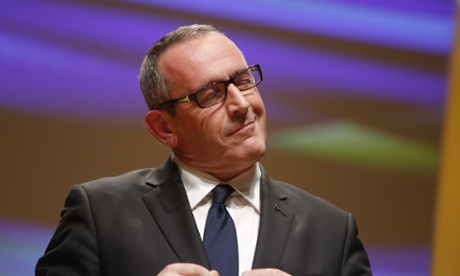
Stewart Hosie, the SNP’s Treasury spokesman at Westminster, has been elected as the party’s deputy leader. In the run-off he beat Keith Brown, the transport minister at Holyrood, who had been tipped by the press to win. Hosie said the SNP needed a good result at the general election to ensure the Westminster parties delivered on their devolution promises.
Remember what it was they told the Scottish people, many of whom voted No to get more powers. The closest thing to a federal state within one to two years.
Let’s make sure they deliver that promise by delivering the largest number, a record number, of SNP MPs next year. That’s the raw power Westminster understands, that’s what Scotland needs to deliver next year so this party is the guarantor of the powers Scotland needs.
They seem to see the media as the main culprit.
Jim Sillars, a former SNP deputy leader, is telling a fringe meeting that the party should be demanding independence in 2016, according to Tom Gordon’s tweets.
Jim Sillars tells #snp14 fringe: "We lost arithmetically on the 18th [of September] but we won politically"
— Tom Gordon (@HTScotPol) November 14, 2014
Jom Sillars tells #snp14 fringe that next indyref should be fought on shared Yes movement prospectus not just an SNP White Paper
— Tom Gordon (@HTScotPol) November 14, 2014
Jim Sillars tells #snp14 fringe: "We have got to make 2016 the target for demanding independence"
— Tom Gordon (@HTScotPol) November 14, 2014
Here’s an Alex Salmond/SNP reading list.
Will he be a participant in that Westminster election? He’s still not saying, and will maintain that silence at conference this weekend, but all the body language indicates he’ll go for it. “I have made it clear that the only place I would fight is in the north-east,” is as far as he will go.
The BBC’s Norman Smith says Salmond will decide in the next few days.
Aides to @AlexSalmond say he will decide in next few days whether to stand for Westminster seat at general election #snp2014
— norman smith (@BBCNormanS) November 14, 2014
The Nationalists gather in Perth for their annual conference today and, far from being downcast, they are in rampant form. Pound for pound – or, rather, per capita – the SNP is now the largest political party in Britain. Indeed, it’s the only one that can plausibly claim to be a mass organisation. That’s quite something.
The kind of thing that makes one wonder if – just perhaps – next year’s election in Scotland could produce results of the kind seen in Ireland in 1918. John Redmond’s Home Rule bill was passed in 1914 but its implementation delayed by the First World War. Then there was the small matter of Easter 1916 and, most importantly, the British authorities’ cack-handed response to Pearse’s provocation. It all helped to ruin the Irish Parliamentary Party. They lost 61 seats in 1918 as Sinn Fein won a landslide victory in southern Ireland, gaining 67 seats and winning almost 47 percent of the vote.
“A confidence and supply agreement is a possibility,” Salmond muses – he has clearly thought through all the possible permutations and was on the receiving end of other parties attempts to disrupt his own minority administration at Holyrood between 2007 and 2011. He has studied all the tricks.
“Devils,” he snorts. “I took careful notes . . . There is plenty of scope to find things which are really important to you but are really not that important to the government.
“It wouldn’t be the greatest tragedy in the world, for example, for Westminster to accept the reality that the Scottish parliament should run its own elections, its own referendum.”
I look aghast at the idea: an SNP administration in Scotland having control of the question, timing and rules around another referendum. That would mean the existential threat to the UK multiplied, surely?
“Not of immediate pressing concern compared to the enormity, for example, of Ed Miliband’s survival as Prime Minister, which I am sure he would in that situation believe to be of the ultimate importance to the future of everything.”
Salmond also offers his verdict on David Cameron, Ed Miliband and George Osborne.
[Salmond] believes Cameron to be disastrous for the country but probably not his own party; Ed Miliband, though, is “just disastrous – for the party and the country”.
The Chancellor of the Exchequer, George Osborne, receives the grudging, mistrustful respect of one military commander for another, delivered with a reflective bit of chin–rubbing: “Osborne is clever.” As a tactician? “Yeah . . . You wouldn’t want to go into the jungle with him.”
My colleague Severin Carrell points out that, despite losing the referendum, Yes Scotland is still selling calendars for 2015.
So @YesScotland doesn't appear to be shutting up shop after #indyref: it's selling an "official" 2015 calendar pic.twitter.com/RVB6bXto5u
— Severin Carrell (@severincarrell) November 14, 2014
After a rather high-brow debate about the legal implications of “stricter liability”, the cycling motion (see 12.12pm) got remitted back (ie, sent back for a rethink).
But delegates did back the motion supporting the Aberdeen-Elgin-Inverness rail upgrade. They have now stopped for lunch.
Keith Brown, the Scottish government’s transport minister, was tipped in the press as the favourite to win the SNP deputy leadership. But he was beaten by Stewart Hosie, the SNP’s Treasury spokesman at Westminster. Why was that?
In a blog for STV News, Stephen Daisley says it was a victory for the grassroots.
Mr Hosie, MP for Dundee East, and Angela Constance, Scottish Government cabinet secretary for training, youth and women’s employment, were seen as conscientious and dedicated party figures but unlikely to defeat Mr Brown.
But the membership of the SNP, new and shiny and very, very big indeed, had other ideas.
So Mr Hosie’s victory can be seen as a positive vote for him but also, in a sense, a vote against inside-the-bubble thinking.
If Mr Brown was the candidate best equipped to reach out to swing voters and ‘Soft Noes’, Mr Hosie is the grassroots choice; a Nationalist’s Nationalist.
Tom Freeman makes a similar point on Twitter.
Although many MSPs backed Keith Brown, Stuart Hosie clearly backed by new SNP members, especially in Dundee
— Tom Freeman (@HolyroodTom) November 14, 2014
And my colleague Severin Carrell points out that the SNP is a small world.
Small @theSNP world? New deputy leader @StewartHosieMP is married to @NicolaSturgeon campaign manager @ShonaRobison - the Dundee MP/MSP duo
— Severin Carrell (@severincarrell) November 14, 2014
Updated
The SNP social justice motion has been approved. There are more details in the party’s press release.
Scotland's party of social democracy reaffirms commitment to social justice http://t.co/vTMNCCDd9R #SNP14
— The SNP (@theSNP) November 14, 2014
Delegates are now debating a motion on cycling backing the Roadshare campaign for stricter liability. This would create a presumption that, in an accident involving a motorist and a cyclist, the motorist was at fault - unless the motorist could prove otherwise.
Anas Sarwar, the interim leader of the Scottish Labour party, has put out a statement about Nicola Sturgeon and Stewart Hosie’s election as SNP leader and deputy leader respectively.
He says the SNP should accept they lost the referendum.
I offer my congratulations to Nicola Sturgeon and Stewart Hosie on their election as leader and deputy leader of the SNP.
They promised a new style of leadership but in their opening remarks to their conference both showed they are still obsessed by their referendum defeat. The people of Scotland voted in overwhelming numbers against independence, but now they want to use the general election to fight the referendum again.
The people of Scotland will vote for MPs who will fight for their constituents - not for another referendum that the majority of Scots just rejected and choosing ‘celebrity’ candidates from the Yes campaign won’t alter that fact.
Delegates have backed a motion saying that the youth (under 18, and 18 to 20) and apprentice rates for the national minimum wage should be abolished and that all employees over the age of 16 should be entitled to the adult rate.
They are now debating a short motion on social justice saying the party should embrace social justice “and the principle of universal provision wherever possible”.
Nicola Sturgeon's interviews - Summary
Nicola Sturgeon, the new SNP leader, was interviewed on ITV’s Good Morning Britain and on the Today programme this morning. I was on the train to Perth and missed them, but PoliticsHome was in action, as usual, and they’ve got the quotes. Here are the key points.
- Sturgeon said the SNP would never support a Conservative government at Westminster.
The SNP would never, ever put the Tories into government ...
Scotland hasn’t voted Tory for many, many a long year. And one of the democratic arguments for independence is that we shouldn’t have to put with Conservative governments we don’t vote for. The SNP wouldn’t impose a Tory government on Scotland.
-
She did not rule out supporting a minority Labour government, but she said she would prefer to support it on an issue-by-issue basis than by forming a coalition.
In terms of any future arrangement with Labour, I should say the SNP was a minority government in Scotland between 2007 and 2011, and while we prefer being a majority, that was a positive experience for the government and I think for the country as well.
So I guess instinctively I would tend away from formal coalitions towards an arrangement that was more issue-by-issue. But in whatever arrangement there was post-general election we would be seeking to get the best deal, the greatest influence, the strongest voice for Scotland.
-
She said the Scottish parliament should have the power to decide whether or not to hold another independence referendum.
I think the Scottish Parliament should hold the power to decide whether there’s a referendum but I would always prefer to proceed on the basis of agreement ...
One of the things that’s changed about Scotland is that the people are very firmly in charge. So it will be the people who decide whether there’s a referendum, by giving a party a mandate for that and then whether or not they choose independence in that referendum.
-
She said it would be “indefensible” for the UK to leave the EU if Scotland, Wales or Northern Ireland were opposed.
It would be completely against the interests, I think, of the whole UK to come out of the European Union. But it would be democratically indefensible for Scotland or indeed Wales or Northern Ireland to be taken out of the European Union against our will ...
That’s why I’ve suggested that before the UK could come out of Europe then that would require a vote for that across the UK but also in each of the constituent nations of the UK. That kind of double majority system exists in other federal countries. We’re not a federal country but it was former prime minister Gordon Brown who said if people in Scotland voted no then we would be as close to federalism as it was possible to be. I think it’s a fair and democratic proposition.
If a UK government did try to take Scotland out of the EU against its will, Scotland would have to think “long and hard” about its position in the UK, she said.
-
She said she wanted Alex Salmond to continue playing a big role in Scottish politics. It was up to him to decide whether to stand for the Westminster parliament, she said.
I want Alex Salmond to continue to be a big voice in Scottish politics. He’s a colossus in Scottish politics. He’s been the best first minister the country has had, I think - obviously I’m slightly biased, but I think many people would agree with this - but he’s been the best politician of his generation.
So whether he chooses to stay in the Scottish parliament or go back to Westminster, that’s a decision for him and I would back his decision 100%. What I want is for him to continue to be a big presence in Scottish politics because that’s not just good for the SNP that’s good for Scotland as well.
-
She said she hoped her election would show girls and young women that there was no “glass ceiling” on what they could achieve.
I hope it sends a very positive message to young women and to wee girls out there across Scotland that says if you’re good enough, if you work hard enough, there should be no glass ceiling on what you can achieve in life.
But she also said her election as first minister did not mean politicians should take their foot “off the pedal” in terms of promoting gender equality.
Margaret Ferrier, a delegate, has just told the conference in her speech that the referendum was only round one.
The conference has been going for less than an hour now, but there have already been some quite bitter attacks on Labour. Bruce Crawford MSP described them as red Tories. (See 10.42am.) And, in a speech just now, Christine Grahame MSP said the party must never let Labour forget they sided with the Tories in the referendum. She even complained about Labour votes being mixed up with Tory ones on the no side.
Furious Christine Grahame says SNP must never let Labour forget it worked with the Tories in referendum
— Tom Gordon (@HTScotPol) November 14, 2014
Grahame "there were Tory votes side by side with their's (Labour's) and we'll never let them forget it" #snp14
— Iain (@Iain_33) November 14, 2014
Gerry Hassan, an academic, questions where the SNP should really think like this.
Is being on same side as Tories defining for parties? #SNP were on same side as Tories in prev UK #Brexit referendum. Happens. #snp14
— Gerry Hassan (@GerryHassan) November 14, 2014
Delegates are now debating a motion on the referendum, saying that the SNP recognises the results but that the party still believes Scotland “should and will become an independent country”.
The debate was opened by Bruce Crawford MSP, who described Alex Salmond as a “giant” of a man. And he said the SNP must continue fighting Tories, whether of the blue or red (ie, Labour) variety.
Sturgeon is still speaking.
She says she has three priorities as leader.
First, the SNP must govern Scotland with competence.
Second, the SNP must win the 2015 election in Scotland. That’s because, when the SNP is strong, Scotland is strong. “Our interests will be protected,” she says.
With a strong team of SNP MPs at Westminster, there will be “no hiding place” for the Westminster parties. That “vow” of more powers for Scotland must be delivered in full.
And, third, the SNP must continue to make the case for independence. She says the party must do this through persuasion, not by berating its opponents. She wants Scotland to become a normal, independent nation.
And that’s it. She’s finished.
"Come with me and I will take this party and this country forward " @NicolaSturgeon pic.twitter.com/YpLx78OaVn
— Peter MacMahon (@petermacmahon) November 14, 2014
Updated
Nicola Sturgeon's speech accepting the leadership
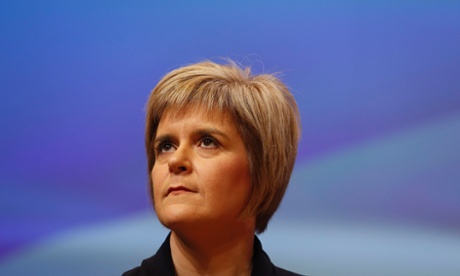
It is also being confirmed that Nicola Sturgeon is the new leader. She was the only candidate.
Accepting the position, Sturgeon thanks the party for placing its trust in her.
She thanks her family and her husband, Peter Murrell. And she says all three candidates in the deputy leadership contest were oustanding candidates.
Addressing Angela Constance and Keith Brown, she says that they would both have made good deputies, and that they both have a big role to play in the party that she leads.
She pays tribute to Hosie. And, although she says she will pay a proper tribute to Alex Salmond in her speech tomorrow, she says Salmond has been an outstanding first minister.
There are few leaders in a democracy who have been able to inherit a party in a better shape than the SNP.
The SNP is the biggest party in Scotland “by a country mile”. The SNP’s trade union group has more members than the entire Scottish Labour party, she says. And the SNP is twice the size of the UK Lib Dems.
The SNP’s membership figure is the equivalent of a UK party having more than 1m members. That has not happened since the 1950s.
One adult in 50 in Scotland is a member of the SNP, she says.
Huge cheers as @NicolaSturgeon confirmed as SNP leader pic.twitter.com/5kOv26yz7p
— Peter MacMahon (@petermacmahon) November 14, 2014
Stewart Hosie is speaking now. He says the SNP deputy leadership campaign was much more friendly than the Labour leadership campaign.
The party is in fine fettle, he says. It should deliver a majority government in 2016, and keep campaigning for independence.
Stewart Hosie elected SNP deputy leader
Here are the figures.
On the first round of voting:
Keith Brown: 34.2%
Angela Constance: 23.5%
Stewart Hosie: 42.2%
And here are the figures on the final round.
Keith Brown: 44.5%
Stewart Hosie: 55.5%
Stewart Hosie has been elected deputy leader.
That’s a surprise. He’s an MP, and not in the Scottish parliament.
Here are some conference statistics from Peter Murrell, the SNP chief executive (and Mr Nicola Sturgeon.)
1,750 @theSNP delegates/visitors, 19 debates, 250 observers, 52 exhibitors, 32 fringe events, 300 media, £1.75m benefit to Perth. #SNP14
— Peter Murrell (@PeterMurrell) November 12, 2014
And here is Elizabeth Grant, the provost of Perth and Kinross, who is opening the conference now.
And we're off. The crowd is going nuts for the provost of Perth and Kinross. #SNP14 pic.twitter.com/X3frrIwA4S
— Jamie Ross (@JamieRoss7) November 14, 2014
As the Guardian reports, the SNP is going to debate changing its rules to allow prominent Yes Scotland campaigners, who may not have been party members, to stand as candidates in the 2015 election.
The Scottish National party is planning to target more seats at Westminster by allowing prominent yes campaigners to stand at the general election, the Guardian can reveal.
The party’s annual conference is expected to endorse plans on Friday to allow its newest members to stand for election, after its ranks were swelled by more than 60,000 new activists and supporters after the referendum.
In a potentially far-reaching move, the party could also promote non-SNP candidates as part of a broader “yes alliance” of independence campaigners, allowing them to stand in place of the SNP under that wider banner.
Two months ago Alex Salmond, Scotland’s first minister and leader of of the Scottish National Party, lost the independence referendum. The result – 55.3% no, 44.7% yes – was worse for the Yes Scotland side than many people anticipated in the final days of the campaign (even though yes did much better than the polls were suggesting a year ago) and less than 24 hours after voting finished Salmond announced he would be resigning as first minister.
Today the SNP conference is meeting in Perth and Salmond is formally handing over as party leader to his deputy, Nicola Sturgeon. She will formally take over as first minister when she is sworn in on Thursday next week. She is addressing the conference tomorrow, but today will be dominated by Salmond, who will deliver his valedictory speech this afternoon.
And what’s remarkable is that is is going to sound like a victory speech. The SNP may have lost the referendum, but since then party membership has soared (up from 25,000 in September to 84,000 now), the Labour vote in Scotland has disintegrated, support for independence has gone up (partly because David Cameron is perceived to be backpeddling on his pledge to give more devolution to Scotland) and anyone who thought that independence was off the agenda for a generation is now having to perform a hasty rethink. According to extracts from the speech released overnight, Salmond (quoting Yeats) is going to say that Scotland has “changed utterly”, that the campaign is far from over and that independence is inevitable.
The referendum Yes vote was 45 per cent, not 55 per cent, but let us proclaim what each of us knows with a greater certainty than ever before – Scotland will become an independent nation.
I want to affirm what we achieved together on the 18th of September 2014.
Because whilst we lost that vote, we also won a great deal.
The 18th September 2014 will come to be seen as the day Scotland took control of her own destiny.
It was a day of empowerment. Of engagement. Of confidence.
It reawakened in millions of Scots a sense of purpose and of hope
It ended – forever – the top down politics of the past and ushered in a new era of participative politics the envy of the democratic world.
So regardless of ‘Yes’ and ‘No’ let us all agree that from the 18th September 2014 the clear winner can be Scotland.
And when the history of Scottish independence is written, be in no doubt that the 18th September 2014 will be remembered as the most significant breakthrough in Scottish political history ….
After the referendum, those very opponents believed that Scotland had been quietened, that we’d had our day in the sun and we should be politely put back in our box.
They thought it was all over…..well it isn’t now.
Because in truth, delegates, everything in Scotland is now different.
All has changed and changed utterly.
The handover of power from one leader to another is always a moment of political theatre rich with emotion, but today’s proceedings should be particularly interesting. Salmond first became SNP leader in 1990, when Margaret Thatcher was still prime minister (just). At the time there was just four SNP MPs, and Scottish independence was widely seen as more of a fantasy than a viable political project. Twenty four years later Scotland has a parliament, the SNP has a majority in it (even though the voting system it has was intended to prevent one-party government) and only a fool would claim to be 100% certain that the United Kingdom won’t break apart within the next 20 years.
Also, Salmond is stepping down after seven years as first minister as a politician who still retains considerable public respect. For a visitor like me from London, where it’s increasingly assumed that political leader are inevitably reviled, that’s a fascinating achievement.
I’ve just arrived at Perth and I will be blogging from the conference today and tomorrow. Here’s the agenda for the day.
10am: Conference opens with announcement of the results of the deputy leadership election.
10.15am: Welcome address by Elizabeth Grant, provost of Perth and Kinross council.
10.30am: Debates on the independence referendum, the minimum wage, social justice, cycling and the Aberdeen-Elgin-Inverness rail.
2pm: Debates on fighting racism and the far right, and on the NHS.
2.40pm: Emergency resolutions.
3pm: Alex Salmond’s speech.
3.40pm: Debates on raptor persecution, CAP funding for Scotland, asylum seekers, energy and crofting reform absenteeism.
If you want to follow me on Twitter, I’m on @AndrewSparrow.