Afternoon summary
- Nicola Sturgeon, Scotland’s first minister and the SNP leader, has opened her party’s conference in Aberdeen with a speech firmly downplaying any prospect of the party pushing for a second referendum in the near future. She did not rule it out, but she insisted that there would probably have to be “strong and consistent evidence” that a majority of Scots favoured independence before she pushed for a second vote. A UK vote to leave the EU could also be a trigger, she said. Her declaration is intended to allow the SNP to go into the Scottish elections next year reassuring voters sceptical about independence than an SNP win does not make another referendum inevitable. The Herald commentator Iain Macwhirter admires what she has done.
Only three months ago people said #indyref2 would be the most divisive issue of #snp15 @NicolaSturgeon nailed it on day one.
— Iain Macwhirter (@iainmacwhirter) October 15, 2015
- The SNP Tommy Sheridan has mocked the “top 10 most ridiculous aspects of the Palace of Westminster”. (See 4.44pm.) Criticising the way politics is conducted at Westminster, he said these flaws justified the SNP’s call for the abolition of the House of Lords and the reform of first-past-the-post. Other MPs also criticised the way Westminster politics operates.
That’s all from me for today.
Thanks for the comments.
Updated
SNP MP says party has helped make Commons 'the gayest parliament in the world'
Tommy Sheppard delivered his list of the “top 10 most ridiculous aspects of the Palace of Westminster” in the afternoon session devoted to speeches from MPs. The main ones were from Angus Robertson (see 3.42pm) and Stewart Hosie (see 5.04pm), but there were also shorter speeches from Callum McCaig, Philippa Whitford, Joanna Cherry, and Tasmina Ahmed-Sheikh. They were all good.
A common theme was how odd the House of Commons is. The MPs sounded like anthropologists returning from a weird and rather backward to telling the folks back home what these creatures are really like.
But it wasn’t all negative. The SNP MP John Nicolson was chairing the session and he had a surprising revelation.
One of the proudest boasts a lot of people think about our parliamentary group is the way it reflects Scotland as a whole. More women than ever before. We are the gayest parliamentary group of any party in the world, which has now made Westminster the gayest parliament in the world.
It’s a bold claim, but it appears to be true. A report in Pink New just after the election quoted research from the LGBT Representation and Rights Research Initiative at the University of North Carolina suggesting Westminster has more LGB MPs, 27, than any other parliament in the world.

Jamie Ross from BuzzFeed (the list specialists) thinks Tommy Sheppard may be trying to put him out of business.
Tommy Sheppard is doing a list of his top ten ridiculous things about Westminster. The man's trying to make me redundant. #snp15
— Jamie Ross (@JamieRoss7) October 15, 2015
In his speech Stewart Hosie, the SNP’s deputy leader and its economic spokesman at Westminster, launched a strong attack on George Osborne’s handling of the economy. He said:
What [Osborne] has done, of course is to insist that the economy doesn’t simply break-even but runs at a surplus hitting £40bn by 2019/20.
But to do that he announced in July that additional welfare cuts would total £33bn in this Parliament and cuts to essential capital spending would be another £5bn
To cut £40bn more than is necessary to run a balanced current budget – all of it paid for by punishing the poorest and stripping the capital budget by another £5bn.
That is rotten politics and even worse economics.

Updated
Tommy Sheppard's 'top 10 most ridiculous aspects of the Palace of Westminster'
Tommy Sheppard, the SNP MP for Edinburgh East, devoted his speech to his “top 10 most ridiculous aspects of the Palace of Westminster”. He read them out in reverse order. Here they are.
10 - Not being allowed to call MPs by name in the chamber. Many MPs have got into trouble for using a person’s name in a debate, he said.
9 - The adversarial layout of the Commons chamber. The lines on the carpet in the chamber are two sword lengths apart, he said.
8 - The fact that the Commons was deliberately designed so that seating is only available for half of the MPs entitled to attend.
That seems to be be fundamentally contemptuous of the whole idea of people in this country being represented in a chamber.
7 - The fact at MPs are not allowed to applaud. Applauding is a “natural human reaction”, he said.
What’s more bizarre than that, whilst we are not allowed to applaud, there seems to be no restriction whatsoever on the number of animal impersonations that the Conservatives are allowed to do in the middle of the debate.
6 - The voting process (ie, having MPs ticked off by hand as they go through a lobby, instead of having electronic voting.)
You will be appalled when I tell you this but we are paid by the taxpayer for up to three hours a week on a busy business week to simply stand in a corridor and wait to give our name to a clerk to explain whether we are voting for or against the proposition. This is a parliament, by the way, that you would almost think was sponsored by Apple, given that we are all given a free iPad when we get there. If we cannot begin to look at electronic voting and coming into the 21st century, it seems to me just dreadfully archaic.
He also complained that MPs were not allowed to abstain, because there is no proper way of recording an abstention.
5 - The way prayers are said in the Commons. Every Commons session starts with prayers, he said. (This takes place in private; you will never see it on TV.) But it is conducted just for members of the Church of England, he said.
4 - The uniforms worn by the door staff in the Commons.
This is, quite simply, Georgian pantomime dress. You will have seen these men, quite literally, in tights and swords, and the most ridiculous part of the uniform that I have come across is a curly ruffle thing that they wear down their back which is called a wig bag. It seems to be just unfair to these poor souls to make them put on this costume in a chamber which is meant to be about making political and important decisions for the country and for the world.
3 - The ability of former MPs to be allowed a pass giving them entry to the Commons.
My first occasion walking into the terrace of the House of Commons was to come across no less than three people who we had just defeated at the election in Scotland, standing there with the same pass that I had, with the same access and privileges that I had. And that’s because, once you join the House of Commons, you are members of a club. And you can stay a member of the club even if the electorate decide you are no longer fit to be there.
2 - The House of Lords. MPs can lose an election, but return to parliament as members of the Lords, he said.
Within members of parliament, we have a situation unique in the civilised world where we actually accept that most of our members of parliament are not elected by the people. And that seems to me an anachronism whose time has come. And if we do nothing else, we must advance the case for the abolition of the House of Lords.
1 - First past the post. That was as “democratic outrage”, he said, because it allowed the Tories to govern with the support of less than one person in four on the electoral register.
This first-past-the-post system is the most corrupt and corrupting practice in a democracy and I would for one resign my seat and give it up tomorrow if they would bring in a system of proportional representation in this country.

Photograph: Murdo MacLeod for the Guardian
Updated
At the conference Tommy Sheppard has just given a speech on the 10 most ridiculous things about Westminster. It was terrific, and I will post a summary of it shortly.
Here’s an SNP conference reading list.
So Sturgeon vowed a re-elected SNP government would build at least 50,000 new affordable homes, at a cost of £3bn. And she went on the offensive over the Nationalist scorecard after eight years in government.
“We will stand proudly on our record. Over the past eight years, while Westminster has cut our budget, we have delivered better services. Our school leavers do better than ever before. We have rebuilt or refurbished one fifth of all school buildings. Crime is at a 41-year low. And NHS waiting times are among the lowest recorded.”
This is what my old English teacher Miss McEachern would gently call “a unique interpretation of the text”.
For all Sturgeon’s bullishness, the Scottish Government’s record is mixed on health, education and justice. The affordable homes pledge demonstrates a commitment to reclaiming the mantle of competent, reliable government. The sensible centrist party with Middle Scotland and young families at its heart.
Ask these new member delegates if they’re okay waiting for a second referendum and you get a divided response. The message that they have to trust Nicola Sturgeon to make the call is getting through.
But you still find quite a few new members who want the second referendum pretty soon. “Immediately,” “tomorrow,” “two years,” “not more than five” were all answers you heard to the question today. Not exactly a generation.
Delve beneath the left-wing and anti-austerity rhetoric and you’ll find a bit of everything: centre-right economics, centre-left social policy, populism, authoritarian law and order, as well as libertarian stances on sexual and gender politics. [Alex Bell, a former SNP head of policy] calls it “the Mhairi Black paradox”: “How exactly does her left-wing vision of Scotland become a reality via the SNP?” ....
Is this ambiguity sustainable, or will the SNP end up collapsing under the weight of its own contradictions before it achieves its goal of independence? There is a danger for nationalists that the party will become a version of what it claims to hate: New Labour, endlessly triangulating, spinning its way out of tricky situations and attempting to reconcile free-market economics with the maintenance of universal benefits. Scottish Labour hopes this will open up space for it to stage a comeback, while groupings such as Rise and the Scottish Greens envisage a scenario in which it will compel the SNP – potentially dependent on their support to form an administration at Holyrood – to ditch the centre ground in favour of a more left-wing policy agenda.
In his article Torrance also quotes from an article about an SNP conference written by Christopher Hitchens for the New Statesman in 1975. Here it is in full. Much of it still applies today. Here’s an excerpt.
In Scotland the Labour and Tory parties are in great disarray, with the Conservatives running third to SNP in total votes, and Labour only 150,000 votes ahead of it. Every crack and creak in the British economy strengthens the Nationalist view that they should ‘quit the sinking ship’. There were ironic jeers and cheers last weekend when a conference speaker pointed out that the Government White Paper had assured voters that ‘English common law will not be affected’ by the EEC.
It does not really matter to them which way the referendum goes: they will still have the initiative. Of course they are wildly opportunist, with a ‘something for everyone’ strategy that reminds one of a chameleon trying to blend itself into a tartan rug. But the disagreements are carefully handled and concealed.
To achieve hegemony, ‘opinion formers’ must assure the public that independence is the only way forward. Nationalism must become the common sense of Scottish life. If the opinion formers lack the required enthusiasm, the SNP must persuade them to think twice before speaking out.
Nationalists are not planning anything as vulgar or blatant as the march on the BBC during the referendum campaign or the abolition of academic freedom. Instead, they are quietly proposing to bring universities into line by nationalising them.
At the last minute, the SNP has slipped three clauses into the Higher -Education Governance Bill currently before the Scot-tish parliament. They give ministers the power to use secondary legislation to impose unspecified conditions on universities without consultation. Universities Scotland, which represents the principals and directors of Scotland’s higher education institutions, says that it fears the ‘control’ the SNP is amassing will lead to the Office of National Statistics reclassifying universities as ‘public’ rather than independent bodies.
This is not a mere slip of the bureaucrat’s pen. Public bodies cannot budget for deficits. They need the approval of government for major projects. In short, Scottish universities will be under SNP rule.
What do SNP activists think of Jeremy Corbyn? BuzzFeed has produced one of those picture thingies with some answers.
SNP want to embarrass Labour by arranging early Commons vote on Trident, Robertson reveals
In his speech Angus Robertson, the SNP’s leader at Westminster, said the SNP would push for an early vote on Trident in the House of Commons. It is for the government to decide when the proper vote on Trident renewal takes place - it is due next year, although there has been speculation that it might be brought forward - but the SNP could trigger a vote on the principle of renewal by choosing this as a topic for one of its opposition day debates.
Robertson made it clear that the intention of any early vote would be to embarrass Labour, which is deeply split over Trident.
This is what Robertson said.
Can I just say to Jeremy Corbyn that one u-turn that he can’t consider is ditching his principled career-long opposition to Trident.
We will have to decide shortly at Westminster on Trident, and the SNP will resolutely oppose the renewal of weapons of mass destruction and the enormous waste of £100bn pounds.
Labour weren’t prepared to have a specific debate on Trident at their conference. I am pleased that the SNP is debating it here at our conference. I’m also happy to help Jeremy Corbyn and ensure that there is an early debate and vote at Westminster aimed at opposing Trident renewal.
Hopefully Jeremy will join the SNP in the lobbies as he has often done in the past in opposing Trident, although I am not holding my breath that he can bring his colleagues in the Parliamentary Labour Party with him.
In theory the Labour party would have to decide how to vote on any Trident motion tabled by the SNP, although conceivably Labour could try to ignore it, and abstain en masse, on the grounds it is reviewing its defence policy and that opposition day motions don’t really matter.

At the conference the SNP are having a “Westminster Hour”, with contributions from MPs.
Angus Robertson, the SNP’s leader at Westminster, is speaking now. He says that one of the highlights of election night was winning Gordon Brown’s old seat, Kirkcaldy and Cowdenbeath, with a majority of 10,000.

Updated
The Herald columnist Iain Macwhirter has praised Nicola Sturgeon’s speech this morning.
Remarkable leadership from @nicolasturgeon effectively ruling out an early referendum. Will dismay many supporters. #snp15
— Iain Macwhirter (@iainmacwhirter) October 15, 2015
To coincide with this afternoon’s TTIP debate (see 2.22pm), the SNP has announced that Nicola Sturgeon has written to David Cameron saying he should ensure the NHS is “explicitly exempt” from the TTIP treaty. If he does not get that guarantee, he should veto it, she says.
.@NicolaSturgeon writes to David Cameron urging him to ensure "NHS is fully & explicitly exempt" from #TTIP & to veto it if it is not #SNP15
— The SNP (@theSNP) October 15, 2015
In the conference now delegates are debating a resolution saying the SNP should demand assurances that public services, including the NHS, are exempt from TTIP (the transatlantic trade and investment partnership). STV’s Stephen Daisley has this observation.
In the main hall, a speaker is inveighing against "big business". Just off the main hall, McDonalds and INEOS have accredited stalls. #SNP15
— Stephen Daisley (@JournoStephen) October 15, 2015
The SNP conference has rejected a bid to reopen the debate about whether the party should support Nato membership, the Press Association reports. In 2012 the party conference voted to abandon its longstanding opposition to an independent Scotland belonging to Nato. As the PA story explains, that decision will not be revisited.
Delegates voted overwhelmingly against an appeal for fresh debate of the decision to ditch its 30-year opposition to an independent Scotland remaining in the defence alliance.
Feelings remain high about the stance, which split the party down the middle at the 2012 conference and forced a number of high-profile resignations.
Demands for a rethink were led by local councillor Audrey Doig who complained the issue had been “swept under the carpet because we’ve already had a vote on this”.
She said that if party leader Nicola Sturgeon was allowed to keep the door open to a second referendum on independence “because we didn’t like the result” of the first one then the same rules should apply.
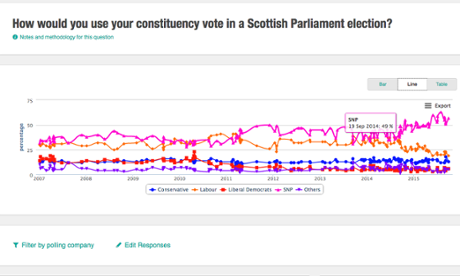
For more on the rise of the SNP, this chart shows how the SNP poll ratings have been rising since 2007 (when the SNP won the Scottish parliamentary elections for the first time). I’ve taken it from the very helpful What Scotland Thinks website.
The SNP has a new party political broadcast which is going out tomorrow night. You can watch it here. It contrasts Westminster with Holyrood (unfavourably, obviously - Westminster is much more antiquated than the Scottish parliament it says, correctly) and it features Mhairi Black, the 21-year-old SNP MP. She will lead the party’s youth campaign in next year’s election.

John Swinney, the deputy first minister and campaign director, explained:
This election will be truly historic for young people, as 16 and 17 year olds will vote for the first time in any national election in any part of the UK. By lowering the voting age we have sent a strong message to young people in Scotland: your opinion does matter, your voice will be heard and your vote will influence the future of our country.
I am delighted that Mhairi will spearhead our youth campaign and will play a key role in electing a strong team of Scottish voices next year. Mhairi’s election itself was remarkable – becoming the youngest ever democratically elected MP in the UK – but since May she has also proved to be a powerful advocate for the people of Scotland. Her maiden speech had a message that resonated far beyond the walls of Westminster and reached an incredible eleven million people.


MPs to vote on English votes for English laws (Evel) next Thursday
Hours after Scotland voted to reject independence, David Cameron announced that he wanted to boost the rights of English MPs at Westminster, by addressing the “West Lothian question” - so called after the then Labour MP Tam Dalyell kept asking why, under devolution, Scots MPs could vote on matters affecting England, but England MPs could not vote on matters affecting West Lothian. As a solution, the Tories are proposing “English votes for English laws”, or Evel.
And this morning Chris Grayling, the leader of the Commons, told MPs that they will vote on introducing Evel next Thursday. He said:
I have this morning published updated proposals for changes to the standing orders reflecting the discussions and the feedback I have had since July as well as the letter I received from the procedure committee in September which is published on their website. The revisions are clearly indicated in the new document.
I published these proposals today to give the House further time to consider them before the debate. I’m also conscious the procedure committee is due to report on Monday and I won’t be tabling the final proposed standing order changes until I’ve read that report and have been able to make any final changes before we table them probably on Monday night.
The new proposals are on the leader of the Commons’ website here (pdf).

There are some other interesting findings in the YouGov poll tables (pdf). Here they are.
- Scottish voters are still opposed to independence, but only by a narrow margin. Excluding don’t knows, 52% are opposed, and 48% are in favour.
- Voters are much more likely to trust the SNP to tell the truth than other parties. Some 45% trust it to tell the truth, compared to 25% for Scottish Labour, 21% for the Scottish Conservatives and 17% for the Lib Dems. These are remarkable figures and, in so far as they give an insight into party image, they must go some way to help explaining why the SNP is so popular. But even the SNP has more people saying they don’t trust it to tell the truth (50%) than saying they do.
- Some 59% of Scots think Michelle Thomson, the MP who stood down as SNP business spokesperson in Westminster after it emerged police were investigating irregularities relating to property deals, should resign her seat. And 67% think Alistair Carmichael, the Lib Dem MP criticised for lying about his knowledge of an anti-SNP leak during the election campaign when he was Scottish secretary, should resign.
- Only 29% of Scots see the SNP as “very sleazy and disreputable”. The Scottish Lib Dems are also on 29%. Scottish Labour and the Scottish Conservatives are both seen as “very sleazy and disreputable” by 38% of voters.
SNP has 30-point lead over Labour, as YouGov finds Labour getting no Corbyn bounce
YouGov has published its first poll from Scotland since Jeremy Corbyn became Labour leader. It says that there is no evidence yet that Corbyn’s election is helping the party.
Here is the YouGov write-up. And here’s an excerpt. The figures are for voting intention in a Holyrood. The SNP has a 30-point lead over Labour.
It’s early days, but there’s absolutely no sign of movement so far. In the first YouGov/Times Scottish voting intention poll since Mr Corbyn became leader, Labour has actually lost a percentage point, down to 21%, and the Conservatives have gained one, up to 19%. The SNP remains at an overwhelming 51%.
When asked specifically if Jeremy Corbyn’s leadership makes you more or less likely to vote Labour, only 15% of Scottish voters say ‘more likely’, compared to 16% of voters in England and 20% of voters in Wales. What’s more, a higher percentage of Scottish voters say Mr Corbyn is performing badly (46%) than say the same in England (44%).
No 'Corbyn effect' on Scottish Labour vote – http://t.co/jPedomXrLx pic.twitter.com/F2LV2U6sQV
— YouGov (@YouGov) October 15, 2015
Here is some more comment on Nicola Sturgeon’s speech.
From the Guardian’s Rafael Behr
Sturgeon isn't a brilliant orator but the strength of her strategic position came across well enough there.
— Rafael Behr (@rafaelbehr) October 15, 2015
From the Economist’s Jeremy Cliffe
Maybe she will give more detail on Saturday but Sturgeon incredibly vague on policy. Loads about popularity and power, little on using it.
— Jeremy Cliffe (@JeremyCliffe) October 15, 2015
Nicola Sturgeon's speech - Summary and analysis
Nicola Sturgeon’s main speech to the SNP conference will come on Saturday afternoon, but this morning’s address, although relatively short, was much more than just a self-congratulatory warm-up (although it was that too). It contained new material on the second referendum issue and a formula that sounded as if it were intended to shelve, from now until the Scottish elections next year, any further controversy about what might or might not trigger a second independence poll.
Here are the main points.
- Sturgeon played down the prospect of the SNP trying to hold a second Scottish independence referendum over the next five years. She insisted it was important to “respect” the decision taken in September last year, and, for the first time, she said the SNP would not try to hold another referendum unless there was “strong and consistent evidence that people have changed their minds and that independence has become the choice of a clear majority in this country”. (See 10.57am.) Arguably you could say that she has contracted out SNP referendum policy to YouGov although, as she has said before, she did argue that a vote to take the UK out of the EU if the Scots wanted to stay in would justify a second referendum. Some SNP activists are very keen to hold a second referendum. But Sturgeon’s announcement reflects an awareness that many Scottish voters, including those who voted yes last year, dread the thought of going through this argument all over again and are opposed to a second independence poll anytime soon. For example, here an excerpt from a write-up of a focus group conducted in Scotland during the general election.
One thing nobody said the [SNP] should push for, and very few said they wanted, was an early second independence referendum. “We need to move on. I think everyone’s acknowledged that”; “I voted Yes but I don’t think you can keep having referendums until you get the answer you want. Apart from anything else, if we voted for independence people would then start saying they wanted a referendum to join the Union. It should be a generational thing, not every few years.”
The experience of Quebec also explains why repeat independence referendums can be dangerous for independence parties. Of course, the Scottish government does not actually have the legal power to call an independence referendum because that is a matter reserved to Westminster. But that does not constrain the SNP much because if a majority SNP government were to call for one, or to threaten to organise its own “illegal” one, Westminster would come under considerable pressure to allow it.
Sky News’s Faisal Islam points out that this will mean the SNP manifesto will be the first for years not to promise a guaranteed referendum.
Every single SNP manifesto until now for Scottish elections: 1999, 2003, 2007, 2011 offered a guaranteed referendum pic.twitter.com/FSsmX2ejkQ
— Faisal Islam (@faisalislam) October 15, 2015
And the Financial Times’s John McDermott sums it all up quite neatly.
Sturgeon, translated: we will have another independence referendum when opinion polls suggest that we will win one. #SNP15
— John McDermott (@johnpmcdermott) October 15, 2015
- Sturgeon suggested she had given up hope of Jeremy Corbyn being able to provide effective opposition to the Tories.
You know, there is much that I hoped the SNP and Jeremy Corbyn could work together on.
But over these last few weeks, it has become glaringly obvious that he is unable to unite his party on any of the big issues of our day.
When he says he opposes Trident, he is attacked, not just by the Tories, but by his own shadow cabinet.
When he says he opposes the welfare cap, he is opposed, not just by Iain Duncan Smith, but by his own Shadow Justice Secretary.
A shadow justice secretary, incidentally, who is a member of the unelected House of Lords.
Labour is unreliable, unelectable and unable to stand up to the Tories.
During the general election Sturgeon talked repeatedly during the general election of how she hoped to form some kind of “progressive alliance” with Labour at the time. At the time Labour figures doubted her sincerity (because they believed her real priorities were independence and fighting Labour in Scotland), and today’s comments seem to confirm she is more interested in undermining Labour than cooperating with it. The SNP believes that, if it can persuade the Scots that Labour has no hope of winning a Westminster majority, they may be more inclined to back independence.
- She said she hoped people who opposed independence could be persuaded to back the SNP. (But, as an unfortunate headline on a post earlier put it, this does not mean that she wants no voters to vote SNP next year. She wants No voters to vote SNP next year, which is not the same thing.)
- She said the SNP would go into next year’s elections committed to building 50,000 affordable homes. This would cost £3bn, she said.

Updated
The SNP MP Tommy Sheppard is speaking now. He says the Smith commission was a watered down version of the federalism promised by David Cameron, Ed Miliband and Nick Clegg in “the Vow” just before the referendum. And the Scotland bill is a watered down version of the Smith commission report, he says.
He says the Tories will rue the day they use their votes in the Commons to oppose the SNP on this. Every time they do that, they will fuel demand for independence. Every time they say no to one thing, they are increasing our desire to have everything, he says.
Delegates have now voted for the motion, which says the Scotland bill “does not meet the spirit or letter of the Smith commission recommendations” and urges the UK government to implement it in full.
The conference is now debating the Scotland bill, and a motion saying the UK government’s legislation (which is still going through the Commons) “does not meet the spirit or letter of the Smith commission”, the cross-party body set up after the independence referendum to make recommendations for further devolution to Scotland. The UK government says the bill does implement the plans in the Smith commission report, but the SNP does not accept that.
John Swinney, the Scotland’s deputy first minister, is speaking now. He says the Scottish parliament’s devolution (further powers) committee published a report earlier this year explaining in detail why the bill does not match the Smith commission promises.
Sturgeon is winding up now.
Next May, I will ask the people of Scotland, for the first time, to elect me as first minister.
And we, together, will seek what no party in the devolution era has yet achieved - a third term in office.
We will do so with humility, but with a determination to win.
Our task is clear.
We must convince the people of this country that I will be the best First Minister, that we are the best team, and that we have the best policies and the best vision to lead Scotland confidently into the next decade.
If we do that, then we will win.
So let’s get on with our conference. Let’s get on with the job.
And that’s it.
That’s not Sturgeon’s main speech to conference. That will come on Saturday. This speech was just a warm-up.
Still, it had more content than some of these warm-up speeches do. I’ll post a summary shortly.
Sturgeon promises 50,000 affordable homes if SNP win next year's election
Sturgeon says the SNP will go into the next year’s election with a commitment to build 50,000 affordable homes.
One of the biggest issues in the campaign will be housing.
Making sure that everyone has a safe, warm and affordable home is central to our government’s drive to make this country fairer and more prosperous.
We have a good record on housing. In this parliament, we had a target of building 30,000 affordable homes and we are on track to meet it.
We also started a new generation of council house building.
And we have taken steps to safeguard social housing for the future by abolishing the right to buy.
We must now go further and we will.
Our plans must be affordable. But they must also be ambitious.
I am therefore announcing today a bold new commitment.
If we are re-elected next May, our target in the next parliament will be to build at least 50,000 new affordable homes.
Sturgeon says she wants anti-independence voters to vote SNP next year
Sturgeon says the SNP wants to attract support from people who opposed independence in next year’s elections, not just from those who support independence.
For those who want Scotland to be independent, there is only one vote next year that makes sense - and that is a vote for the SNP.
But I don’t want to just win the votes of independence supporters.
I want to inspire people who voted No to vote SNP too.
I want them to vote SNP because we are the best party, with the best ideas and the best people to lead Scotland forward.
Updated
Sturgeon says a vote to leave the EU could trigger a second independence referendum.
Of course, there is one issue that could so materially and fundamentally change the circumstances in which people voted last year, that it deserves to be considered on its own merits.
That is, of course, the EU.
So let me say this to David Cameron.
Last year, you told the Scottish people that the only way to protect our EU membership was to vote No. It was one of the central issues of your campaign.
If you try to take Scotland out of the EU against our democratic wishes, you will be breaching the terms of last year’s vote.
And, in those circumstances, you may well find that the demand for a second independence referendum is unstoppable.
Sturgeon says the SNP has to carry on trying to get people to change their mind on independence.
If we want Scotland to be independent - and we do - then we have to change more minds.
We have to build the case and make it even stronger. We have to convince those we didn’t convince last year.
And we have to persuade a majority of Scots of what we believe to be true.
Independence is the best future for our country.
Sturgeon says SNP will need 'strong evidence' views have changed before holding second independence referendum
Sturgeon says she is putting the SNP on election footing.
And she turns to what is manifesto for next year’s election should say about an independence referendum.
As you might have noticed, I get asked regularly what our manifesto will say about a second independence referendum.
So let me address that question directly.
Our manifesto will set out the details.
But today I’ll tell you the principles that will guide it.
Those principles are respect and democracy.
Friends,
I believe with all my heart that Scotland should be an independent country.
But I respect the decision that our country made last year.
So let me be clear. To propose another referendum in the next parliament without strong evidence that a significant number of those who voted No have changed their minds would be wrong and we won’t do it.
It would not be respecting the decision that people made.
But, over the next few years, as the Tories impose even deeper cuts, press ahead with Trident renewal and fail to honour in full the vow of more powers for our parliament, I think support for independence will continue to rise.
But that is not all.
So let me also be clear about this.
If there is strong and consistent evidence that people have changed their minds and that independence has become the choice of a clear majority in this country, then we have no right to rule out a referendum and we won’t do that either.
No one has the right to stand in the way of democracy.
So, those will be the principles that guide us - respect and democracy.
Sturgeon turns to the Tories.
And as Labour becomes ever more divided, the Tories - under the cloak of centrist rhetoric - threaten to even more deeply divide our society.
Tax credit cuts for the lowest paid, repeal of the human rights act, attacks on trade union freedoms and disgracefully divisive language on immigration..
...this is not a Tory government moving to the centre.
This is a Tory government trying to shift the centre ground of British politics sharply to the right.
Sturgeon says Labour 'unreliable, unelectable and unable to stand up to Tories'
Sturgeon says she hoped she might be able to work with Jeremy Corbyn.
But it is clear he cannot unite his party, she says. When he criticises Trident, he is attacked by his own side.
The SNP will oppose Trident always, he says.
And, when Corbyn said he was opposed to the benefits cap, he was criticised by Lord Falconer, the shadow justice secretary. And Falconer is an unelected member of the Lords. There will never be member of the Lords in an SNP cabinet, she says.
Labour is unreliable, unelectable and unable to stand up to the Tories.
At Westminster there is only one principled opposition to David Cameron and George Osborne, and that’s the SNP, she says.
Sturgeon says the SNP will continue to make Scotland’s voice heard at Westminster.
Some MPs will be late arriving today, she says. But that is because they were in the Commons last night voting against Tory austerity.
They did that united and with no hesitation. Contrast that with Labour, she says. Labour originally planned to vote for the budget charter. It was only SNP pressure that persuaded them to change their mind, she says.
The SNP is the only party with the conviction and unity to fight austerity.
Sturgeon has more figures about how the party has grown.
In the general election in 2010, fewer than half a million people voted SNP.
In the Scottish Election a year later, our support grew to just over 900,000 votes.
And in the general election this year, almost 1.5 million people chose our party.
That’s almost one million more people – in just five years and across all parts of our country– persuaded to put their trust in the SNP to lead Scotland forward.
Rousing welcome for @NicolaSturgeon from #SNP15. pic.twitter.com/BNo8D3sQK1
— Kevin Stewart MSP (@KevinStewartMSP) October 15, 2015
Nicola Sturgeon's speech
Nicola Sturgeon, Scotland’s first minister and the SNP leader, is speaking now.
The scale of our conference this week is awesome – 3,500 delegates, and almost 1,000observers, exhibitors and journalists.
Making this - by far - the biggest ever gathering in the history of the SNP.
And, delegates, what an amazing year this has been.
Over the last few months, our party has continued to grow.
We are now more than four times bigger that we were on referendum day last year.
The growth of our party is extraordinary.
She says the party membership now stands at 114,121.
Callum McCaig says that the SNP will be coming back to Aberdeen quite a lot because, now that the party is so big, this is one of only two venues in Scotland big enough for its party conference.
The conference proceedings are getting underway. Callum McCaig, the SNP MP for Aberdeen South, is speaking, and he starts with a jibe at Labour for its U-turn over the fiscal charter.
He says in Westminster he often hears people saying that, after the SNP’s victory in the general, it is nice having so many Scots in the Commons. But there are just the same number of Scots as there used to be, he says. It is just that it did not feel like that when they were Labour MPs.
The conference is being held in the Aberdeen Exhibition and Conference Centre. It is huge - or, at least, huge compared to the hall in Perth, where the SNP have been holding their annual conferences for the last few years.
Pretty vast. John Swinney being interviewed by BBC somewhere in far distance pic.twitter.com/YGvDVXCLxc
— Magnus Gardham (@GardhamHT) October 15, 2015
Here is an extract from an SNP news release about how this conference is by far the largest in the party’s 81-year history.
Compared to last year’s autumn conference in Perth, there will be four times as many seats in the hall, three times the number of observers, three times as many fringe meetings, an exhibition space three times the size, and a media centre six times the size to accommodate over 500 members of the media.
Some 3,500 delegates are attending, and another 1,000 “observers” (lobbyists?), exhibitors and journalists. The party now has 112,000 members, four times as many as it had last year. The taxi driver who picked me up from the airport even said that he would be attending the conference tomorrow; after attending events like this for 20 years, that’s the first time, I think, I’ve had had a lift from a cabbie who was also planning to take part.
There is no contest as to which is the most successful political party in the UK today. Just look at these two charts.
This one shows the Scottish general election results in 2010. It looks as if Scotland was fairly evenly divided between orange (the Lib Dems), red (Labour), yellow (the SNP) and blue (Conservative), but most people in Scotland live in the red bits, and that blue patch is a single Conservative constituency mostly full of sheep. In 2010 Labour still had a tight grasp on Scotland’s Westminster constituencies (although the SNP was in power in the Scottish parliament at Holyrood.)
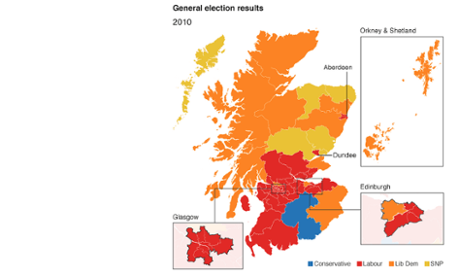
And this is what happened in May this year. Scotland went SNP, with the party taking 56 of the 59 Westminster constituencies. Labour, the Lib Dems and the Tories were left with one apiece.
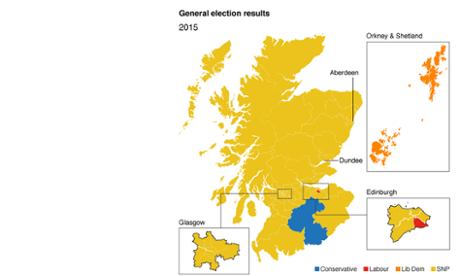
Today the SNP’s three-day conference is opening in Aberdeen. The party continues to enjoy an enormous lead over its rivals in the polls, and the focus of the conference will be on next year’s Scottish parliament elections, although the issue of whether or not the party will push for a second independence referendum continues to preoccupy many. As today’s Guardian preview story says, Nicola Sturgeon, the SNP leader, and her colleagues intend to put the brakes on moves towards a second independence referendum by declaring that the Scottish government will hold fire until “strong and consistent evidence” emerges of a change in public opinion.
Here is the agenda for the day.
10.30am: The SNP MPs Kirsty Blackman and Callum McCaig open the conference.
10.40am: Nicola Sturgeon, Scotland’s first minister, gives a speech on looking forward to the 2016 Scottish elections.
11am: Debates on motions covering the Scotland bill, public services, climate change, nuclear weapons and carers.
2pm: Debates on motions covering TTIP (the transatlantic trade and investment partnership), women in prisons and the third sector.
3pm: Speeches from Angus Roberson, the SNP’s leader at Wesminter, and Stewart Hosie, the SNP’s deputy leader.
4pm: Debates on party accounts and party rule changes.
I will be covering the conference all day.
If you want to follow me or get in touch on Twitter, I’m on @AndrewSparrow.
Updated